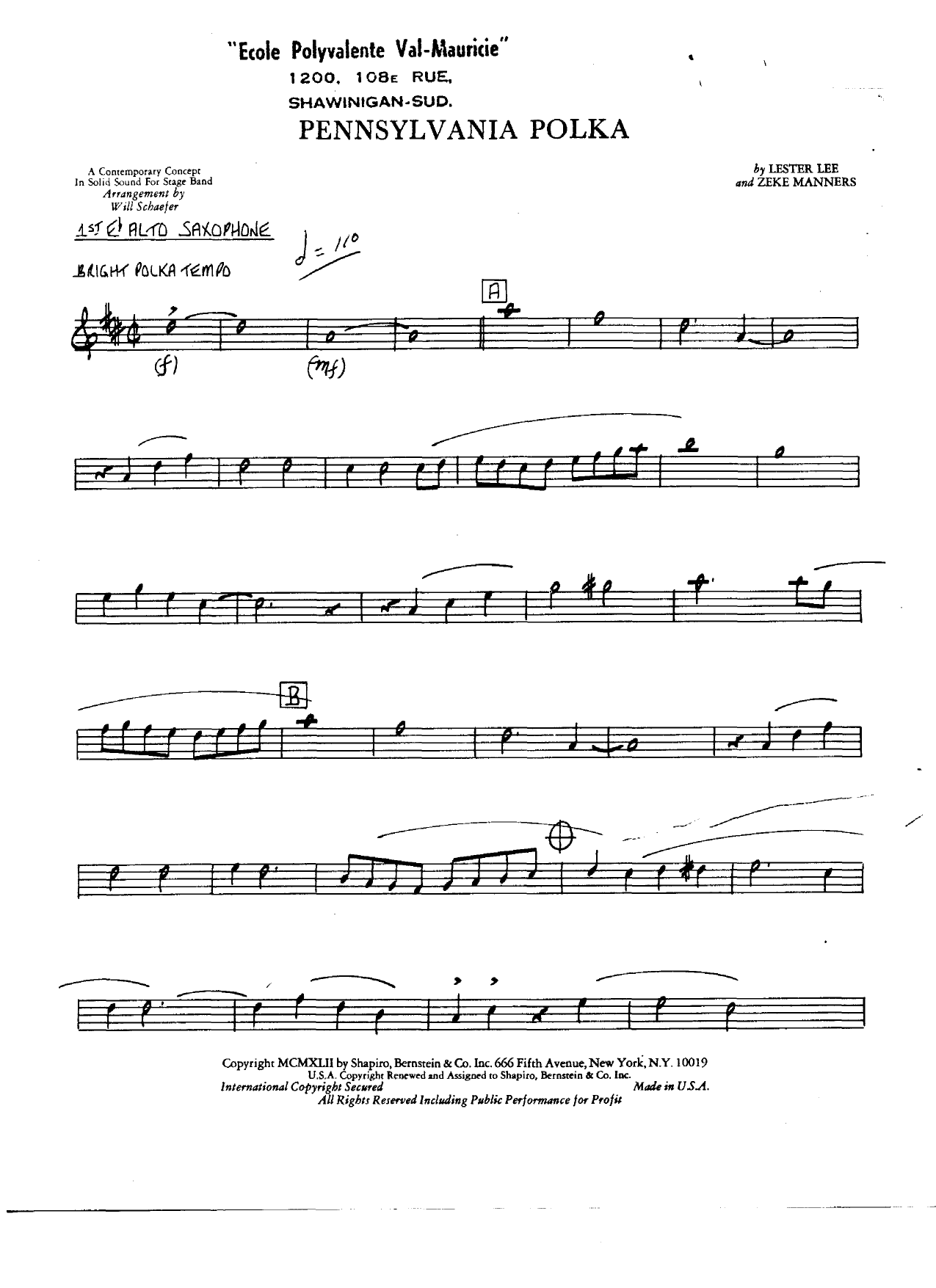
Pennsylvania Polka (W.Schaefer)
Composed by Lester Lee
Arranged by W.Schaefer
- Ensemble: Big Band Dance
- Style: Jazz Standard
- Pages: 36
- Instruments (17): 1st Eb Alto Saxophone, 2nd Eb Alto Saxophone, 1st Bb Tenor Saxophone, 2nd Bb Tenor Saxophone, Eb Baritone Saxophone, 1st Bb Trumpet, 2nd Bb Trumpet, 3rd Bb Trumpet, 4th Bb Trumpet, 1st Trombone, 2nd Trombone, 3rd Trombone, 4th Trombone, Guitar, Piano, Bass, Drums
- Difficulty: advanced
- Content: Individual Parts
- Format: PDF Download (Instant)
- Price: $24.99
Originally composed by Lester Lee in 1942 and immortalized by the Andrews Sisters in the musical film *Give Out, Sisters*, "Pennsylvania Polka" stands as an iconic mid-century novelty classic that successfully crossed over from traditional folk roots into the American jazz and pop vernacular. Its buoyant melodies later earned it iconic status as a cultural touchstone, serving famously as an unofficial anthem for the Pittsburgh Steelers during their 1970s dynasty and featuring prominently in modern cinematic works like *Groundhog Day*. Translating this infectious, accordion-driven European dance form into the language of the big band, W.Schaefer crafts an engaging stylistic fusion that bridges traditional oom-pah charm with mid-century swing orchestration. Built around a brisk, buoyant two-beat polka feel rather than a traditional continuous swing pulse, the chart thrives on bright syncopation, crisp articulation, and high-spirited ensemble interplay. The harmonic language remains faithful to the approachable diatonic framework of the original tune while injecting fresh vitality through clever brass stabs, bouncy counter-melodies, and shifting textural densities. W.Schaefer skillfully avoids heavy-handed treatment, instead utilizing light, punchy section voicings that keep the rhythm section driving forward with infectious momentum. The mood is unabashedly joyful, evoking vintage dance halls, community celebrations, and energetic theatrical stages. Throughout the 113-page orchestration, the melodic weight shifts fluidly across the entire ensemble. The woodwinds frequently carry the primary thematic material, utilizing tight parallel harmonies reminiscent of classic vocal trios, while the brass counter with sharp, playful interjections. Feature moments include clever call-and-response sections between the saxophones and brass, as well as dynamic transitional interludes that showcase crisp rhythm section interaction. Technical demands center primarily on clean double-tonguing in the trumpet section, agile fingerwork across rapid scalar passages in the woodwinds, and absolute rhythmic precision to maintain the characteristic polka bounce without dragging the tempo. Ensembles ranging from ambitious high school stage bands and collegiate jazz laboratories to professional community big bands will find this chart an absolute crowd-pleaser. Because it breaks away from standard medium-swing fare while demanding tight section blend and articulation discipline, it serves as an exceptional educational tool for teaching stylistic versatility. Directors looking to inject high-energy variety, nostalgic charm, and crowd-engaging entertainment into a concert or dance-card program will find W.Schaefer’s comprehensive arrangement an invaluable addition to their library. Conductors should establish a bright, driving two-beat feel right from the downbeat, ensuring the rhythm section maintains an authentic bounce without rushing. The bass player should lean heavily into the alternating root-fifth pattern characteristic of the polka style, locking tightly with the ride cymbal and snare accent. Brass players must focus on short, articulate staccato markings; avoid heavy, lagging jazz accents, keeping the tone bright and focused. Saxophone sections need to practice their passages with a light, classical-leaning vibrato to capture the traditional dance-hall aesthetic before opening up during transitional swing breaks. Pay careful attention to dynamic contrasts between the verse statements and full ensemble shout sections. Rehearsals should isolate the rapid unison lines in the woodwinds to ensure clean articulation across all registers before integrating the brass backing figures. Q: What instruments and parts are included in this 113-page arrangement? A: This comprehensive big band orchestration features 17 distinct instrumental parts, including a full saxophone section (Two Alto Saxophones, Two Tenor Saxophones, and Baritone Saxophone), standard brass allocations, and a complete rhythm section score. Q: What is the difficulty level of this chart? A: This arrangement is well-suited for intermediate to advanced ensembles, such as high school and collegiate big bands, primarily requiring strong articulation control and rhythmic stamina rather than advanced improvisational skills. Q: What is the historical style and background of this piece? A: Based on Lester Lee's 1942 hit popularized by the Andrews Sisters, this chart reimagines the classic polka genre within a vibrant, mid-century big band dance framework. Q: What makes W.Schaefer’s arrangement unique? A: The chart uniquely merges traditional European polka rhythms with clever big band horn voicings, utilizing tight woodwind harmonies and punchy brass call-and-response figures that elevate a novelty tune into a sophisticated stage piece. Q: What is the recommended tempo and performance duration? A: The piece should be performed at a brisk, lively polka tempo (around 120-132 BPM), resulting in a performance duration of approximately 2.5 to 3 minutes depending on repeat choices.
Questions and answers
- What is included in the Pennsylvania Polka (W.Schaefer) PDF?
- The verified current file contains individual parts across 36 pages.
- How many instruments or parts are listed for Pennsylvania Polka (W.Schaefer)?
- The verified instrumentation list contains 17 entries for this Big Band Dance arrangement.
- Who is credited for Pennsylvania Polka (W.Schaefer)?
- Composer: Lester Lee. Arranger: W.Schaefer.
- What difficulty is listed for Pennsylvania Polka (W.Schaefer)?
- The verified difficulty level is advanced.
- What style is listed for Pennsylvania Polka (W.Schaefer)?
- The catalog lists the style as Jazz Standard.
- Can I preview Pennsylvania Polka (W.Schaefer) before buying?
- Yes. The product page provides a preview generated from the current PDF file.
- How is Pennsylvania Polka (W.Schaefer) delivered?
- After successful payment, the digital PDF is made available for download. The displayed price is $24.99.
Musicians Also Search For
Pennsylvania Polka W.Schaefer PDF • Pennsylvania Polka W.Schaefer sheet music • Pennsylvania Polka arranged by W.Schaefer • W.Schaefer big band dance charts • W.Schaefer jazz arrangements PDF • Pennsylvania Polka Lester Lee sheet music • Pennsylvania Polka Lester Lee big band dance arrangements • Lester Lee big band dance charts • Pennsylvania Polka big band dance arrangements • Pennsylvania Polka big band dance PDF download • Pennsylvania Polka jazz sheet music • big band dance sheet music download • Pennsylvania Polka individual parts download • Pennsylvania Polka sheet music PDF • Pennsylvania Polka Jazz Standard charts • Jazz Standard big band dance arrangements • buy Pennsylvania Polka sheet music • download Pennsylvania Polka PDF • Pennsylvania Polka jazz charts • best W.Schaefer big band dance arrangements • Lester Lee arranged by W.Schaefer • Pennsylvania Polka printable sheet music • big band dance repertoire PDF