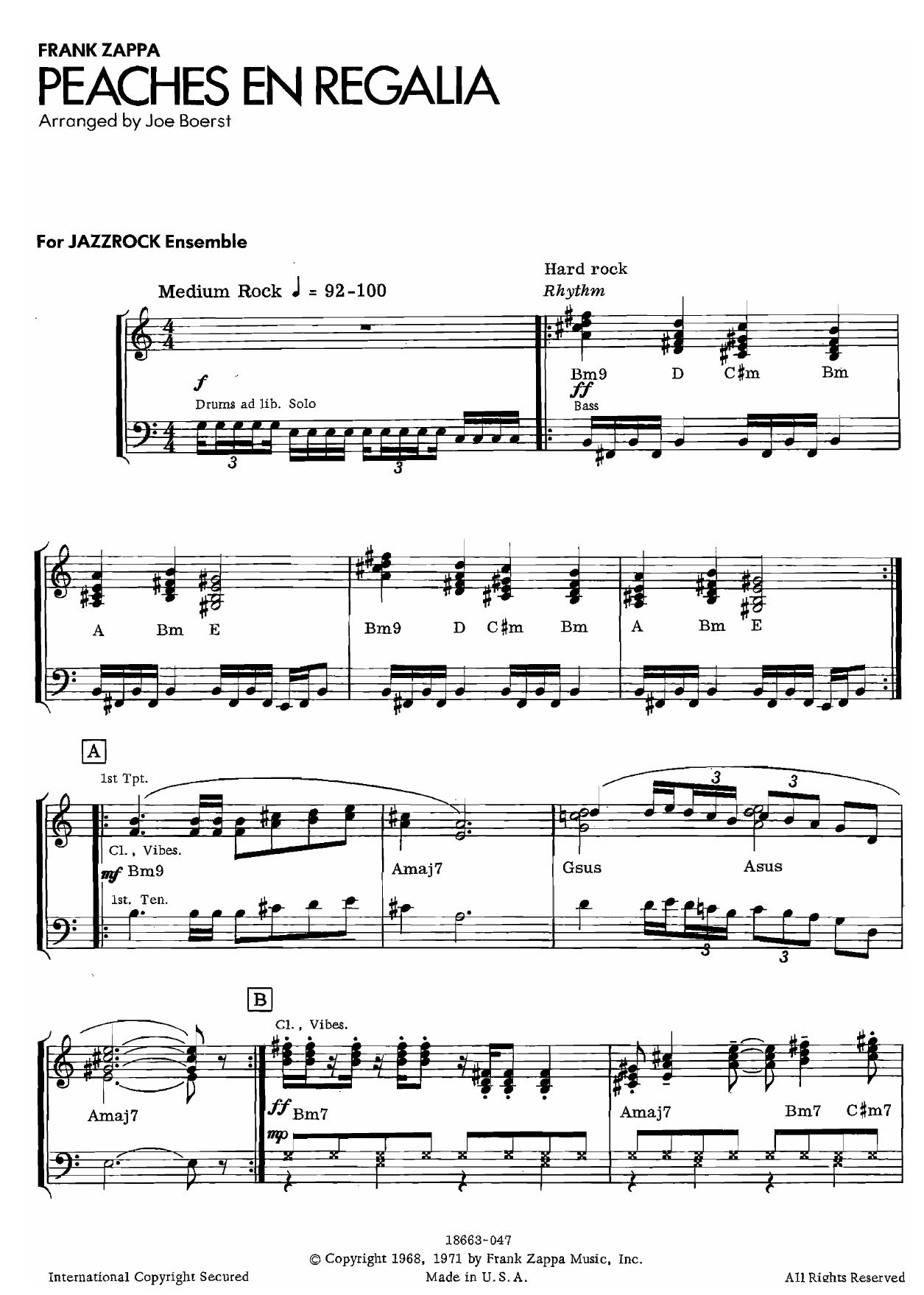
Peaches En Regalia (J.Boerst)
Composed by Frank Zappa
Arranged by J.Boerst
- Ensemble: Big Band
- Style: Jazz Standard
- Pages: 35
- Instruments (22): 1st Flute, 2nd Flute, 1st Eb Alto Saxophone, 2nd Eb Alto Saxophone, 1st Bb Tenor Saxophone, 2nd Bb Tenor Saxophone, Eb Baritone Saxophone, Bb Clarinet, 1st Bb Trumpet, 2nd Bb Trumpet, 3rd Bb Trumpet, 4th Bb Trumpet, 1st Trombone, 2nd Trombone, 3rd Trombone, Bass Trombone, Piano, Bass Guitar, Drums, Vibraphone, Percussion, Amplified Guitar
- Difficulty: medium
- Content: Individual Parts
- Format: PDF Download (Instant)
- Price: $24.99
Frank Zappa’s iconic instrumental masterpiece, originally released on his 1969 landmark solo album *Hot Rats*, stands as a monumental bridge between progressive rock, modern chamber music, and post-bop jazz fusion. "Peaches En Regalia" possesses a dense, joyous, and labyrinthine melodic architecture that has captivated musicians across genres for over half a century. Although conceived in a rock-and-roll studio environment utilizing multi-tracked overdubs, the composition’s intricate counterpoint, sophisticated harmonic shifts, and infectious rhythmic vitality make it a natural, highly rewarding vehicle for contemporary big band orchestration. J.Boerst’s ambitious big band adaptation captures the exuberant, cartoonish complexity of Zappa’s original while translating its multi-layered studio texture into a cohesive, high-energy acoustic jazz ensemble language. Driven by a bright, effervescent tempo and a complex, driving rhythmic groove, the arrangement maintains the buoyant, celebratory mood of the original recording while introducing expansive, brass-heavy textures and intricate woodwind doubling. The chart opens with the instantly recognizable, multi-part thematic motif passed dynamically between the flutes, clarinets, and alto saxophones, immediately establishing a light yet intensely demanding sonic landscape that evokes a sense of whimsical triumph. The arranging approach relies heavily on tight, pointillistic ensemble writing, where rapid-fire unison lines break apart into lush, extended-tertial harmonies. J.Boerst avoids standard block-chord writing in favor of independent linear movement, reflecting Zappa's compositional fascination with twentieth-century classical counterpoint. A standout structural moment arrives in the central development section, which features a soaring tenor saxophone feature underpinned by a shifting metric backdrop. The subsequent shout chorus utilizes full-ensemble Tutti forces to build staggering dynamic tension, driven by punchy syncopated brass stabs and cascading woodwind scales that resolve into a triumphant restatement of the head. Advanced collegiate, top-tier high school, and professional jazz ensembles will find this 35-page chart an exceptional showcase for technical precision and stylistic versatility. Because the scoring incorporates parts for 20 distinct instruments—including dual flutes, clarinets, and a comprehensive sax-brass-rhythm setup—the ensemble must possess strong section playing capabilities and acute intonation awareness. The rhythmic unison demands absolute synchronization across the entire band, rewarding meticulous sectional rehearsing with a performance that is as intellectually stimulating for the performers as it is thrilling for the audience. Executing J.Boerst's arrangement of "Peaches En Regalia" requires pristine articulation discipline and absolute rhythmic precision. The tempo must remain bright and buoyant, treated with an unyielding forward momentum that mimics a classical perpetual motion piece blended with a relentless jazz swing feel. Conductors should pay immediate attention to the frequent meter and accent shifts; subdividing mentally is mandatory for the woodwind and brass sections during the rapid scalar passages. Technically, the primary challenge lies in the intricate unison lines shared between the flutes, clarinets, and saxophones. Players must match articulation styles meticulously—favoring a clean, light staccato over heavy tongue strokes to maintain the sparkling texture. Brass players should keep vibrato controlled and use crisp, bright plunger or straight mutes where indicated to achieve the cutting, satirical timbre characteristic of Zappa's aesthetic. In rehearsal, isolate the complex transitional interludes at slow tempos before building up to performance speed, ensuring that the rhythm section locks firmly into the underlying groove without rushing the syncopated hits. Q: What specific instruments and parts are included in this arrangement? A: The chart is scored for a 20-instrument ensemble, featuring Flute 1, Flute 2, Clarinet, Alto Saxophone 1, Alto Saxophone 2, Tenor Saxophone 1, plus standard big band brass and rhythm section instrumentation, complete with a comprehensive conductor score. Q: What is the difficulty level of this big band chart? A: This arrangement is graded as advanced, making it best suited for collegiate, professional, and top-tier high school jazz orchestras capable of handling dense counterpoint, rapid metric shifts, and demanding woodwind doubling. Q: What is the musical style and historical context of the piece? A: Rooted in Frank Zappa's 1969 jazz-fusion masterpiece from the album *Hot Rats*, this arrangement translates a classic progressive-rock instrumental into a high-energy, contemporary big band jazz standard format. Q: What makes J.Boerst's arrangement unique compared to other versions? A: J.Boerst uniquely preserves Zappa's complex, multi-layered studio counterpoint by utilizing intricate woodwind doublings and independent linear voice-leading rather than traditional, generic big band block-chord voicings. Q: What is the approximate performance duration and tempo feel of the arrangement? A: The piece is set at a bright, driving tempo feel that translates Zappa's original energetic momentum, with a standard performance duration typically lasting between 3 and 4 minutes.
Questions and answers
- What is included in the Peaches En Regalia (J.Boerst) PDF?
- The verified current file contains a conductor score and individual parts across 35 pages.
- How many instruments or parts are listed for Peaches En Regalia (J.Boerst)?
- The verified instrumentation list contains 22 entries for this Big Band arrangement.
- Who is credited for Peaches En Regalia (J.Boerst)?
- Composer: Frank Zappa. Arranger: J.Boerst.
- What difficulty is listed for Peaches En Regalia (J.Boerst)?
- The verified difficulty level is medium.
- What style is listed for Peaches En Regalia (J.Boerst)?
- The catalog lists the style as Jazz Standard.
- Can I preview Peaches En Regalia (J.Boerst) before buying?
- Yes. The product page provides a preview generated from the current PDF file.
- How is Peaches En Regalia (J.Boerst) delivered?
- After successful payment, the digital PDF is made available for download. The displayed price is $24.99.
Musicians Also Search For
Peaches En Regalia J.Boerst PDF • Peaches En Regalia J.Boerst sheet music • Peaches En Regalia arranged by J.Boerst • J.Boerst big band charts • J.Boerst jazz arrangements PDF • Peaches En Regalia Frank Zappa sheet music • Peaches En Regalia Frank Zappa big band arrangements • Frank Zappa big band charts • Peaches En Regalia big band arrangements • Peaches En Regalia big band PDF download • Peaches En Regalia jazz sheet music • big band sheet music download • Peaches En Regalia conductor score PDF • Peaches En Regalia individual parts download • Peaches En Regalia sheet music PDF • Peaches En Regalia Jazz Standard charts • Jazz Standard big band arrangements • buy Peaches En Regalia sheet music • download Peaches En Regalia PDF • Peaches En Regalia jazz charts • best J.Boerst big band arrangements • Frank Zappa arranged by J.Boerst • Peaches En Regalia printable sheet music • big band repertoire PDF