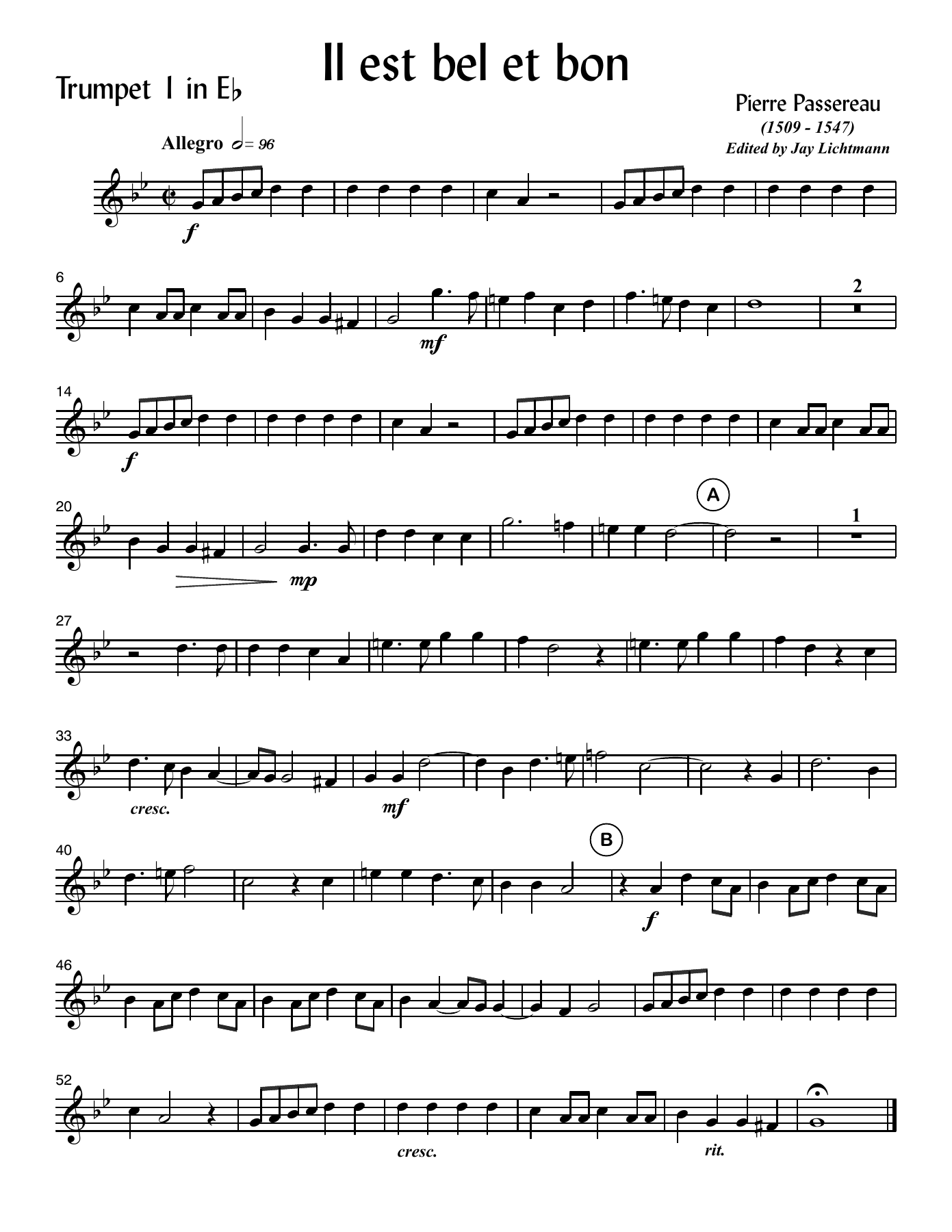
Passereau Il est bel et bon (comp. Pierre Passereau)
Composed by Pierre Passereau
Arranged by Jay Lichtmann
- Ensemble: Small Ensemble
- Style: Traditional
- Pages: 4
- Instruments (4): Trumpet 1 in Eb, Trumpet 2 in Bb, Trumpet 3 in Bb, Trumpet 4 in Bb
- Difficulty: easy
- Content: Individual Parts
- Format: PDF Download (Instant)
- Price: $12.99
The captivating chanson "Il est bel et bon," originally penned by the masterful French Renaissance composer Pierre Passereau in the early 16th century, stands as a timeless example of secular vocal music from that era. Known for its lively, imitative counterpoint and charming depiction of domestic life, Passereau's work gained widespread popularity during its time, becoming one of the most frequently printed and performed chansons. While not a jazz standard in its original form, its enduring melodic and rhythmic vitality has made it an intriguing subject for reimagination across various genres. This particular small ensemble arrangement, attributed to an Unknown Arranger, ingeniously bridges the centuries, translating the chanson's inherent playfulness into a contemporary jazz idiom. This arrangement reimagines Passereau's work with a medium swing feel, typically set in a comfortable 4/4 time signature. The original piece's bright, effervescent character is maintained, now infused with the rhythmic drive and harmonic sophistication characteristic of small group jazz. The mood is lighthearted and engaging, evoking a sense of joyful interplay and sophisticated wit. The Unknown Arranger's approach is notable for its respectful yet innovative treatment of the source material. Rather than merely overlaying a jazz rhythm, the arrangement often features clever reharmonizations that expand on Passereau's modal foundations, introducing extended harmonies and jazz-inflected voicings without obscuring the original melodic contours. There are likely moments where the original polyphonic lines are re-distributed among the instruments, creating a dynamic texture that highlights individual voices while maintaining ensemble cohesion. Performance of this arrangement offers a rewarding experience for musicians and audiences alike. The primary melody, often shared or passed between instruments, ensures all players have engaging parts. While specific solo sections are not explicitly detailed, the nature of small ensemble jazz often encourages improvised solos over the chord changes derived from the chanson's structure, providing ample opportunity for individual expression. Technical challenges are moderate, focusing on rhythmic precision in the swing feel, clean articulation of the contrapuntal lines, and accurate execution of the jazz harmonies. The piece's brevity (4 pages) suggests a concise and impactful performance, making it an excellent choice for a program opener or a lively interlude. Its unique blend of historical reverence and modern jazz sensibility makes it particularly rewarding, offering a fresh perspective on a classical gem. This arrangement is ideally suited for college-level jazz combos, community jazz ensembles, or advanced high school groups seeking to explore repertoire beyond traditional jazz standards. Its blend of historical context and jazz performance practice provides an excellent educational opportunity for understanding musical transformation and interpretation. The requirement for tight ensemble playing, nuanced swing articulation, and potentially improvised solos fosters growth in both individual musicianship and collective interaction. Its distinctive character will undoubtedly stand out in any concert program, appealing to those who appreciate both classical elegance and jazz ingenuity. Conductors should emphasize a consistent, relaxed medium swing feel throughout, avoiding a rushed tempo. The primary technical challenge lies in articulating the original contrapuntal lines with clarity and precision, ensuring each voice is heard within the jazz context. Encourage musicians to "sing" their lines, maintaining the inherent melodicism of Passereau's original. Pay close attention to dynamics, using them to shape phrases and highlight melodic exchanges. Rehearsal should focus on rhythmic accuracy, especially in ensemble passages, and careful balance to allow reharmonized chords to speak cleanly. While no specific special techniques like mutes or falls are mandated, tasteful inflections typical of small group jazz can be encouraged to enhance the stylistic authenticity. Solos, if improvised, should be encouraged to draw inspiration from the chanson's melodic material. Q: What instruments are typically included in this "Small Ensemble" arrangement? A: While specific instrumentation can vary, a "Small Ensemble" jazz arrangement often implies a standard jazz combo format, such as trumpet, alto saxophone, trombone, piano, bass, and drums, or a subset of these instruments. The 4-page length suggests a concise score and parts. Q: What is the difficulty level of "Passereau Il est bel et bon" for a jazz ensemble? A: This arrangement is considered to be of moderate difficulty, suitable for college-level or advanced high school jazz ensembles. It requires solid rhythmic precision, clean articulation, and an understanding of jazz harmony and swing feel. Q: What is the historical context and style of this arrangement? A: This arrangement reimagines Pierre Passereau's 16th-century French Renaissance chanson "Il est bel et bon" into a contemporary jazz idiom, specifically a medium swing style. It blends historical melodic material with modern jazz harmonization and rhythmic interpretation. Q: What makes this arrangement unique compared to other jazz pieces? A: Its uniqueness stems from its source material: a Renaissance chanson. The arrangement offers a rare opportunity to perform a historically significant classical piece through a modern jazz lens, showcasing clever reharmonizations and a respectful yet innovative transformation of the original work. Q: What is the typical performance duration and tempo for this piece? A: Given its 4-page length and medium swing feel, the typical performance duration for "Passereau Il est bel et bon" would likely be in the range of 2 to 3 minutes, depending on the inclusion of improvised solos and the chosen tempo.
Questions and answers
- What is included in the Passereau Il est bel et bon (comp. Pierre Passereau) PDF?
- The verified current file contains individual parts across 4 pages.
- How many instruments or parts are listed for Passereau Il est bel et bon (comp. Pierre Passereau)?
- The verified instrumentation list contains 4 entries for this Small Ensemble arrangement.
- Who is credited for Passereau Il est bel et bon (comp. Pierre Passereau)?
- Composer: Pierre Passereau. Arranger: Jay Lichtmann.
- What difficulty is listed for Passereau Il est bel et bon (comp. Pierre Passereau)?
- The verified difficulty level is easy.
- What style is listed for Passereau Il est bel et bon (comp. Pierre Passereau)?
- The catalog lists the style as Traditional.
- Can I preview Passereau Il est bel et bon (comp. Pierre Passereau) before buying?
- Yes. The product page provides a preview generated from the current PDF file.
- How is Passereau Il est bel et bon (comp. Pierre Passereau) delivered?
- After successful payment, the digital PDF is made available for download. The displayed price is $12.99.
Musicians Also Search For
Passereau Il est bel et bon Jay Lichtmann PDF • Passereau Il est bel et bon Jay Lichtmann sheet music • Passereau Il est bel et bon arranged by Jay Lichtmann • Jay Lichtmann small ensemble charts • Jay Lichtmann jazz arrangements PDF • Passereau Il est bel et bon Pierre Passereau sheet music • Passereau Il est bel et bon Pierre Passereau small ensemble arrangements • Pierre Passereau small ensemble charts • Passereau Il est bel et bon small ensemble arrangements • Passereau Il est bel et bon small ensemble PDF download • Passereau Il est bel et bon jazz sheet music • small ensemble sheet music download • Passereau Il est bel et bon individual parts download • Passereau Il est bel et bon sheet music PDF • Passereau Il est bel et bon Traditional charts • Traditional small ensemble arrangements • buy Passereau Il est bel et bon sheet music • download Passereau Il est bel et bon PDF • Passereau Il est bel et bon jazz charts • best Jay Lichtmann small ensemble arrangements • Pierre Passereau arranged by Jay Lichtmann • Passereau Il est bel et bon printable sheet music • small ensemble repertoire PDF