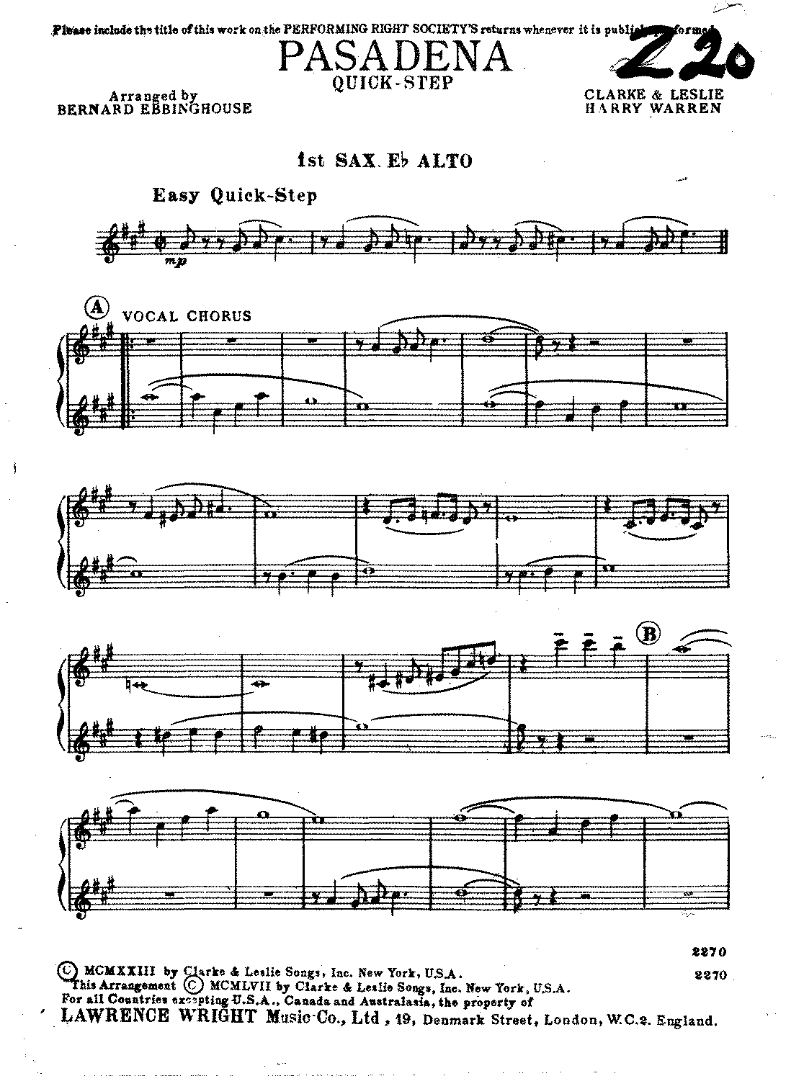
Pasadena (B.Ebbinghouse)
Composed by Harry Warren
Arranged by B. Ebbinghouse
- Ensemble: Big Band Dance
- Style: Quickstep
- Pages: 25
- Instruments (16): 1st Sax. Eb Alto, 3rd Sax. Eb Alto, 2nd Sax. Bb Tenor, 4th Sax. Bb Tenor, 5th Sax. Eb Baritone, Piano Conductor & Accordion Guide, Guitar, Bass, Drums, 1st Trombone, 2nd Trombone, 3rd Trombone, 1st Bb Trumpet, 2nd Bb Trumpet, 3rd Bb Trumpet, 4th Trumpet
- Difficulty: easy
- Content: Individual Parts
- Format: PDF Download (Instant)
- Price: $24.99
Harry Warren's "Pasadena" emerged during the vibrant dance band era of the 1920s and 30s, a period when quicksteps and foxtrots dominated ballrooms and radio waves. While not a jazz standard in the improvisational sense, its enduring melody and energetic rhythm made it a staple for dance orchestras and a tune that evokes the optimism and lively spirit of pre-war American popular music. Warren, a prolific and highly successful composer, penned countless hits for Hollywood musicals, and "Pasadena" exemplifies his knack for crafting catchy, memorable tunes perfectly suited for dancing. This piece captures the essence of that golden age, offering a glimpse into the sophisticated yet accessible soundscapes that defined an era. B. Ebbinghouse's arrangement of "Pasadena" is a masterful reimagining, tailored for a big band dance ensemble, specifically a reduced sax section. The musical character is an exhilarating, up-tempo quickstep, firmly rooted in a bright 4/4 meter. The arrangement is set in a vibrant, accessible key, designed to convey an immediate sense of joy and kinetic energy. It evokes the feeling of a bustling dance floor or a lively social gathering, with a mood that is consistently uplifting and effervescent. Ebbinghouse's approach emphasizes clarity and drive, ensuring that the infectious rhythm propels the piece forward from start to finish, maintaining a high level of excitement without ever feeling rushed or chaotic. Ebbinghouse's distinctive treatment of "Pasadena" showcases his expertise in crafting arrangements for smaller big band configurations, particularly with a focus on the saxophone section. The arrangement features intricate, yet highly playable, soli sections primarily within the saxophones, demonstrating elegant voice leading and rich harmonic textures despite the reduced instrumentation. While there isn't a dedicated improvised solo section, the melody is expertly distributed, primarily carried by the saxophones, with occasional interjections and counter-melodies from other voices. The technical challenges lie in maintaining the brisk tempo with precision, ensuring tight ensemble playing in the soli passages, and articulating the quick, syncopated rhythms cleanly. The reward of performing this piece comes from its sheer infectiousness and the satisfaction of delivering a polished, high-energy dance number that truly captures the spirit of the quickstep. This arrangement is ideally suited for college, community, or professional big band dance ensembles looking for a vibrant, historically informed piece that is both challenging and highly rewarding. Its reduced instrumentation makes it particularly appealing for groups that may not have a full complement of brass but still desire a rich, full sound. The focus on tight ensemble work and precise articulation makes it an excellent vehicle for developing rhythmic accuracy and blend within the saxophone section, while its undeniable charm makes it a crowd-pleaser for any performance setting. Conductors should aim for a bright, unflagging quickstep tempo, around 200-220 bpm, maintaining a consistent 4/4 feel throughout. The primary technical challenge lies in the precise articulation of the saxophone soli passages; encourage players to use a light, detached tonguing for eighth-note runs to maintain clarity and drive. Emphasize rhythmic accuracy, particularly in the syncopated figures, ensuring all players are locked into the ensemble pulse. There are no special techniques like mutes or falls required, focusing instead on clean execution and dynamic shaping. Rehearsal time should be dedicated to balancing the saxophone voicings and ensuring the melody, often passed between saxes, always projects clearly over the accompaniment. Focus on the overall energetic character to truly bring this dance-era gem to life. Q: What instruments are included in this arrangement? A: This arrangement is scored for a big band dance ensemble with a reduced saxophone section, specifically including Alto Saxophone 3, Tenor Saxophone 2, Tenor Saxophone 4, Baritone Saxophone 5, and a Vocal Chorus. Q: What is the difficulty level of "Pasadena (B.Ebbinghouse)"? A: This arrangement is suitable for college, community, or professional big band dance ensembles. It presents challenges in maintaining a brisk quickstep tempo, precise articulation in saxophone soli sections, and tight ensemble rhythmic accuracy. Q: What is the musical style and historical context of this arrangement? A: This arrangement is a vibrant, up-tempo quickstep, reflecting the popular dance band era of the 1920s and 30s. The original piece was composed by Harry Warren, a prolific composer known for his catchy melodies from that period. Q: What makes B. Ebbinghouse's arrangement of "Pasadena" unique? A: B. Ebbinghouse's treatment is distinctive for its expert scoring for a reduced big band dance ensemble, particularly its intricate yet playable saxophone soli sections. It focuses on clarity, drive, and elegant voice leading, capturing the original's spirit with a fresh, focused approach. Q: What is the typical performance duration or recommended tempo for this piece? A: As an up-tempo quickstep, the recommended tempo for "Pasadena (B.Ebbinghouse)" is approximately 200-220 beats per minute, resulting in a lively and energetic performance duration typical of dance numbers from its era.
Questions and answers
- What is included in the Pasadena (B.Ebbinghouse) PDF?
- The verified current file contains individual parts across 25 pages.
- How many instruments or parts are listed for Pasadena (B.Ebbinghouse)?
- The verified instrumentation list contains 16 entries for this Big Band Dance arrangement.
- Who is credited for Pasadena (B.Ebbinghouse)?
- Composer: Harry Warren. Arranger: B. Ebbinghouse.
- What difficulty is listed for Pasadena (B.Ebbinghouse)?
- The verified difficulty level is easy.
- What style is listed for Pasadena (B.Ebbinghouse)?
- The catalog lists the style as Quickstep.
- Can I preview Pasadena (B.Ebbinghouse) before buying?
- Yes. The product page provides a preview generated from the current PDF file.
- How is Pasadena (B.Ebbinghouse) delivered?
- After successful payment, the digital PDF is made available for download. The displayed price is $24.99.
Musicians Also Search For
Pasadena B. Ebbinghouse PDF • Pasadena B. Ebbinghouse sheet music • Pasadena arranged by B. Ebbinghouse • B. Ebbinghouse big band dance charts • B. Ebbinghouse jazz arrangements PDF • Pasadena Harry Warren sheet music • Pasadena Harry Warren big band dance arrangements • Harry Warren big band dance charts • Pasadena big band dance arrangements • Pasadena big band dance PDF download • Pasadena jazz sheet music • big band dance sheet music download • Pasadena individual parts download • Pasadena sheet music PDF • Pasadena Quickstep charts • Quickstep big band dance arrangements • buy Pasadena sheet music • download Pasadena PDF • Pasadena jazz charts • best B. Ebbinghouse big band dance arrangements • Harry Warren arranged by B. Ebbinghouse • Pasadena printable sheet music • big band dance repertoire PDF