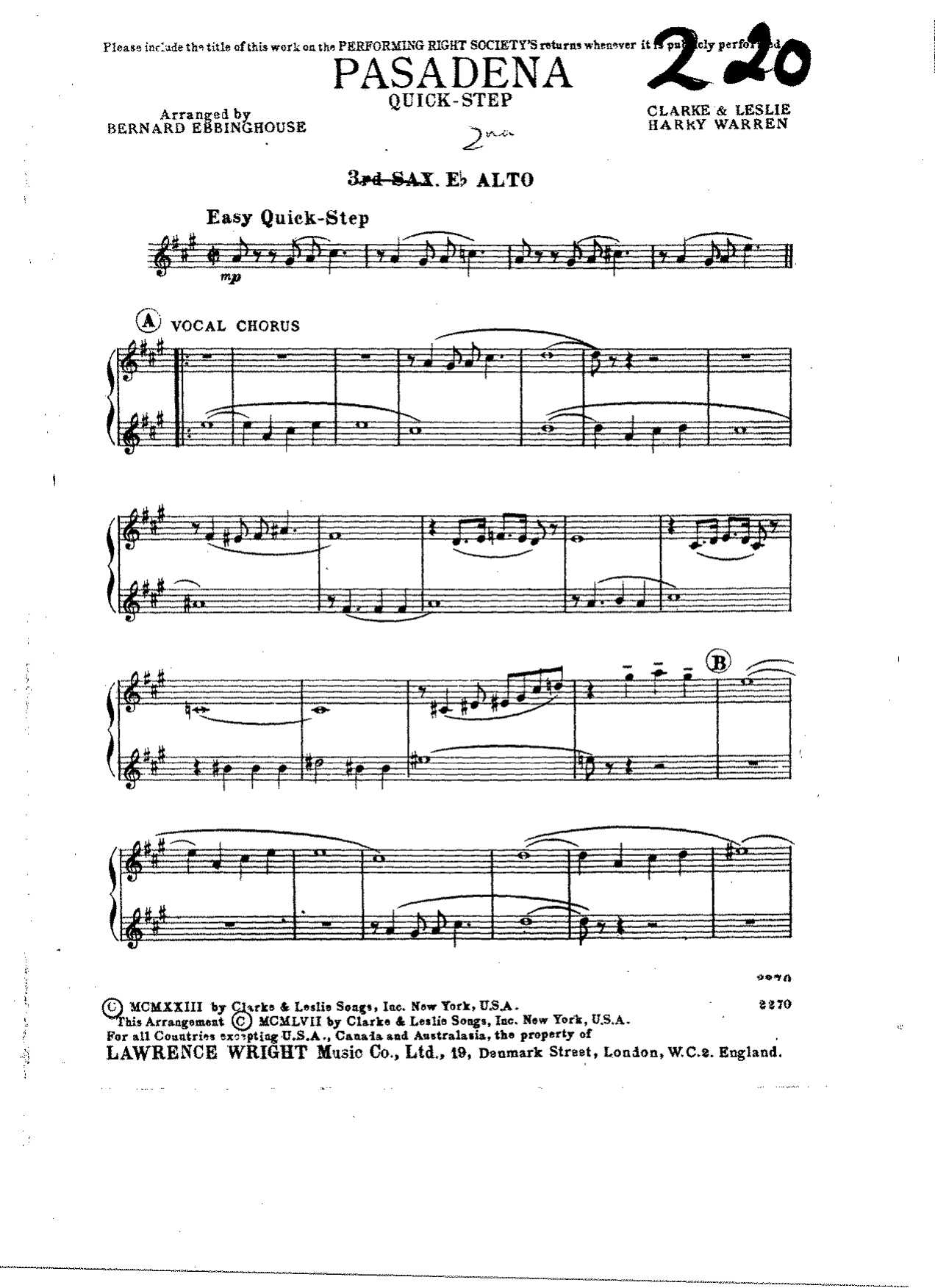
Pasadena (B.Ebbinghouse)
Composed by B. Ebbinghouse
Arranged by B.Ebbinghouse
- Ensemble: Big Band Dance
- Style: Jazz Standard
- Pages: 25
- Instruments (16): 1st Sax. Eb Alto, 3rd Sax. Eb Alto, 2nd Sax. Bb Tenor, 4th Sax. Bb Tenor, 5th Sax. Eb Baritone, 1st Bb Trumpet, 2nd Bb Trumpet, 3rd Bb Trumpet, 4th Trumpet, 1st Trombone, 2nd Trombone, 3rd Trombone, Guitar, Bass, Drums, Piano Conductor & Accordion Guide
- Difficulty: easy
- Content: Individual Parts
- Format: PDF Download (Instant)
- Price: $24.99
B.Ebbinghouse’s sophisticated big band orchestration of "Pasadena" captures the vibrant energy of mid-century swing and sophisticated dance orchestra traditions. Rooted in the golden era of big band jazz, the composition channels the breezy, syncopated elegance of 1930s and 40s dance halls while incorporating modern harmonic coloring characteristic of Ebbinghouse's writing style. The piece reflects a transatlantic jazz sensibility, blending American swing idioms with European precision, making it a captivating showcase for ensembles seeking a blend of nostalgic charm and crisp, contemporary execution. Propelled by an infectious medium-up swing groove in 4/4 time, the arrangement opens with an inviting instrumental setup before introducing a prominent vocal chorus that anchors the narrative. The mood is celebratory, sophisticated, and relentlessly swinging, evoking the glamorous atmosphere of vintage supper clubs and ballroom dance floors. Ebbinghouse utilizes lush, extended chord voicings in the brass and reeds, creating a warm yet transparent harmonic texture that supports the vocal line without ever feeling congested. The melodic movement shifts fluidly between the featured vocalist and tight, highly coordinated wind interjections, establishing a dynamic call-and-response dialogue that keeps both the performers and listeners thoroughly engaged. The unique instrumentation layout—focusing specifically on a four-part horn texture featuring Alto Saxophone 3, Tenor Saxophone 2, Baritone Saxophone 5, alongside a dedicated Vocal Chorus—presents a tightly knit, chamber-jazz big band approach. Rather than relying on a massive wall of sound, Ebbinghouse exploits the unique timbral qualities of these specific reed voices to carve out rich, counter-melodic lines and punchy backgrounds. The arrangement features nuanced dynamic contrasts, subtle harmonic shifts, and sophisticated voice-leading that demands impeccable intonation and rhythmic unity. The climax builds through a brilliantly crafted shout chorus that showcases the interplay between the saxophone section and the vocal lead, offering a masterclass in balance and stylistic articulation. Advanced high school, collegiate, and professional community big bands will find this 25-page arrangement to be a rewarding and distinctive addition to their repertoire. Because the scoring relies heavily on a specialized subset of the traditional big band lineup rather than a full conventional brass section, it provides a stellar opportunity to work intensely on sectional blend, stylistic uniformity, and vocal accompaniment sensitivity. Conductors will appreciate the transparent score layout, which allows precision in phrasing and swing subdivisions, ensuring that ensembles can easily target the sophisticated articulation markings essential to capturing B.Ebbinghouse's authentic style. Achieving an authentic performance of this arrangement requires meticulous attention to the stylistic nuances of medium-tempo swing. The rhythm section must maintain a driving, feather-light ride cymbal pattern while avoiding heavy downbeats; the pulse should feel conversational and relaxed yet intensely rhythmic. Key technical challenges lie in the intricate harmonic voicings assigned to the saxophone sub-section (Alto 3, Tenor 2, Baritone 5). Because the parts are written with tight intervals and chromatic passing tones, sectional blend and intonation require slow, isolated sectional rehearsals before integrating with the vocalist. Pay close attention to dynamic markings: the background figures behind the vocal chorus must never exceed a mezzo-forte, ensuring the lyrics remain crystal clear. Articulation should feature classic swing phrasing—dacosts and tongue-slurs on the upbeat eighth notes, with proper use of light accents on the backbeats (beats 2 and 4). Directors should rehearse the ensemble's dynamic crescendos leading into the transitional modulatory phrases to preserve the characteristic elegance of Ebbinghouse’s writing. Q: What specific instruments and parts are included in this arrangement? A: This arrangement is scored for a specialized 4-instrument configuration consisting of Alto Saxophone 3, Tenor Saxophone 2, Baritone Saxophone 5, and a dedicated Vocal Chorus part, spanning a comprehensive 25-page score and set of parts. Q: What is the difficulty level of this arrangement? A: This piece is geared toward advanced high school, collegiate, and professional ensembles due to its sophisticated harmonic language, tight sectional interplay, and the requirement for precise stylistic blend among the horns. Q: What is the musical style and historical context of "Pasadena" as treated here? A: Written in the style of a classic jazz standard with a distinct mid-century dance orchestra flair, it blends traditional swing-era vitality with the refined, modern arranging sensibilities of B.Ebbinghouse. Q: What makes this specific B.Ebbinghouse arrangement unique? A: Its uniqueness lies in the specialized, transparent four-part horn and vocal scoring, which avoids a dense full-ensemble wall of sound in favor of intricate counter-melodies, rich extended voicings, and an intimate cabaret-style delivery. Q: What is the recommended tempo and performance duration? A: The piece is designed to be performed at a comfortable, swinging medium-up tempo with a durable groove, typically resulting in a performance duration of approximately 3 to 4 minutes depending on the vocal delivery and live pacing.
Questions and answers
- What is included in the Pasadena (B.Ebbinghouse) PDF?
- The verified current file contains a conductor score and individual parts across 25 pages.
- How many instruments or parts are listed for Pasadena (B.Ebbinghouse)?
- The verified instrumentation list contains 16 entries for this Big Band Dance arrangement.
- Who is credited for Pasadena (B.Ebbinghouse)?
- Composer: B. Ebbinghouse. Arranger: B.Ebbinghouse.
- What difficulty is listed for Pasadena (B.Ebbinghouse)?
- The verified difficulty level is easy.
- What style is listed for Pasadena (B.Ebbinghouse)?
- The catalog lists the style as Jazz Standard.
- Can I preview Pasadena (B.Ebbinghouse) before buying?
- Yes. The product page provides a preview generated from the current PDF file.
- How is Pasadena (B.Ebbinghouse) delivered?
- After successful payment, the digital PDF is made available for download. The displayed price is $24.99.
Musicians Also Search For
Pasadena B.Ebbinghouse PDF • Pasadena B.Ebbinghouse sheet music • Pasadena arranged by B.Ebbinghouse • B.Ebbinghouse big band dance charts • B.Ebbinghouse jazz arrangements PDF • Pasadena B. Ebbinghouse sheet music • Pasadena B. Ebbinghouse big band dance arrangements • B. Ebbinghouse big band dance charts • Pasadena big band dance arrangements • Pasadena big band dance PDF download • Pasadena jazz sheet music • big band dance sheet music download • Pasadena conductor score PDF • Pasadena individual parts download • Pasadena sheet music PDF • Pasadena Jazz Standard charts • Jazz Standard big band dance arrangements • buy Pasadena sheet music • download Pasadena PDF • Pasadena jazz charts • best B.Ebbinghouse big band dance arrangements • B. Ebbinghouse arranged by B.Ebbinghouse • Pasadena printable sheet music • big band dance repertoire PDF