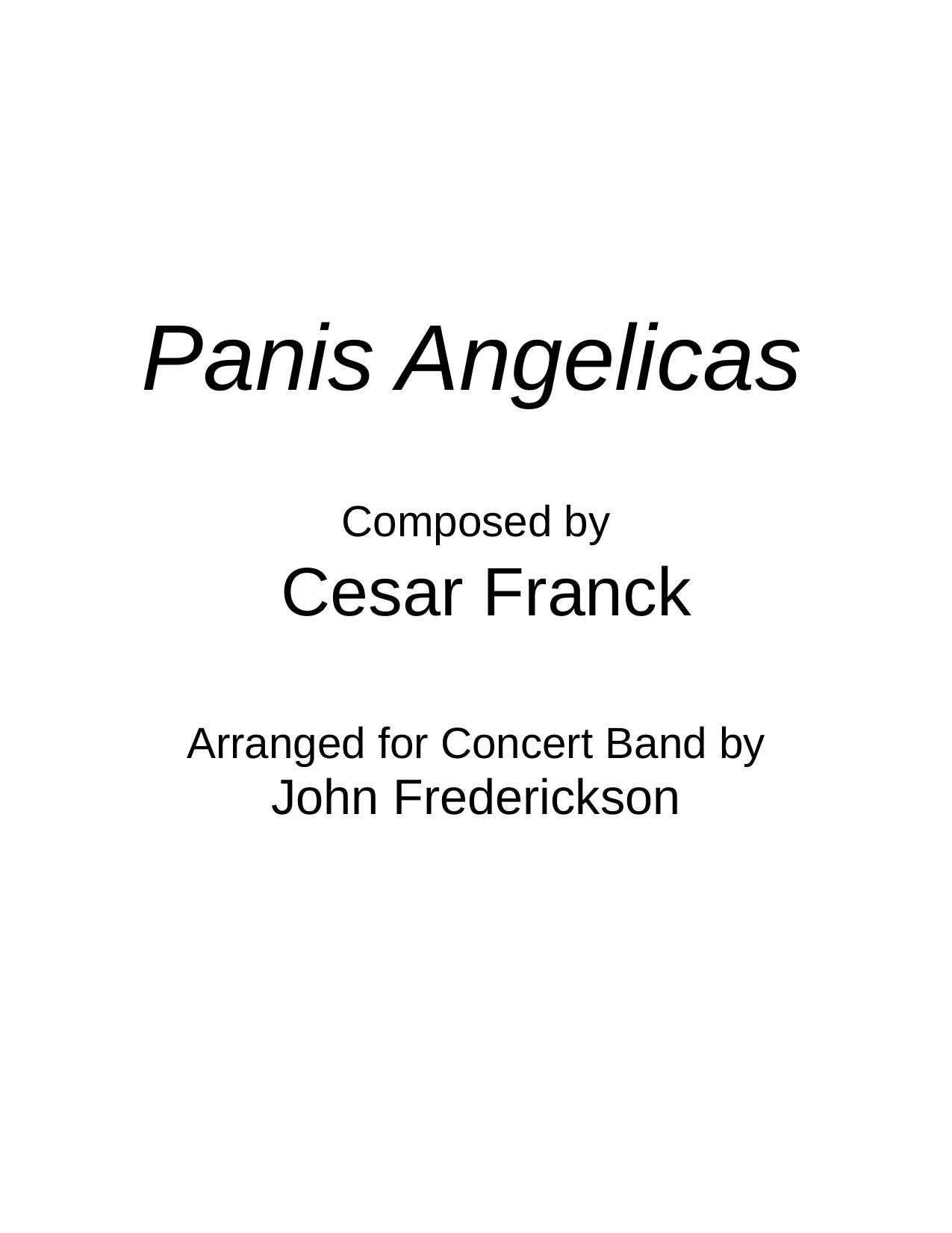
Panis Angeligas (J.Frederickson)
Composed by César Franck
- Ensemble: Concert Band
- Pages: 32
- Instruments (22): Flute -1, Flute -2, Oboe, Clarinet 1, Clarinet 2, Clarinet 3, Bass Clarinet in Bb, Soprano Sax, Alto Sax 1, Alto Sax 2, Tenor Sax, Baritone Sax, Trumpet 1, Trumpet 2, Trumpet 3, Horn 1, Horn 2, Euphonium, Trombone 1, Trombone 2, Bass Trombone, Tuba
- Difficulty: easy
- Content: Individual Parts
- Format: PDF Download (Instant)
- Price: $22.99
César Franck's "Panis Angelicus," originally a sacred motet composed in 1872 as part of his *Messe à trois voix*, holds a revered place in classical and sacred music traditions. Its timeless melody, characterized by its flowing lyricism and profound emotional depth, has transcended its liturgical origins to become a widely recognized and cherished piece. While not a traditional jazz standard, its enduring melodic beauty and harmonic richness make it an intriguing canvas for jazz interpretation, attracting arrangers who seek to infuse its classical grandeur with contemporary improvisational and rhythmic sensibilities. The original composition evokes a sense of solemn reverence and spiritual contemplation, offering a stark yet compelling contrast to the dynamic and expressive world of jazz. This particular jazz arrangement of "Panis Angelicus" transforms Franck's devotional work into a sophisticated medium swing chart, maintaining the original's inherent grace while imbuing it with a vibrant, understated groove. Set in a comfortable 4/4 time signature, the piece unfolds at a moderate tempo, allowing for both rhythmic precision and melodic expressiveness. The overall mood is one of elegant introspection, evolving into moments of warm, expansive harmony. The arranger, J. Frederickson, demonstrates a keen understanding of both classical structure and jazz idiom, crafting a piece that feels both familiar and refreshingly new. Expect rich, often extended harmonies that lean into lush jazz voicings, creating a sonic tapestry that supports the iconic melody without overshadowing it. Frederickson's approach is marked by thoughtful orchestration and a nuanced blend of ensemble textures. The melody is initially presented by the flute and clarinet, offering a delicate and ethereal quality that pays homage to the original's sacred nature. As the arrangement progresses, the melody is passed through various sections, including a beautifully voiced saxophone soli, showcasing the ensemble's blend and balance. While there are no extended improvised solo sections, the arrangement features brief, lyrical obbligatos and counter-melodies from the woodwinds, adding layers of improvisatory flavor. The technical demands are moderate, focusing on precise articulation, blend, and dynamic control, particularly in the intricate inner voices. The piece culminates in a full ensemble statement, building to a warm, resonant climax before receding into a gentle, contemplative close. This arrangement is ideally suited for college, community, and advanced high school concert bands seeking to expand their repertoire with a piece that bridges classical elegance and jazz sophistication. Its rewarding nature lies in its ability to challenge musicians to play with sensitivity, musicality, and a refined sense of ensemble. The careful voicings and dynamic contours provide ample opportunity for developing a cohesive and expressive sound, making it an excellent vehicle for teaching blend, balance, and stylistic interpretation within a jazz context. Musicians will find satisfaction in exploring the interplay between the timeless melody and the rich, contemporary harmonic language. Conductors should emphasize a relaxed, yet precise medium swing feel throughout, ensuring the underlying pulse is steady without becoming rigid. Pay close attention to the dynamic markings, as the piece relies heavily on subtle shifts in volume and articulation to convey its emotional arc. The initial melodic statements in the flute and clarinet require a delicate, sustained tone, while later ensemble passages demand a full, blended sound without sacrificing clarity in the inner voices. Rehearsal time should be dedicated to balancing the rich, often dense harmonies, ensuring that no single voice overpowers another. Focus on achieving a seamless legato in the melodic lines and a unified approach to rhythmic figures. No special techniques like plunger mutes or falls are required; the emphasis is on pure tone production and sensitive musicality. Encourage musicians to listen across sections to fully appreciate the interplay of counter-melodies and harmonic movement. Q: What instruments are included in this arrangement? A: This arrangement is scored for 16 instruments, specifically designed for concert band. The instrumentation includes Piccolo, Flute, Oboe, Bassoon, Clarinet, and other standard concert band sections. Q: What is the difficulty level of "Panis Angelicus (J.Frederickson)"? A: This arrangement is rated as moderate to advanced, making it suitable for college, community, and advanced high school concert bands. It requires musicians to have good control over blend, balance, and dynamic nuance. Q: What is the musical style and historical context of this arrangement? A: This is a jazz arrangement of César Franck's classical sacred motet "Panis Angelicus," originally composed in 1872. It reinterprets the timeless melody within a medium swing jazz idiom, blending classical elegance with contemporary harmonies. Q: What makes this arrangement unique compared to other versions of "Panis Angelicus"? A: J. Frederickson's arrangement stands out for its sophisticated jazz voicings, thoughtful orchestration for concert band, and its ability to maintain the original's lyrical beauty while infusing it with a subtle, elegant swing feel, rather than a traditional jazz combo approach. Q: What is the approximate performance duration and tempo of this piece? A: The piece is set at a medium swing tempo in 4/4 time. The approximate performance duration is typically around 3-4 minutes, depending on the conductor's interpretation of the tempo.
Questions and answers
- What is included in the Panis Angeligas (J.Frederickson) PDF?
- The verified current file contains a conductor score and individual parts across 32 pages.
- How many instruments or parts are listed for Panis Angeligas (J.Frederickson)?
- The verified instrumentation list contains 22 entries for this Concert Band arrangement.
- Who is credited for Panis Angeligas (J.Frederickson)?
- Composer: César Franck.
- What difficulty is listed for Panis Angeligas (J.Frederickson)?
- The verified difficulty level is easy.
- Can I preview Panis Angeligas (J.Frederickson) before buying?
- Yes. The product page provides a preview generated from the current PDF file.
- How is Panis Angeligas (J.Frederickson) delivered?
- After successful payment, the digital PDF is made available for download. The displayed price is $22.99.
Musicians Also Search For
Panis Angeligas César Franck sheet music • Panis Angeligas César Franck concert band arrangements • César Franck concert band charts • Panis Angeligas concert band arrangements • Panis Angeligas concert band PDF download • Panis Angeligas jazz sheet music • concert band sheet music download • Panis Angeligas conductor score PDF • Panis Angeligas individual parts download • Panis Angeligas sheet music PDF • buy Panis Angeligas sheet music • download Panis Angeligas PDF • Panis Angeligas jazz charts • Panis Angeligas printable sheet music • concert band repertoire PDF