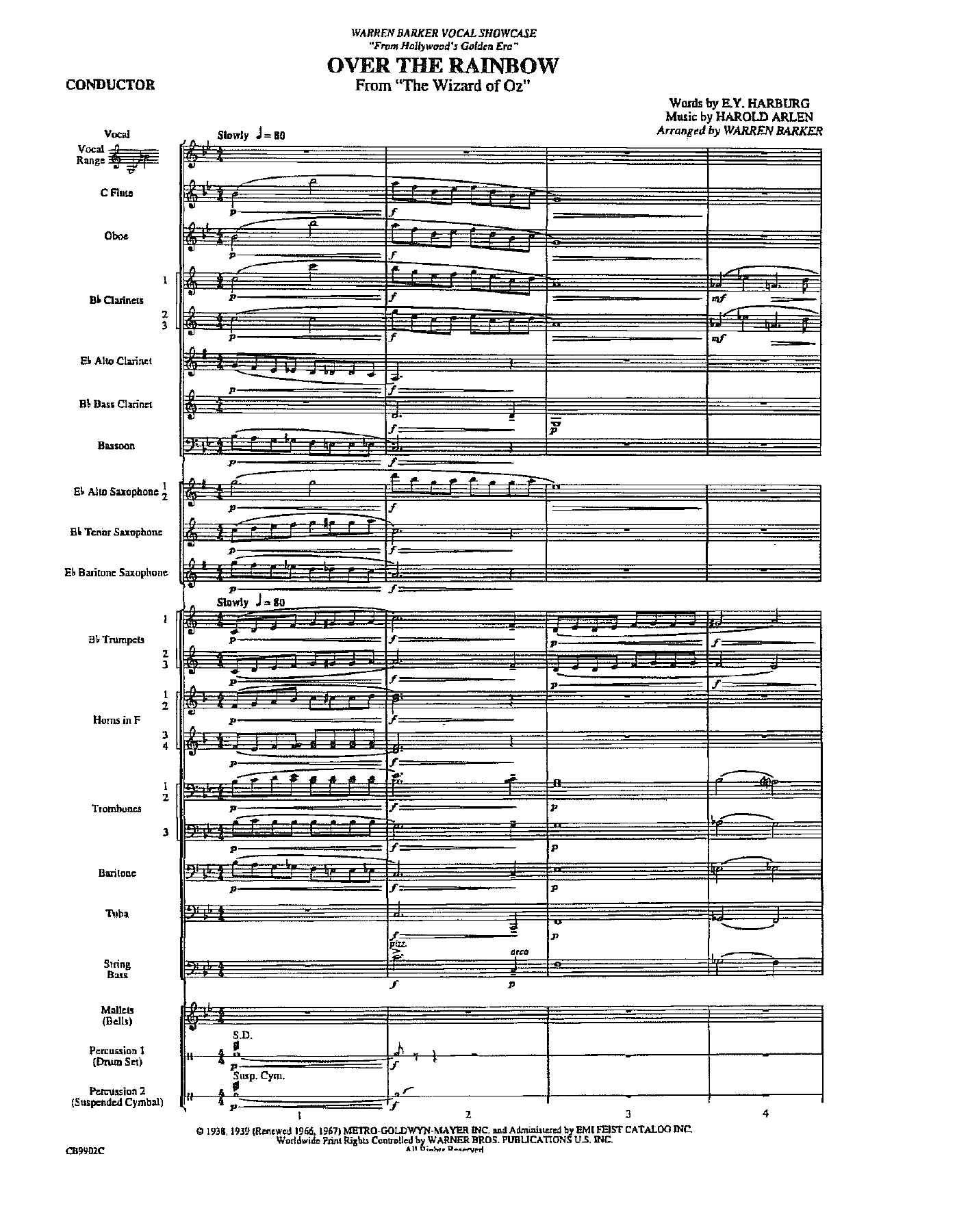
Over The Rainbow (W.Barker)
Composed by Harold Arlen
Arranged by W.Barker
- Ensemble: Concert Band
- Style: Musical Theatre
- Pages: 44
- Instruments (32): Vocal, C Flute, Oboe, 1st Bb Clarinet, 2nd Bb Clarinet, 3rd Bb Clarinet, Eb Alto Clarinet, Bb Bass Clarinet, Bassoon, 1st Eb Alto Saxophone, 2nd Eb Alto Saxophone, Bb Tenor Saxophone, Eb Baritone Saxophone, 1st Bb Trumpet, 2nd Bb Trumpet, 3rd Bb Trumpet, 1st Horn in F, 2nd Horn in F, 3rd Horn in F, 4th Horn in F, 1st Trombone, 2nd Trombone, 3rd Trombone, Baritone, Baritone T.C., Tuba, String Bass, Mallet Percussion (Bells), Percussion 1 (Drum Set), Percussion 2 (Suspended Cymbal), Optional Solo Bb Tenor Saxophone, Optional Solo Eb Alto Saxophone
- Difficulty: medium
- Content: Individual Parts
- Format: PDF Download (Instant)
- Price: $22.99
Harold Arlen's timeless ballad, "Over The Rainbow," emerged from the golden age of Hollywood musicals in 1939, forever etched into popular culture by Judy Garland's iconic performance in *The Wizard of Oz*. More than just a film song, its poignant melody and hopeful lyrics quickly transcended its origins, becoming a quintessential American standard embraced by jazz musicians and vocalists alike. It represents a pinnacle of Tin Pan Alley songwriting, characterized by its soaring melodic lines, sophisticated harmonic progression, and an emotional depth that resonates across generations. Its enduring appeal lies in its universal message of longing and optimism, making it a staple in the Great American Songbook and a frequent subject for reinterpretation across diverse musical genres. W.Barker's concert band arrangement of "Over The Rainbow" reimagines this classic as a slow, expressive ballad, set in a reflective 4/4 meter. The arrangement opens with a delicate, almost ethereal quality, immediately establishing a mood of introspective beauty. Barker, known for his sensitive handling of orchestral textures and rich harmonic palettes, approaches this piece with a focus on lush, sustained voicings that allow the melody to unfold gradually. The key of Eb Major provides a warm, resonant foundation, enhancing the inherent tenderness of the original composition. This isn't a swing chart; rather, it’s a meticulously crafted concert band piece designed to showcase the ensemble's lyrical capabilities and dynamic control, evoking a sense of profound longing and eventual triumph. The arrangement features the iconic melody passed gracefully between various sections of the concert band, beginning with a tender woodwind choir, then transitioning to the brass, often with soaring counter-melodies in the flutes or clarinets. Barker's signature is evident in his use of extended harmonies and subtle reharmonizations that add a contemporary sheen without betraying the original's emotional core. There are no improvised solos in this arrangement; instead, the focus is on the collective ensemble sound and the expressive interpretation of the melodic lines. Technical challenges primarily revolve around achieving a unified, sustained tone, precise intonation within complex voicings, and executing nuanced dynamic shifts from *pianissimo* to *forte* with seamless control. A particularly rewarding moment occurs during the bridge, where the full band swells into a rich, expansive texture before returning to the main theme with renewed emotional weight. This arrangement is ideally suited for advanced high school, collegiate, community, and professional concert bands seeking a profoundly moving and technically rewarding piece that highlights their expressive capabilities and collective musicianship. Conductors should emphasize a unified, sustained tone throughout, particularly in the longer melodic phrases. Intonation will be paramount, especially in the woodwind and brass choir sections where Barker employs rich, often close voicings. Encourage musicians to listen across sections to blend seamlessly. The tempo should be a consistent slow ballad feel, allowing the music to breathe without dragging. Dynamic control is crucial; practice the subtle crescendos and decrescendos to build and release tension effectively. There are no special techniques like plungers or falls required, but precise articulation, particularly in the initial entrances and releases of phrases, will enhance the lyrical quality. Rehearsal should focus on the ensemble's collective breath and phrasing, treating the entire band as a single, expressive instrument. Q: What instruments and parts are included in this arrangement? A: This concert band arrangement typically includes standard instrumentation: flutes, oboes, clarinets (Bb, Bass), saxophones (Alto, Tenor, Bari), trumpets, horns, trombones, euphonium, tuba, and percussion. Specific percussion parts will vary but generally include mallets and timpani. Q: What is the difficulty level of "Over The Rainbow (W.Barker)"? A: This arrangement is rated as advanced high school to collegiate/community level. It requires strong lyrical playing, excellent intonation, precise dynamic control, and mature musicianship from all sections. Q: What musical style and historical context does this arrangement represent? A: While the original "Over The Rainbow" is a classic musical theatre ballad from 1939, W.Barker's arrangement reinterprets it for concert band, focusing on a slow, expressive ballad style with rich, contemporary harmonic voicings, rather than a traditional jazz swing feel. Q: What makes W.Barker's arrangement of "Over The Rainbow" unique? A: Barker's distinctive approach lies in his lush, sustained voicings, subtle reharmonizations, and the thoughtful distribution of the melody across various sections of the concert band, creating a deeply emotive and sonically rich experience without relying on improvisation. Q: What is the typical performance duration and tempo for this piece? A: As a slow ballad, the performance duration is typically around 4-5 minutes, depending on the conductor's interpretation. The tempo should be a consistent slow 4/4, allowing for maximum expressive phrasing.
Questions and answers
- What is included in the Over The Rainbow (W.Barker) PDF?
- The verified current file contains a conductor score and individual parts across 44 pages.
- How many instruments or parts are listed for Over The Rainbow (W.Barker)?
- The verified instrumentation list contains 32 entries for this Concert Band arrangement.
- Who is credited for Over The Rainbow (W.Barker)?
- Composer: Harold Arlen. Arranger: W.Barker.
- What difficulty is listed for Over The Rainbow (W.Barker)?
- The verified difficulty level is medium.
- What style is listed for Over The Rainbow (W.Barker)?
- The catalog lists the style as Musical Theatre.
- Can I preview Over The Rainbow (W.Barker) before buying?
- Yes. The product page provides a preview generated from the current PDF file.
- How is Over The Rainbow (W.Barker) delivered?
- After successful payment, the digital PDF is made available for download. The displayed price is $22.99.
Musicians Also Search For
Over The Rainbow W.Barker PDF • Over The Rainbow W.Barker sheet music • Over The Rainbow arranged by W.Barker • W.Barker concert band charts • W.Barker jazz arrangements PDF • Over The Rainbow Harold Arlen sheet music • Over The Rainbow Harold Arlen concert band arrangements • Harold Arlen concert band charts • Over The Rainbow concert band arrangements • Over The Rainbow concert band PDF download • Over The Rainbow jazz sheet music • concert band sheet music download • Over The Rainbow conductor score PDF • Over The Rainbow individual parts download • Over The Rainbow sheet music PDF • Over The Rainbow Musical Theatre charts • Musical Theatre concert band arrangements • buy Over The Rainbow sheet music • download Over The Rainbow PDF • Over The Rainbow jazz charts • best W.Barker concert band arrangements • Harold Arlen arranged by W.Barker • Over The Rainbow printable sheet music • concert band repertoire PDF