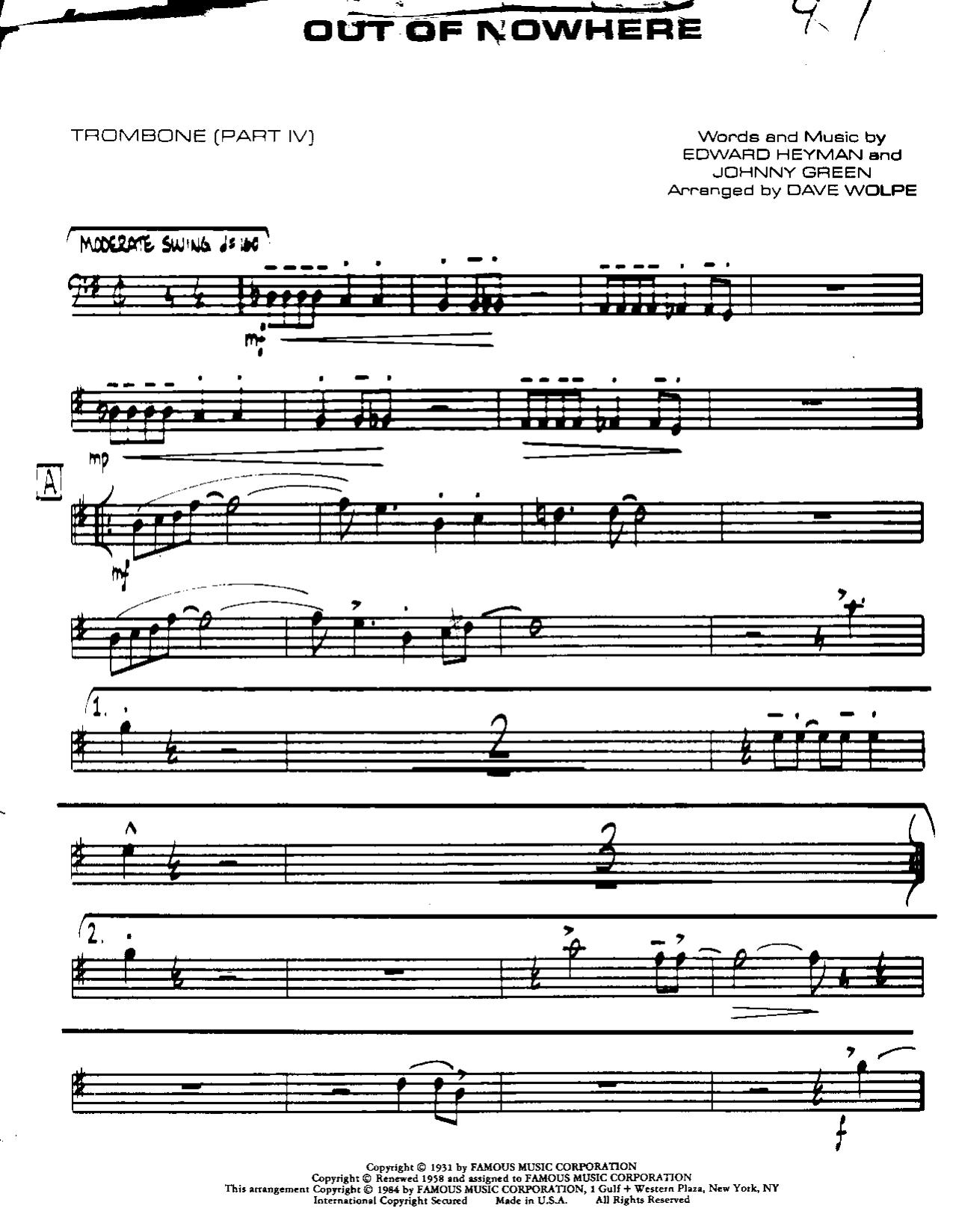
Out of Nowhere (D.Wolpe)
Composed by Edward Heyman and Johnny Green
Arranged by Dave Wolpe
- Ensemble: Small Ensemble
- Style: SWING
- Pages: 3
- Difficulty: easy
- Content: Sheet Music
- Format: PDF Download (Instant)
- Price: $12.99
"Out of Nowhere," originally composed by Edward Heyman and Johnny Green, emerged in 1931, a quintessential product of the burgeoning American Songbook era. This period, nestled between the Roaring Twenties and the Big Band Swing era, saw the creation of countless melodies that would become the bedrock of jazz improvisation. Its enduring appeal lies in its sophisticated harmonic progression and memorable, lyrical melody, quickly establishing it as a standard embraced by countless jazz luminaries. Artists like Coleman Hawkins, Charlie Parker, and Miles Davis each put their indelible stamp on the tune, solidifying its place in the jazz canon as a vehicle for both melodic interpretation and intricate improvisation. The song's structure and chord changes offer a rich landscape for exploration, making it a perennial favorite for musicians seeking a blend of accessibility and harmonic depth. Dave Wolpe's arrangement of "Out of Nowhere" for small ensemble masterfully captures the essence of a medium swing feel, presenting the piece in a bright and engaging manner. The musical character is one of sophisticated energy, maintaining the original's melodic integrity while infusing it with Wolpe's signature clarity and drive. The arrangement likely resides in a comfortable key, such as F or Bb, allowing for natural brass and woodwind voicings that contribute to a full, yet transparent, sound. Wolpe is renowned for his ability to craft arrangements that sound much larger than their instrumentation suggests, often employing tight, harmonically rich voicings that give a professional sheen without overwhelming the ensemble. Expect a mood that is both buoyant and classic, suitable for a variety of performance settings. Wolpe's approach to "Out of Nowhere" is characterized by his meticulous attention to voicing and rhythmic precision, hallmarks of his arrangements in the swing style. While specific details would require examining the score, it's typical for Wolpe to feature the melody initially in a lead voice, often the trumpet or alto saxophone, before developing it through various soli sections. These soli passages, where a section plays a harmonized melodic line, are a signature of his writing, showcasing the ensemble's blend and articulation. Expect well-crafted background figures that support the soloists without cluttering the texture. The arrangement likely includes designated solo sections, providing ample space for improvisation over the standard changes. Technical challenges would focus on clean articulation, precise rhythmic execution in the swing feel, and achieving a balanced blend within the small ensemble. The reward lies in performing a classic standard with a professional, authentic swing sound, making it a satisfying experience for both musicians and audience. This arrangement is ideally suited for college-level jazz combos, advanced high school ensembles, or community jazz groups seeking a polished and accessible chart. Its small ensemble format fosters individual responsibility and encourages strong musicianship from each player. The clear writing and thoughtful voicings make it an excellent teaching tool for developing ensemble cohesion, swing articulation, and improvisational skills within a structured yet flexible framework. The arrangement's ability to sound full with fewer players makes it particularly attractive for groups with limited instrumentation but a desire for a professional swing sound. Conductors should emphasize a relaxed, medium swing feel from the outset, ensuring a consistent pulse and light articulation, particularly in the brass. The primary technical challenge lies in achieving tight ensemble blend and precise rhythmic unison during the soli sections; encourage musicians to listen across the ensemble rather than just within their section. Pay close attention to dynamics, using subtle swells and releases to shape phrases and prevent the arrangement from sounding flat. There are no special techniques like plungers or falls explicitly required, but a natural jazz inflection, including slight scoops and falls where appropriate, will enhance the authentic swing feel. Rehearsal time should focus on balancing the voicings, ensuring that inner voices are heard without overpowering the lead, and working on the rhythmic accuracy of the background figures during solos. Q: What instruments are included in the "Out of Nowhere (D.Wolpe)" small ensemble arrangement? A: This arrangement typically includes parts for a standard small jazz ensemble, such as trumpet, alto saxophone, tenor saxophone, trombone, piano, bass, and drums, though specific instrumentation may vary slightly. Q: What is the difficulty level of this arrangement? A: This arrangement is considered to be of an intermediate to advanced intermediate difficulty, suitable for college-level jazz combos, advanced high school ensembles, or proficient community jazz groups. Q: What is the musical style and historical context of "Out of Nowhere"? A: "Out of Nowhere" is a classic jazz standard from 1931, characterized by its medium swing feel and sophisticated harmonic progression, representing the Golden Age of the American Songbook. Q: What makes Dave Wolpe's arrangement of "Out of Nowhere" unique? A: Dave Wolpe's arrangement is known for its clear, professional voicings, effective soli sections, and ability to make a small ensemble sound full and authentic, while maintaining the integrity of the original standard. Q: What is the typical performance duration or tempo for this piece? A: As a medium swing piece, "Out of Nowhere" is typically performed at a comfortable tempo, allowing for clear articulation and improvisation, usually resulting in a performance duration of approximately 3 to 4 minutes depending on the number and length of solos.
Musicians Also Search For
Out of Nowhere Dave Wolpe PDF • Out of Nowhere Dave Wolpe sheet music • Out of Nowhere arranged by Dave Wolpe • Dave Wolpe small ensemble charts • Dave Wolpe jazz arrangements PDF • Out of Nowhere Edward Heyman and Johnny Green sheet music • Out of Nowhere Edward Heyman and Johnny Green small ensemble arrangement • Edward Heyman and Johnny Green small ensemble charts • Out of Nowhere small ensemble arrangement • Out of Nowhere small ensemble PDF download • Out of Nowhere jazz ensemble sheet music • small ensemble sheet music instant download • Out of Nowhere sheet music with parts • Out of Nowhere SWING chart • SWING small ensemble arrangements • buy Out of Nowhere sheet music online • download Out of Nowhere PDF • Out of Nowhere jazz chart • best Dave Wolpe small ensemble arrangements • Edward Heyman and Johnny Green songs arranged by Dave Wolpe • Out of Nowhere printable sheet music • small ensemble repertoire PDF