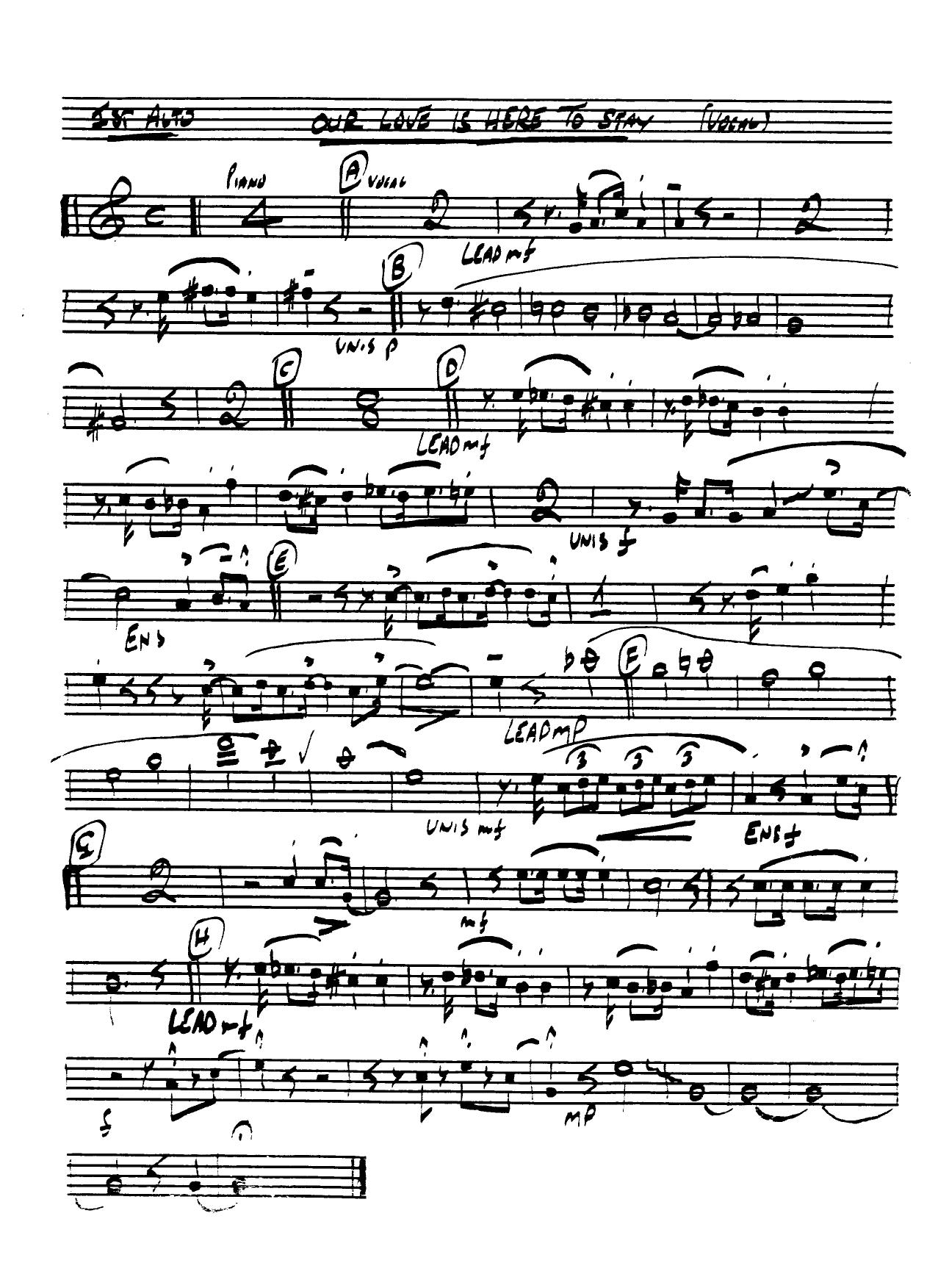
Our Love Is Here To Stay (J.Farley)
Composed by George Gershwin
Arranged by John Farley
- Ensemble: Big Band
- Pages: 18
- Instruments (18): 1st Alto Saxophone, 2nd Alto Saxophone, 1st Tenor Saxophone, 2nd Tenor Saxophone, Baritone Saxophone, 1st Trumpet, 2nd Trumpet, 3rd Trumpet, 4th Trumpet, 1st Trombone, 2nd Trombone, 3rd Trombone, 4th Trombone, Piano, Guitar, Bass, Drums, Vocal
- Difficulty: easy
- Content: Individual Parts
- Format: PDF Download (Instant)
- Price: $24.99
George Gershwin’s timeless masterpiece, "Our Love Is Here To Stay," holds a sacred place in the Great American Songbook as the final composition Gershwin completed before his untimely death in 1937, with lyrics subsequently added by Ira Gershwin for the film *The Goldwyn Follies*. Immortalized by legendary interpreters such as Billie Holiday, Frank Sinatra, and Gene Kelly, this quintessential standard embodies the sophisticated romanticism of the late swing era. Its enduring appeal lies in its seamless blend of accessible melodic contour and sophisticated harmonic progression, making it an essential vehicle for jazz exploration across generations. Masterfully reimagined for contemporary big band by arranger John Farley, this chart treats the classic theme with a rich, expressive palette that balances nostalgic warmth with modern harmonic color. Written in a relaxed, flowing medium swing feel, the arrangement opens with a lush, rubato-infused introduction in the piano before settling into a steady, infectious groove. Farley’s chart evokes a mood of sophisticated introspection, transitioning gracefully from intimate, whispered ensemble passages to surging, dynamically expansive peaks that capture the bittersweet optimism of Ira Gershwin's lyric. Farley’s distinctive arranging style shines through in the clever use of re-harmonization and textural contrast. The melody is initially introduced by a muted trumpet section underscored by delicate, voicings in the lower reeds and piano, creating an intimate dialogue before opening up to full ensemble orchestration. A standout feature of this chart is the sweeping sax soli, which weaves intricate, bebop-inflected lines through altered dominant chords, followed by a dynamically charged shout chorus that builds tension through cunning chromatic voice-leading. Solo opportunities are provided for lead alto saxophone and piano, allowing featured soloists to stretch out over standard chord changes refreshed by Farley's subtle substitutions. Designed with advanced high school, collegiate, and professional community big bands in mind, this arrangement demands a high level of stylistic maturity and section cohesion. While the brass ranges remain sensible—with lead trumpet peaking comfortably at written high A—the primary challenges lie in maintaining a pristine, unhurried swing feel at a moderate tempo, balancing intricate dynamic nuances, and executing clean articulation across the ensemble. Conductors will find that this 18-page chart rewards careful attention to balance and blend, offering a sophisticated, crowd-pleasing focal point for any standard jazz concert program. Executing John Farley’s arrangement of "Our Love Is Here To Stay" successfully hinges on the ensemble's ability to maintain a relaxed, forward-moving medium swing feel without rushing. The quarter note should serve as the absolute anchor, particularly during the rubato intro where the piano must establish a delicate, conversational rubato before handing the pulse firmly over to the rhythm section. Pay close attention to dynamic contrast: the quieter passages require immense breath support and controlled intonation, especially when using cup or straight mutes in the trumpet and trombone sections. In the saxophone soli, ensure that eighth-note lines are articulated with traditional jazz phrasing—swinging the eighth notes and accentuating the upbeats of beats two and four. The rhythm section should approach the accompaniment with a light, interactive touch; the pianist should avoid heavy comping during exposed melodic statements, utilizing sparse, upper-structure voicings instead. During the shout chorus, resist the urge to over-blow; let the natural brass and sax voicings project the crescendo, ensuring that the accented syncopations lock tightly with the drummer's ride cymbal and hi-hat on two and four. Q: What instruments and parts are included in this big band arrangement? A: This chart is scored for a standard 11-instrument big band instrumentation, featuring a complete four-trumpet section (1st through 4th Trumpet), piano, and auxiliary rhythm section parts, totaling an 18-page publication that includes a comprehensive conductor score. Q: What is the overall difficulty level of this arrangement? A: This arrangement is tailored for advanced high school, collegiate, and professional community big bands, requiring strong ensemble blend, stylistic maturity in medium swing, and precise control over dynamic nuances rather than extreme technical endurance. Q: What is the historical background and musical style of this piece? A: Originally composed by George Gershwin with lyrics by Ira Gershwin in 1937, this piece is a cornerstone of the Great American Songbook, presented here in a sophisticated, expressive medium swing jazz big band style. Q: What makes John Farley’s arrangement unique compared to other versions? A: Farley’s treatment stands out through its artful re-harmonizations, an intricately crafted saxophone soli, a dynamically shifting shout chorus, and thoughtful feature spots for both lead alto saxophone and piano. Q: What is the suggested performance tempo and duration for this chart? A: The arrangement is set at a relaxed, flowing medium swing tempo (approximately quarter note = 112-120 BPM), resulting in a performance duration of roughly 4 to 5 minutes depending on solo choruses.
Questions and answers
- What is included in the Our Love Is Here To Stay (J.Farley) PDF?
- The verified current file contains individual parts across 18 pages.
- How many instruments or parts are listed for Our Love Is Here To Stay (J.Farley)?
- The verified instrumentation list contains 18 entries for this Big Band arrangement.
- Who is credited for Our Love Is Here To Stay (J.Farley)?
- Composer: George Gershwin. Arranger: John Farley.
- What difficulty is listed for Our Love Is Here To Stay (J.Farley)?
- The verified difficulty level is easy.
- Can I preview Our Love Is Here To Stay (J.Farley) before buying?
- Yes. The product page provides a preview generated from the current PDF file.
- How is Our Love Is Here To Stay (J.Farley) delivered?
- After successful payment, the digital PDF is made available for download. The displayed price is $24.99.
Musicians Also Search For
Our Love Is Here To Stay John Farley PDF • Our Love Is Here To Stay John Farley sheet music • Our Love Is Here To Stay arranged by John Farley • John Farley big band charts • John Farley jazz arrangements PDF • Our Love Is Here To Stay George Gershwin sheet music • Our Love Is Here To Stay George Gershwin big band arrangements • George Gershwin big band charts • Our Love Is Here To Stay big band arrangements • Our Love Is Here To Stay big band PDF download • Our Love Is Here To Stay jazz sheet music • big band sheet music download • Our Love Is Here To Stay individual parts download • Our Love Is Here To Stay sheet music PDF • buy Our Love Is Here To Stay sheet music • download Our Love Is Here To Stay PDF • Our Love Is Here To Stay jazz charts • best John Farley big band arrangements • George Gershwin arranged by John Farley • Our Love Is Here To Stay printable sheet music • big band repertoire PDF