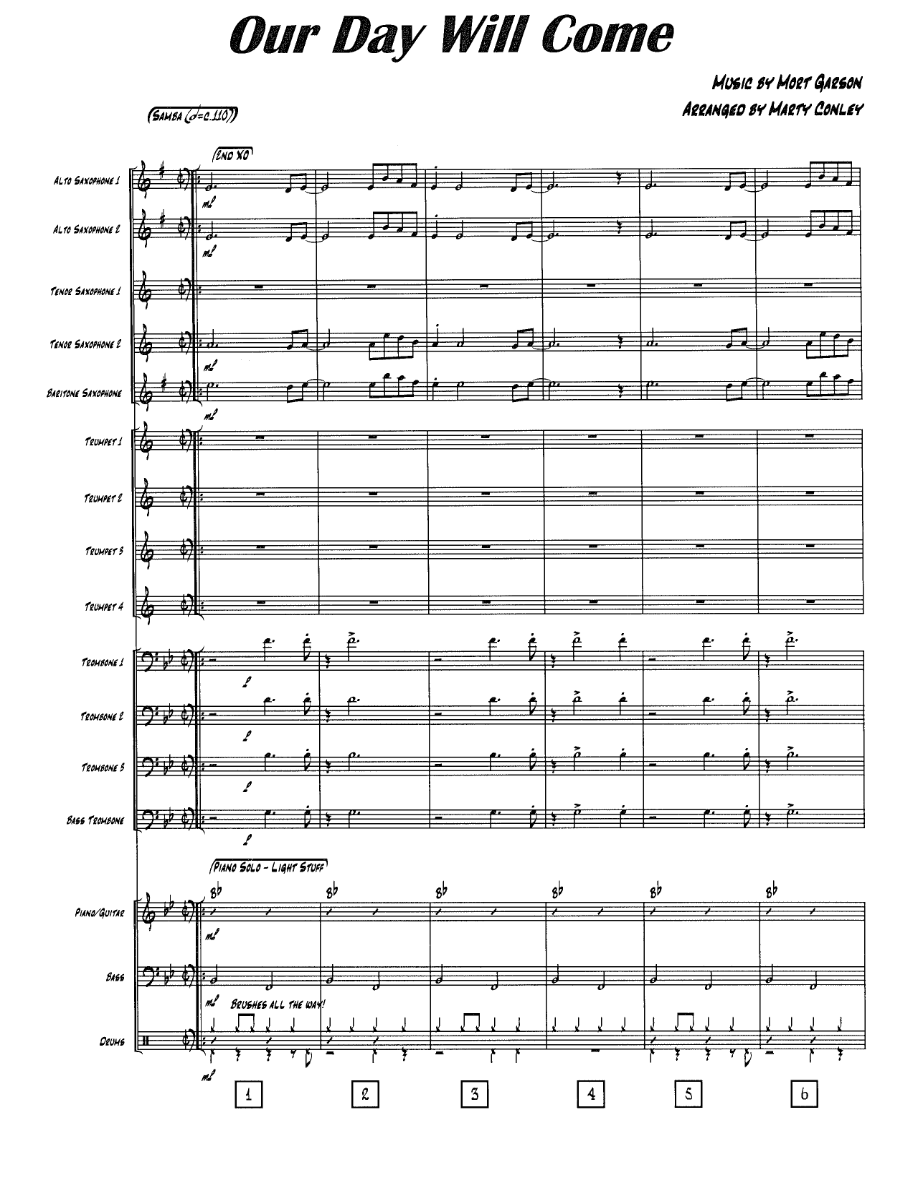
Our Day Will Come (M.Conley) sheet music preview

Our Day Will Come (M.Conley)

Composed by Bob Hilliard, Mort Garson

Arranged by M.Conley

  • Ensemble: Big Band
  • Style: Jazz Standard
  • Pages: 72
  • Instruments (16): Alto Saxophone 1, Alto Saxophone 2, Tenor Saxophone 1, Tenor Saxophone 2, Baritone Saxophone, Trumpet 1, Trumpet 2, Trumpet 3, Trumpet 4, Trombone 1, Trombone 2, Trombone 3, Bass Trombone, Piano/Guitar, Bass, Drum Set
  • Difficulty: advanced
  • Content: Individual Parts
  • Format: PDF Download (Instant)
  • Price: $24.99

"Our Day Will Come," originally penned by Bob Hilliard and Mort Garson, first charmed audiences in 1963, rising to prominence through Ruby & The Romantics' iconic vocal rendition. This timeless melody, a quintessential example of the early 1960s pop-jazz crossover, quickly became a beloved standard due to its optimistic lyrical theme and instantly memorable, flowing melodic lines. While often associated with vocalists, its harmonic richness and inherent swing feel have long made it a favorite among instrumental jazz ensembles, providing a canvas for interpretation that bridges the gap between pop accessibility and jazz sophistication. The original's gentle, medium-tempo feel and hopeful sentiment define its enduring appeal, making it a staple in both jazz and easy-listening repertoires. M.Conley's big band arrangement masterfully reinterprets this classic, infusing it with a vibrant, medium-swing groove while retaining the original's inherent warmth. The arrangement opens with a lush, harmonically rich saxophone soli, immediately establishing a sophisticated yet accessible sound. Conley's signature approach to voicings is evident throughout, employing extended harmonies and close-knit clusters that add depth and color without obscuring the melody. The piece is primarily set in a comfortable 4/4 medium swing, allowing for a relaxed yet driving feel. The melodic lead is shared dynamically, initially presented by the saxophone section, then transitioning to the brass with a powerful, yet controlled, ensemble sound. This thoughtful distribution keeps the arrangement engaging and highlights the full spectrum of the big band's capabilities. A standout feature of this arrangement is its carefully crafted solo section, offering improvisational opportunities over the familiar chord changes. Following a compelling ensemble build-up, a featured solo is designated for Tenor Saxophone 1, providing a chance for expressive improvisation. This is supported by subtle, harmonically interesting background figures from the other sections, ensuring the soloist remains the focal point while maintaining ensemble cohesion. The arrangement culminates in a powerful shout chorus that builds to a satisfying climax, showcasing the full ensemble's dynamic range and rhythmic precision. Conley's treatment elevates the piece from a simple standard to a compelling big band showpiece, balancing tradition with fresh, contemporary voicings. This arrangement is ideally suited for college-level jazz ensembles, advanced high school bands, and community big bands seeking a rewarding and challenging addition to their repertoire. The technical demands are moderate, focusing on blend, balance, and rhythmic precision rather than extreme ranges or blistering tempos. The intricate voicings and dynamic contrasts offer excellent educational opportunities for developing ensemble sound and musicality. Performing this chart is particularly rewarding due to its familiar melody, which resonates with audiences, and the sophisticated harmonic language that provides a rich experience for the musicians. It's a piece that truly shines in performance, evoking a sense of nostalgic joy and sophisticated swing. This arrangement thrives on a consistent, relaxed medium-swing feel at approximately 120-130 BPM. Emphasize a light, buoyant articulation in the rhythm section, ensuring the bass and drums provide a solid, unwavering foundation without being overly aggressive. The primary technical challenge lies in achieving precise intonation and balance within the dense saxophone and brass voicings, particularly during the opening soli and shout chorus. Encourage musicians to listen across sections and blend carefully. Dynamic contrasts are crucial; observe crescendo and decrescendo markings diligently to build tension and release. Pay close attention to the ensemble hits and cut-offs, ensuring crisp, unified attacks. The Tenor Saxophone 1 solo should be encouraged to be lyrical and expressive, supported by the understated but harmonically rich backgrounds. Rehearse the shout chorus in sections to ensure rhythmic accuracy and powerful, unified articulation from all brass and saxophones. Q: What instruments are included in this arrangement? A: This arrangement is scored for a standard 17-piece big band, including Alto Saxophone 1 & 2, Tenor Saxophone 1 & 2, Baritone Saxophone, Trumpet 1-4, Trombone 1-4, Piano, Bass, Drums, and Guitar. Q: What is the difficulty level of "Our Day Will Come (M.Conley)"? A: This arrangement is rated as medium-advanced, suitable for college-level jazz ensembles, advanced high school bands, and proficient community big bands. It requires good intonation, blend, and rhythmic precision. Q: What musical style and historical context does this arrangement represent? A: This is a big band jazz arrangement of "Our Day Will Come," a classic pop-jazz standard from 1963, famously recorded by Ruby & The Romantics. It embodies the optimistic, melodic character of early 1960s popular music interpreted through a sophisticated jazz lens. Q: What makes M.Conley's arrangement of "Our Day Will Come" unique? A: M.Conley's treatment is distinguished by its lush, extended harmonies, sophisticated voicings in the saxophone and brass sections, and a dynamic distribution of the melody. It features a prominent Tenor Saxophone 1 solo and a powerful, well-constructed shout chorus. Q: What is the typical performance duration and tempo for this piece? A: The typical performance duration for this arrangement is approximately 3-4 minutes. It is designed to be played at a medium-swing tempo, generally around 120-130 beats per minute.

Musicians Also Search For

Our Day Will Come M.Conley PDFOur Day Will Come M.Conley sheet musicOur Day Will Come arranged by M.ConleyM.Conley big band chartsM.Conley jazz arrangements PDFOur Day Will Come Bob Hilliard, Mort Garson sheet musicOur Day Will Come Bob Hilliard, Mort Garson big band arrangementBob Hilliard, Mort Garson big band chartsOur Day Will Come big band arrangementOur Day Will Come big band PDF downloadOur Day Will Come jazz ensemble sheet musicbig band sheet music instant downloadOur Day Will Come conductor score PDFOur Day Will Come individual parts downloadOur Day Will Come sheet music with partsOur Day Will Come Jazz Standard chartJazz Standard big band arrangementsbuy Our Day Will Come sheet music onlinedownload Our Day Will Come PDFOur Day Will Come jazz chartbest M.Conley big band arrangementsBob Hilliard, Mort Garson songs arranged by M.ConleyOur Day Will Come printable sheet musicbig band repertoire PDF

All arrangements by M.Conley All Bob Hilliard, Mort Garson sheet music