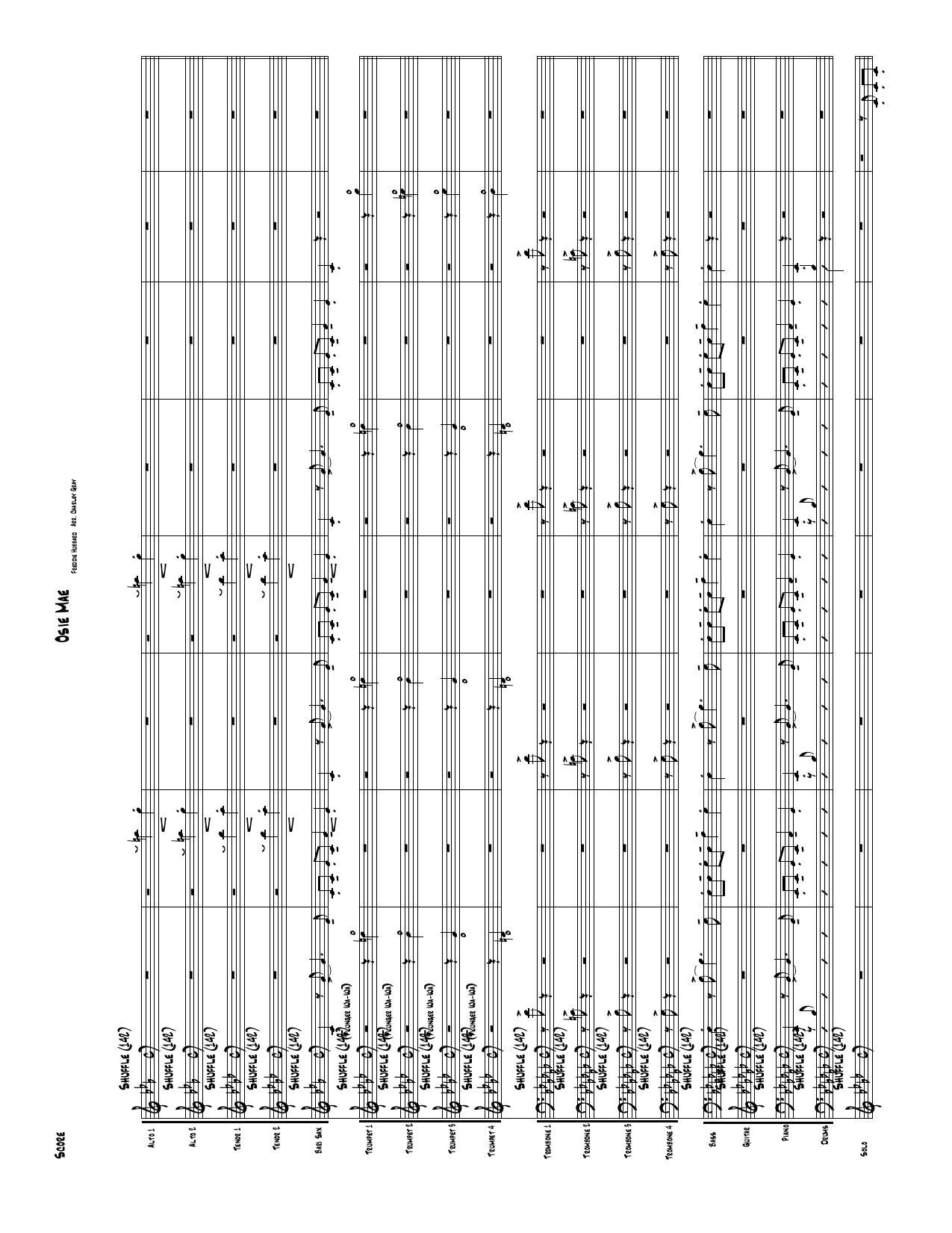
Osie Mae (C.Gray) sheet music preview

Osie Mae (C.Gray)

Composed by C. Gray

Arranged by C.Gray

  • Ensemble: Big Band
  • Style: Jazz Standard
  • Pages: 53
  • Instruments (18): Alto Saxophone 1, Alto Saxophone 2, Tenor Saxophone 1, Tenor Saxophone 2, Baritone Saxophone, Trumpet 1, Trumpet 2, Trumpet 3, Trumpet 4, Trombone 1, Trombone 2, Trombone 3, Trombone 4, Guitar, Piano, Bass, Drums, Soloist
  • Difficulty: advanced
  • Content: Individual Parts
  • Format: PDF Download (Instant)
  • Price: $24.99

"Osie Mae," composed and arranged by C.Gray, stands as a compelling contribution to the modern jazz standard canon, capturing the sophisticated harmonic language and driving rhythmic intensity of mid-century big band writing while infusing a fresh, contemporary compositional voice. Rooted in the rich tradition of post-bop and straight-ahead swing, the composition bridges the gap between classic 1960s Blue Note aesthetics and modern ensemble complexity. The work emerged from a desire to celebrate melodic lyricism underpinned by intricate, modal-leaning harmonic structures, quickly establishing itself as a favorite among discerning bandleaders looking to push their horn sections beyond predictable blues and rhythm changes. Propelled by an infectious, driving medium-up swing groove in 4/4 time, the arrangement opens with a sultry, understated motif in the lower reeds before expanding into rich, harmonically dense brass voicings. The mood shifts fluidly between introspective, blues-infused reflection and high-octane celebratory exuberance. C.Gray employs lush, extended chordal extensions—frequently utilizing major sevenths, sharp elevenths, and altered dominants—to create a sophisticated texture that rewards repeated listening. The arrangement features a tightly interlocked sax soli that pays homage to the classic Benny Golson and Thad Jones writing styles, characterized by sweeping chromatic approaches and intricate rhythmic unisons that demand absolute precision from the reed section. As the chart unfolds, the melodic weight distributes evenly across the ensemble, though the trumpet and alto saxophone sections carry the primary thematic statements. A standout feature of C.Gray's treatment is the expansive, building shout chorus, which utilizes dynamic contrast and staggered syncopation to create a towering wall of sound before dropping down into a sleek, conversational exchange between the rhythm section and the horns. Open solo sections are provided for tenor saxophone and trumpet, backed by sophisticated shout-chorus background figures that maintain forward momentum without crowding the soloists. The harmonic framework offers improvisers a fertile ground to explore both diatonic lyricism and outside-leaning altered lines. Advanced high school ensembles with strong section leaders, as well as collegiate, community, and professional big bands, will find this chart an ideal centerpiece for festival programs or formal concert sets. While the technical demands—particularly regarding tempo maintenance, articulation uniformity, and endurance—require a mature ensemble, the payoff is an immensely satisfying performance experience that showcases a modern big band's technical prowess and stylistic versatility. Conductors approaching "Osie Mae" must prioritize rhythmic crispness and balance, particularly during the dense brass counterlines. The target tempo should live comfortably around quarter note = 184 BPM, maintaining a relentless, forward-leaning swing feel rather than dragging into a heavy stomp. The primary technical hurdle lies in the execution of the fast, articulated sixteenth-note runs in the woodwinds during the soli sections; players should practice these passages isolated and slurred before applying the written articulation. Brass players should pay careful attention to dynamic markings, ensuring that background figures remain subservient to the featured soloists or primary melody lines. Utilize controlled, subtle falls and doits where indicated, avoiding exaggerated effects that could obscure the sophisticated underlying harmony. Rehearsals should begin section by section, ensuring the rhythm section locks in the foundational ride-cymbal groove and walking bass line before layering in the horn stack voicings. Q: What instruments and parts are included in this publication? A: The full 53-page package includes a comprehensive conductor score and parts for a standard 17-instrument big band lineup: Alto Saxophone 1, Alto Saxophone 2, Tenor Saxophone 1, Tenor Saxophone 2, Baritone Saxophone, 4 Trumpets, 4 Trombones, Piano, Guitar, Bass, and Drums. Q: What is the difficulty level of this arrangement? A: This chart is graded as advanced (approximate difficulty level 4.5 out of 5), making it best suited for advanced high school, collegiate, and professional big bands due to its intricate harmonies, fast swing tempo, and technical soli demands. Q: What is the musical style and historical context of "Osie Mae"? A: Composed by C.Gray, "Osie Mae" is written in the tradition of modern straight-ahead jazz and post-bop big band literature, blending 1960s modal sophistication with high-energy swing. Q: What makes this arrangement by C.Gray unique? A: The arrangement stands out for its lush, extended chord voicings, a meticulously crafted sax soli reminiscent of the Thad Jones writing style, and a dynamic shout chorus that builds intense harmonic and rhythmic tension. Q: What is the performance duration and suggested tempo for this piece? A: The arrangement runs approximately 5 to 6 minutes when performed at the suggested medium-up swing tempo of quarter note = 184 BPM.

Questions and answers

What is included in the Osie Mae (C.Gray) PDF?
The verified current file contains a conductor score and individual parts across 53 pages.
How many instruments or parts are listed for Osie Mae (C.Gray)?
The verified instrumentation list contains 18 entries for this Big Band arrangement.
Who is credited for Osie Mae (C.Gray)?
Composer: C. Gray. Arranger: C.Gray.
What difficulty is listed for Osie Mae (C.Gray)?
The verified difficulty level is advanced.
What style is listed for Osie Mae (C.Gray)?
The catalog lists the style as Jazz Standard.
Can I preview Osie Mae (C.Gray) before buying?
Yes. The product page provides a preview generated from the current PDF file.
How is Osie Mae (C.Gray) delivered?
After successful payment, the digital PDF is made available for download. The displayed price is $24.99.

Musicians Also Search For

Osie Mae C.Gray PDFOsie Mae C.Gray sheet musicOsie Mae arranged by C.GrayC.Gray big band chartsC.Gray jazz arrangements PDFOsie Mae C. Gray sheet musicOsie Mae C. Gray big band arrangementsC. Gray big band chartsOsie Mae big band arrangementsOsie Mae big band PDF downloadOsie Mae jazz sheet musicbig band sheet music downloadOsie Mae conductor score PDFOsie Mae individual parts downloadOsie Mae sheet music PDFOsie Mae Jazz Standard chartsJazz Standard big band arrangementsbuy Osie Mae sheet musicdownload Osie Mae PDFOsie Mae jazz chartsbest C.Gray big band arrangementsC. Gray arranged by C.GrayOsie Mae printable sheet musicbig band repertoire PDF

All arrangements by C.Gray All C. Gray sheet music