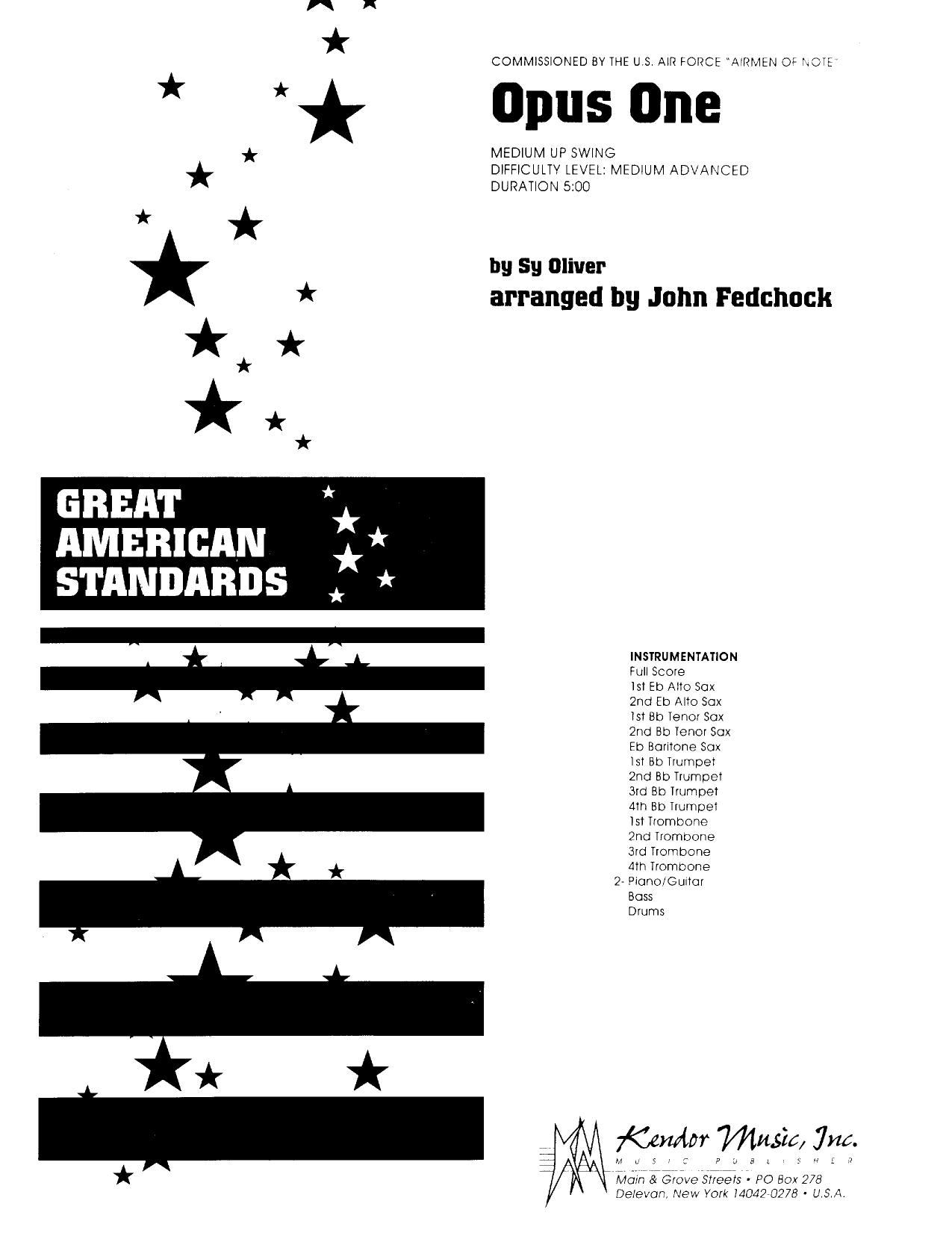
Opus One (J.Fedchock)
Composed by Sy Oliver
Arranged by John Fedchock
- Ensemble: Big Band
- Pages: 65
- Instruments (16): 1st Eb Alto Sax, 2nd Eb Alto Sax, 1st Bb Tenor Sax, 2nd Bb Tenor Sax, Eb Baritone Sax, 1st Bb Trumpet, 2nd Bb Trumpet, 3rd Bb Trumpet, 4th Bb Trumpet, 1st Trombone, 2nd Trombone, 3rd Trombone, 4th Trombone, Guitar/Piano, Bass, Drums
- Difficulty: advanced
- Content: Individual Parts
- Format: PDF Download (Instant)
- Price: $24.99
Sy Oliver’s "Opus One" stands as a monumental pillar of the Swing Era, originally composed in 1943 and immortalized by the Tommy Dorsey Orchestra. As one of the most recognizable melodies in the jazz canon, it captured the optimistic, driving energy of the mid-century big band scene. Oliver, a master of the "two-beat" swing feel, crafted a tune that balanced melodic simplicity with a relentless rhythmic drive, eventually becoming a staple for ballroom dancers and jazz enthusiasts alike. This composition represents the pinnacle of the transition from early swing to the more sophisticated orchestral jazz that would define the mid-1940s and beyond. John Fedchock’s reimagining of this classic brings a modern, sophisticated edge to the familiar melody without sacrificing its inherent swing. Known for his prolific work with the Woody Herman Orchestra and his own New York Big Band, Fedchock infuses the chart with his signature linear writing and dense, colorful voicings. While the original Dorsey version leaned heavily on a straightforward dance beat, Fedchock elevates the material with intricate brass punctuations and harmonically rich saxophone solis. The arrangement typically settles into a medium-up swing tempo, utilizing a driving 4/4 time signature to create a sense of forward motion that feels both grounded in tradition and harmonically adventurous. The arrangement demands precision across all sections, particularly during the high-energy shout chorus where the brass section is pushed to demonstrate both range and rhythmic unity. Fedchock often distributes the melodic responsibility, allowing the saxophones to showcase fluid, bebop-influenced lines while the trombones provide a robust, foundational punch—a nod to his own virtuosity on the instrument. Solo sections are structured to allow for significant improvisational freedom, usually backed by tasteful, evolving backgrounds that build in intensity. The 65-page score reveals a meticulous attention to detail, from the specific articulation markings to the carefully balanced dynamic shifts that define the contemporary big band sound. Professional ensembles and advanced collegiate big bands will find this arrangement a rewarding challenge that serves as a sophisticated centerpiece for any concert program. Because of the complex harmonic language and the technical demands of the brass ranges, it requires a high level of rhythmic maturity and section blend. It is not merely a nostalgia trip; rather, it is a contemporary masterclass in big band writing that honors Sy Oliver’s legacy while pushing the ensemble toward a more modern aesthetic. Success in performing Fedchock’s "Opus One" hinges on maintaining a crisp, light swing feel even as the ensemble volume increases. The tempo should be established at a comfortable medium-up pace where the eighth notes remain swinging but never rushed. Conductors should pay close attention to the saxophone soli sections, ensuring that the lead alto dominates the texture while the lower voices provide harmonic support without dragging the tempo. Brass players must execute falls and doits with uniform duration to maintain the professional "sheen" required for this style. Rehearsal time should be dedicated to the shout chorus, focusing on the balance between the trumpets' upper register and the trombones' counter-lines. Ensure the rhythm section maintains a steady "four-to-the-bar" acoustic bass feel to anchor the complex horn arrangements. Q: What is the specific instrumentation required for this version of Opus One? A: This arrangement is scored for a standard 17-piece big band, consisting of 5 saxophones (AATTB), 4 trumpets, 4 trombones, and a 4-piece rhythm section (piano, bass, drums, and guitar). The 65-page set includes a full conductor’s score and all individual instrumental parts. Q: What is the difficulty level of John Fedchock’s Opus One? A: This is an advanced-level arrangement (Grade 5+) intended for professional musicians or high-level collegiate ensembles. It features demanding brass ranges, sophisticated harmonic substitutions, and intricate rhythmic figures that require precise execution. Q: How does this arrangement differ from the original Tommy Dorsey version? A: While it retains Sy Oliver’s iconic melody, John Fedchock introduces modern linear counterpoint, more dense "New York style" voicings, and an expanded shout chorus. It moves away from the simple dance-band formula toward a more concert-oriented, virtuosic jazz style. Q: What musical style and era does this piece represent? A: The piece is a contemporary reimagining of a Swing Era standard. It blends the traditional 1940s swing feel with modern big band techniques, including bebop-influenced saxophone lines and extended jazz harmonies characteristic of the late 20th-century big band revival. Q: What is the recommended tempo and approximate duration for performance? A: The arrangement is best performed at a medium-up swing tempo, typically between 180 and 200 BPM. Depending on the length of the improvised solos, the performance duration usually ranges between five and seven minutes.
Questions and answers
- What is included in the Opus One (J.Fedchock) PDF?
- The verified current file contains a conductor score and individual parts across 65 pages.
- How many instruments or parts are listed for Opus One (J.Fedchock)?
- The verified instrumentation list contains 16 entries for this Big Band arrangement.
- Who is credited for Opus One (J.Fedchock)?
- Composer: Sy Oliver. Arranger: John Fedchock.
- What difficulty is listed for Opus One (J.Fedchock)?
- The verified difficulty level is advanced.
- Can I preview Opus One (J.Fedchock) before buying?
- Yes. The product page provides a preview generated from the current PDF file.
- How is Opus One (J.Fedchock) delivered?
- After successful payment, the digital PDF is made available for download. The displayed price is $24.99.
Musicians Also Search For
Opus One John Fedchock PDF • Opus One John Fedchock sheet music • Opus One arranged by John Fedchock • John Fedchock big band charts • John Fedchock jazz arrangements PDF • Opus One Sy Oliver sheet music • Opus One Sy Oliver big band arrangements • Sy Oliver big band charts • Opus One big band arrangements • Opus One big band PDF download • Opus One jazz sheet music • big band sheet music download • Opus One conductor score PDF • Opus One individual parts download • Opus One sheet music PDF • buy Opus One sheet music • download Opus One PDF • Opus One jazz charts • best John Fedchock big band arrangements • Sy Oliver arranged by John Fedchock • Opus One printable sheet music • big band repertoire PDF