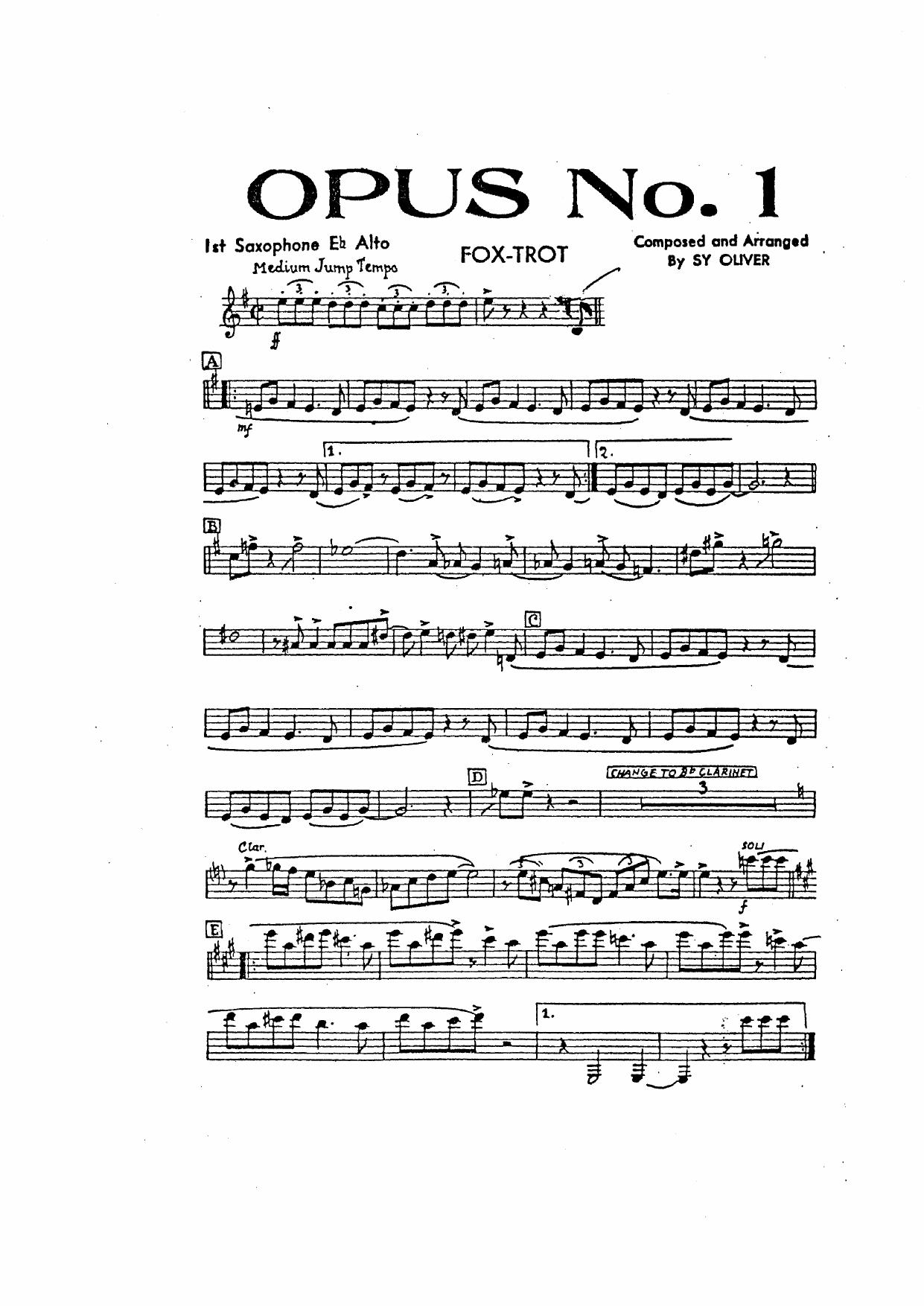
Opus No.1 (S.Oliver)
Composed by Sy Oliver
Arranged by Sy Oliver
- Ensemble: Big Band
- Style: Jazz Standard
- Pages: 35
- Instruments (17): 1st Saxophone Eb Alto, 2nd Saxophone Bb Tenor, 3rd Saxophone Eb Alto, 4th Saxophone Bb Tenor, Baritone, 1st Trumpet in Bb, 2nd Trumpet in Bb, 3rd Trumpet in Bb, 4th Trumpet, 1st Trombone, 2nd Trombone, 3rd Trombone, 4th Trombone, Piano, Guitar, Bass, Drums
- Difficulty: medium
- Content: Individual Parts
- Format: PDF Download (Instant)
- Price: $24.99
Sy Oliver’s legendary swing anthem "Opus No.1" stands as one of the defining instrumental masterpieces of the big band era. Originally written and arranged by Oliver for the Tommy Dorsey Orchestra and recorded in 1945, the tune quickly became Dorsey’s signature theme song, encapsulating the high-octane excitement and driving momentum of mid-1940s swing. Rooted in the classic Kansas City-meets-Harlem swing tradition that Oliver helped pioneer during his monumental tenure as chief arranger for Jimmie Lunceford, "Opus No.1" bridges the gap between sophisticated, tightly knit ensemble writing and irrepressible dance-hall energy. It remains an essential cornerstone of big band repertoire, celebrated for its infectious groove, intricate counterpoint, and relentless forward motion. Propelled by an exuberant medium-up swing feel in 4/4 time, the arrangement radiates an atmosphere of unbridled joy and sophisticated celebration. The harmonic language is firmly grounded in traditional swing-era extensions, utilizing rich major-seventh voicings, snappy secondary dominants, and clever chromatic passing tones that keep the ear engaged. The emotional trajectory builds steadily from a cheeky, understated opening statement into a roaring, high-energy tour de force. The chart demands a crisp, buoyant articulation throughout; the rhythm section must lock into a driving, feather-light ride cymbal pulse that pushes the horns without ever dragging or rushing the tempo. Sy Oliver’s compositional fingerprint is stamped all over this score, characterized by brilliant block-voicing for the reeds, punchy brass interjections, and a masterclass in dynamic contrast. The arrangement showcases Oliver's trademark call-and-response structures, seamlessly trading motifs between the brass and saxophone sections before uniting them in lush, harmonized solis. Brass players will encounter classic swing-era articulations, including sharp staccatos, expressive doits, and plunger effects that add vocal-like inflections to the lines. The woodwinds, anchored by robust writing across the two alto saxophones, tenor saxophone, and baritone saxophone, require absolute technical precision to execute the lightning-fast scalar runs and interlocking counter-melodies that weave beneath the primary theme. Navigating this 36-page chart offers immense rewards for advanced ensembles capable of mastering its demanding ensemble blend and stylistic nuances. The melodic weight shifts fluidly across the entire big band, ensuring that every section shares the spotlight rather than resting on the rhythm or lead voices alone. Featured solo spaces allow standout improvisers to stretch out over standard swing changes, while the magnificent, multi-tiered shout chorus serves as the structural peak of the performance, requiring immense stamina, breath support, and dynamic control from the entire brass roster. Advanced high school, collegiate, and professional jazz orchestras will find this arrangement an ideal vehicle for showcasing section cohesion, stylistic authenticity, and endurance. While the individual note-reading is accessible for experienced players, achieving the polished articulation, razor-sharp rhythmic unisons, and authentic 1945 swing aesthetic demands a mature ensemble with a strong collective sense of groove. Conductors tackling Sy Oliver’s "Opus No.1" should establish a brisk, buoyant medium-up swing tempo (around 160–168 BPM) that feels effortless rather than rushed. The primary technical hurdle lies in the execution of the rhythmically complex unison passages and the snappy, synchronized short notes; the entire band must practice these spots with a metronome clicking on beats two and four to internalize the authentic jazz subdivision. Saxophones need to pay close attention to balance within the chordal voicings, ensuring that inner voices project without covering the lead alto. Brass players should approach mutes and special effects (such as doits and falls) with clean intonation and careful dynamic restraint so they color the ensemble texture rather than piercing it. Rehearsals should initially focus section-by-section on swing phrasing—emphasizing the upbeats and leaning into the natural weight of the downbeats—before combining forces to build the seamless crescendo leading into the final shout chorus. Q: What instruments and parts are included in this arrangement? A: This 36-page big band chart is scored for a standard 16-instrument ensemble, featuring parts for Alto Saxophone 1, Alto Saxophone 3, Tenor Saxophone 2, Baritone Saxophone, Trumpet 1, and associated full big band instrumentation. Q: What is the difficulty level of this arrangement? A: This arrangement is best suited for advanced high school, collegiate, and professional big bands due to its demanding stamina, intricate ensemble unisons, and requirement for authentic swing-era articulation. Q: What is the historical background and style of "Opus No.1"? A: Composed and arranged by Sy Oliver and made famous by the Tommy Dorsey Orchestra in 1945, this piece is a cornerstone of the mid-1940s swing era, blending driving rhythms with sophisticated, brass-heavy orchestration. Q: What makes this specific arrangement by Sy Oliver unique? A: It features Oliver's signature arranging hallmarks, including brilliant block-voicing for the reeds, clever call-and-response dynamics between brass and saxophones, and a magnificent multi-tiered shout chorus. Q: What is the recommended performance tempo and duration for this piece? A: The arrangement is performed at a brisk, energetic medium-up swing tempo (around 160–168 BPM), typically running between 3 and 4 minutes depending on the length of improvised solo choruses.
Questions and answers
- What is included in the Opus No.1 (S.Oliver) PDF?
- The verified current file contains individual parts across 35 pages.
- How many instruments or parts are listed for Opus No.1 (S.Oliver)?
- The verified instrumentation list contains 17 entries for this Big Band arrangement.
- Who is credited for Opus No.1 (S.Oliver)?
- Composer: Sy Oliver. Arranger: Sy Oliver.
- What difficulty is listed for Opus No.1 (S.Oliver)?
- The verified difficulty level is medium.
- What style is listed for Opus No.1 (S.Oliver)?
- The catalog lists the style as Jazz Standard.
- Can I preview Opus No.1 (S.Oliver) before buying?
- Yes. The product page provides a preview generated from the current PDF file.
- How is Opus No.1 (S.Oliver) delivered?
- After successful payment, the digital PDF is made available for download. The displayed price is $24.99.
Musicians Also Search For
Opus No.1 Sy Oliver PDF • Opus No.1 Sy Oliver sheet music • Opus No.1 arranged by Sy Oliver • Sy Oliver big band charts • Sy Oliver jazz arrangements PDF • Opus No.1 Sy Oliver big band arrangements • Opus No.1 big band arrangements • Opus No.1 big band PDF download • Opus No.1 jazz sheet music • big band sheet music download • Opus No.1 individual parts download • Opus No.1 sheet music PDF • Opus No.1 Jazz Standard charts • Jazz Standard big band arrangements • buy Opus No.1 sheet music • download Opus No.1 PDF • Opus No.1 jazz charts • best Sy Oliver big band arrangements • Opus No.1 printable sheet music • big band repertoire PDF