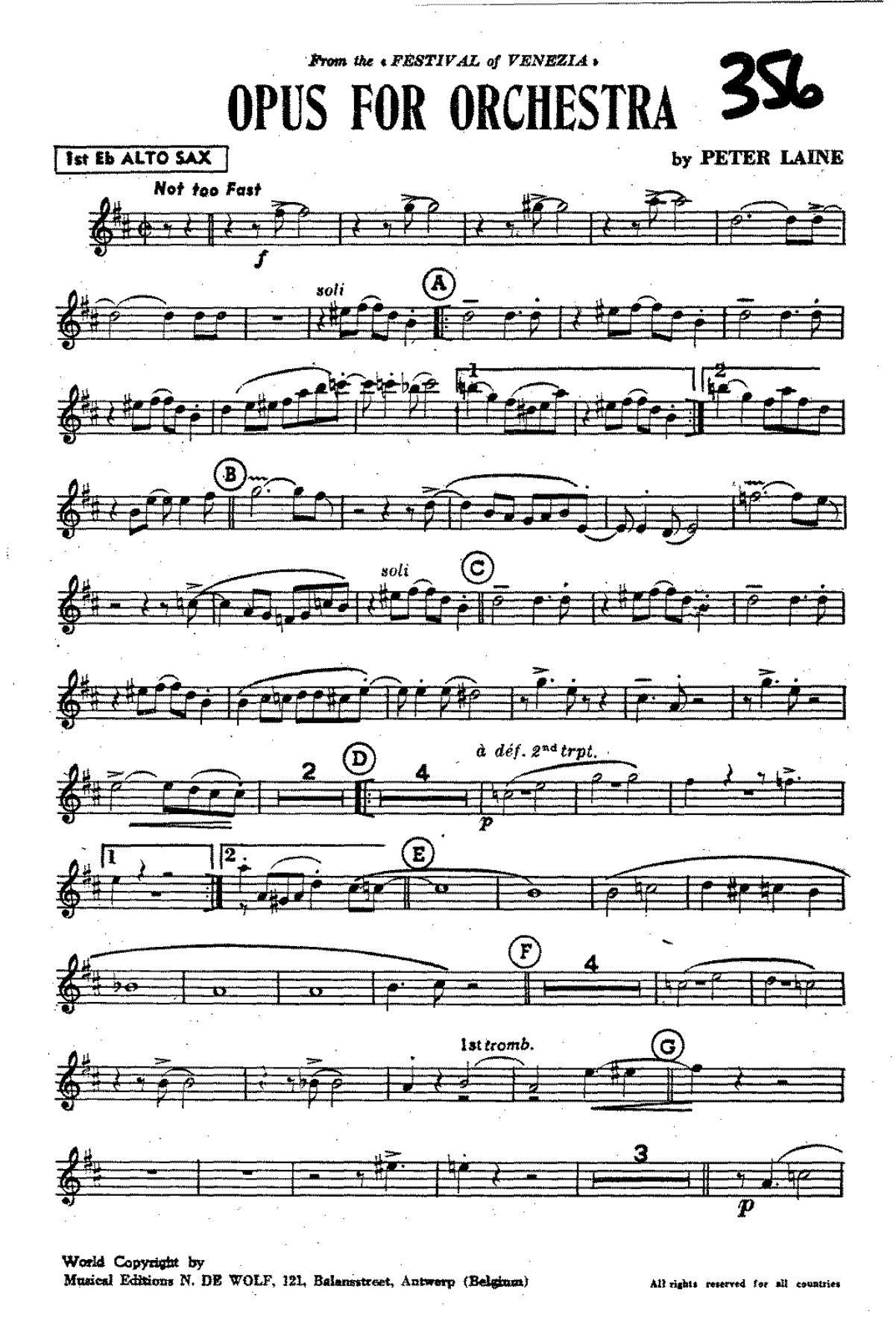
Opus For Orchestra (P.Laine)
Composed by Gerry Mulligan
Arranged by P.Laine
- Ensemble: Big Band
- Style: Jazz Standard
- Pages: 10
- Instruments (17): Alto Saxophone 1, Alto Saxophone 2, Tenor Saxophone 1, Tenor Saxophone 2, Baritone Saxophone, Trumpet 1, Trumpet 2, Trumpet 3, Trumpet 4, Trombone 1, Trombone 2, Trombone 3, Bass Trombone, Guitar, Piano, Bass, Drums
- Difficulty: easy
- Content: Individual Parts
- Format: PDF Download (Instant)
- Price: $24.99
Gerry Mulligan's "Opus For Orchestra" stands as a quintessential representation of the West Coast Cool Jazz movement, originally penned by the legendary baritone saxophonist and arranger himself. Composed and recorded during the vibrant 1950s, an era defined by its sophisticated harmonic language, relaxed tempos, and intricate counterpoint, this piece embodies the intellectual yet effortlessly swinging aesthetic that Mulligan pioneered. While not as widely recorded as some of his quartet work, "Opus For Orchestra" showcases Mulligan's profound understanding of big band orchestration, highlighting his signature melodicism and the interplay between sections that became a hallmark of his larger ensemble writing. It's a testament to the era's focus on composition and arrangement, often featuring interwoven melodic lines rather than relying solely on individual soloists, making it a significant, albeit perhaps less frequently performed, jazz standard for larger ensembles. P.Laine's arrangement of "Opus For Orchestra" meticulously captures the original's cool, medium-swing feel, set in a comfortable 4/4 meter. The piece unfolds with a relaxed yet driving energy, characterized by its smooth melodic contours and understated harmonic richness. Laine's treatment maintains the original's sophisticated mood, evoking a sense of thoughtful introspection combined with an undeniable, subtle groove. The arrangement is primarily set in the key of F major, allowing for a bright yet mellow brass sound and a fluid saxophone section. The overall energy remains consistent, building subtly through layered textures rather than dramatic dynamic shifts, preserving the cool jazz ethos. P.Laine's distinctive approach to this classic is evident in several key areas. While honoring Mulligan's original voicings, Laine expands upon them with contemporary big band sensibilities, introducing rich, often dense saxophone soli sections that showcase the full harmonic potential of the reed section. The brass writing is articulate and precise, balancing power with the necessary restraint for the cool jazz style. There are carefully crafted counter-melodies and background figures that add depth without cluttering the texture, a hallmark of Laine's arranging style which prioritizes clarity and musicality. The arrangement features a prominent melodic statement by the lead alto saxophone, often doubled by other reeds, before transitioning into a series of well-structured solo sections over the form. The arrangement is designed for a 17-instrument big band, making it suitable for advanced high school, collegiate, community, and professional ensembles looking to explore the nuanced world of cool jazz. The technical challenges lie not in blistering tempos or extreme ranges, but in achieving precise articulation, blend, and balance within the ensemble, particularly in the intricate soli passages and the subtle rhythmic interplay. Featured solos are typically for tenor saxophone and trumpet, offering opportunities for improvisation over the standard changes. The rewarding aspect of performing this piece lies in its inherent musicality and the satisfaction of executing its sophisticated ensemble writing, allowing bands to delve into the historical roots of big band jazz beyond the more common flag-wavers. Conductors should emphasize a relaxed, yet rhythmically precise medium-swing feel from the outset, ensuring the rhythm section lays down a solid, unhurried foundation. Articulation is paramount; encourage saxophones to play with a smooth, legato tongue, while brass should aim for a warm, rounded sound, avoiding overly aggressive attacks. Balance in the saxophone soli sections is crucial, requiring careful attention to inner voices to achieve the intended harmonic richness without one voice dominating. For soloists, encourage a melodic, cool jazz approach rather than a high-energy bebop style, focusing on phrasing and harmonic sophistication. There are no special techniques like plunger mutes or falls required, allowing the focus to remain on blend, intonation, and rhythmic accuracy. Rehearsals should dedicate significant time to the ensemble's overall blend and the subtle dynamic shaping that defines the cool jazz aesthetic. Q: What instruments are included in this arrangement? A: This arrangement is scored for a standard 17-piece big band, including Alto Saxophone 1 & 2, Tenor Saxophone 1 & 2, Baritone Saxophone, Trumpet 1-4, Trombone 1-4, Piano, Bass, Drums, and Guitar. Q: What is the difficulty level of "Opus For Orchestra (P.Laine)"? A: This arrangement is rated as medium-advanced to advanced, suitable for collegiate, community, or professional big bands. It requires strong ensemble playing, precise articulation, and a good understanding of cool jazz phrasing. Q: What musical style and historical context does this arrangement represent? A: This arrangement embodies the West Coast Cool Jazz style of the 1950s, showcasing Gerry Mulligan's sophisticated melodic and harmonic writing, characterized by a relaxed medium-swing feel and intricate ensemble interplay. Q: What makes P.Laine's arrangement of "Opus For Orchestra" unique? A: P.Laine's arrangement honors Mulligan's original while enhancing it with contemporary big band voicings, rich saxophone soli sections, and meticulously crafted background figures, offering a fresh yet authentic interpretation of the classic. Q: What is the approximate performance duration and recommended tempo for this piece? A: The approximate performance duration is 4-5 minutes, depending on the length of improvised solos. The recommended tempo is a medium swing, around quarter note = 120-132 BPM.
Musicians Also Search For
Opus For Orchestra P.Laine PDF • Opus For Orchestra P.Laine sheet music • Opus For Orchestra arranged by P.Laine • P.Laine big band charts • P.Laine jazz arrangements PDF • Opus For Orchestra Gerry Mulligan sheet music • Opus For Orchestra Gerry Mulligan big band arrangement • Gerry Mulligan big band charts • Opus For Orchestra big band arrangement • Opus For Orchestra big band PDF download • Opus For Orchestra jazz ensemble sheet music • big band sheet music instant download • Opus For Orchestra individual parts download • Opus For Orchestra sheet music with parts • Opus For Orchestra Jazz Standard chart • Jazz Standard big band arrangements • buy Opus For Orchestra sheet music online • download Opus For Orchestra PDF • Opus For Orchestra jazz chart • best P.Laine big band arrangements • Gerry Mulligan songs arranged by P.Laine • Opus For Orchestra printable sheet music • big band repertoire PDF