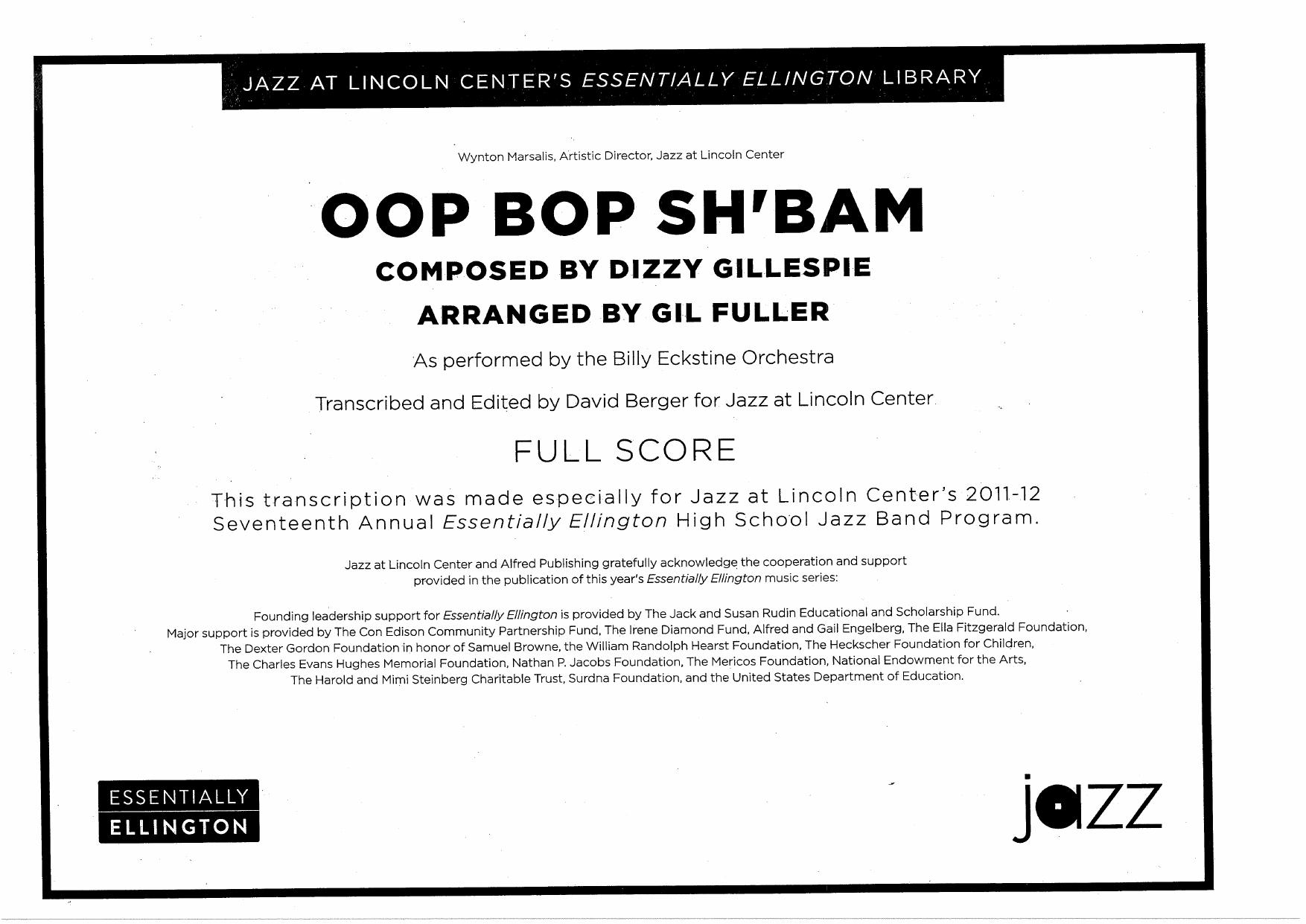
Oop Bop Sh'Bam (G.Fuller) sheet music preview

Oop Bop Sh'Bam (G.Fuller)

Composed by Dizzy Gillespie

Arranged by Gil Fuller-D.GILLESPIE

  • Ensemble: Big Band
  • Pages: 78
  • Instruments (19): Reed 1 Alto Sax, Reed 2 Alto Sax, Reed 3 Tenor Sax, Reed 4 Tenor Sax, Reed 5 Baritone Sax, Trumpet 1, Trumpet 2, Trumpet 3, Trumpet 4, Trombone 1, Trombone 2, Trombone 3, Valve Trombone (Opt.), Trumpet Solo (Opt.), Guitar, Piano, Bass, Drums, Vocal
  • Difficulty: advanced
  • Content: Individual Parts
  • Format: PDF Download (Instant)
  • Price: $24.99

Dizzy Gillespie’s iconic "Oop Bop Sh'Bam" stands as a foundational pillar of the mid-1940s bebop revolution, capturing the playful, hyper-virtuosic, and boundary-pushing spirit of the era's pioneering big bands. First recorded by Gillespie and his orchestra in 1946, the tune bridges the gap between the infectious energy of rhythm and blues novelty numbers and the complex harmonic vocabulary of modern jazz. The title itself nods to the scat-infused vocalisms that peppered early bebop performances, transforming a whimsical phrase into a vehicle for blistering ensemble passages and sophisticated counterpoint. As a snapshot of post-war jazz innovation, the composition showcases how Gillespie and his contemporaries weaponized humor and high-speed execution to redefine American popular music. Propelled by an exuberant, high-octane medium-up swing feel, this arrangement crackles with infectious rhythmic vitality and brisk harmonic movement. The sonic landscape is defined by cascading bebop lines, sparkling brass accents, and a relentless rhythmic drive that demands absolute precision from every section. The emotional tenor is celebratory, urgent, and fiercely joyful, evoking the sweat and electricity of a crowded 52nd Street club in Manhattan. The arrangement wastes no time establishing its groove, launching immediately into punchy ensemble figures that alternate between intricate unison lines and lush, extended-dominant chord voicings characteristic of the period's cutting-edge arranging style. Gil Fuller, collaborating closely with Dizzy Gillespie, brings a masterclass in economy and punch to this orchestration, tailoring the 8-instrument big band instrumentation to deliver maximum acoustic impact without sacrificing transparency. Fuller’s writing treats the compact ensemble like a full-sized orchestra, utilizing clever voice-leading and dynamic contrasting to make the horns sound twice their size. The sax section (Alto, Tenor, Baritone) functions as an agile, interlocking unit that handles rapid-fire bebop solis with fleet-fingered grace, while the brass and trombone anchor the harmonic foundation with sharp, percussive stabs and sweeping glissandos. The chart features dynamic shout choruses that build in intensity, utilizing clever modulations and chromatic passing tones to heighten the tension before resolving into satisfying, high-energy climaxes. Navigating this chart successfully requires crisp articulation, exceptional section cohesion, and a deep internalization of the bebop idiom. The melody is shared fluidly across the front line, punctuated by ample space for improvised solos that allow featured performers to stretch out over standard changes. Technical challenges center primarily on maintaining clean execution at brisk tempos, particularly during fast unison bebop lines and wide-interval leaps in the trumpet and saxophone parts. Advanced high school, collegiate, and professional jazz ensembles will find this arrangement an intensely rewarding challenge that hones players' articulation, stylistic authenticity, and endurance, making it a show-stopping centerpiece for any serious concert or festival program. Success with this arrangement hinges on establishing a relentless, forward-driving medium-up swing tempo that never drags, anchored tightly by the rhythm section. Conductors should emphasize ultra-crisp, short articulations on all eighth-note passages; notes must be tongued lightly with a classic bebop "doodle-tongue" or accented-short approach rather than slurred indiscriminately. Pay close attention to dynamic contrast—sub-ito pianos beneath the soloists create the necessary transparency for improvised lines to breathe against the horn background figures. Brass players should utilize cup or straight mutes where indicated, ensuring that stylistic effects like falls and doits are executed with stylistic taste rather than exaggerated campiness. Rehearsals should initially focus on sectional isolation of the rapid-fire soli sections at a reduced tempo, gradually building metronomic speed while maintaining uniform intonation and rhythmic alignment across the saxophone and brass tiers. Q: What instruments and parts are included in this 78-page arrangement? A: This arrangement is scored for an 8-instrument ensemble featuring Alto Saxophone, Tenor Saxophone, Baritone Saxophone, Trumpet, and Trombone, alongside a complete rhythm section, spanning a comprehensive 78 pages of detailed score and parts. Q: What is the difficulty level of this Gil Fuller-Dudley Gillespie chart? A: This piece is best suited for advanced high school, collegiate, and professional jazz ensembles due to its demanding fast-tempo bebop lines, extended harmonies, and requirement for tight section articulation. Q: What musical style and historical era does "Oop Bop Sh'Bam" represent? A: Composed and made famous by Dizzy Gillespie in 1946, the piece represents the heart of the mid-1940s bebop era, blending the humor of vocal-scat novelty tunes with cutting-edge modern jazz orchestration. Q: What makes this specific arrangement unique? A: Gil Fuller’s masterful adaptation captures the explosive energy of Gillespie’s full-sized 1940s big band, condensing the power into an 8-instrument format without sacrificing harmonic richness, clever counterpoint, or high-octane shout choruses. Q: What is the recommended performance tempo and duration for this piece? A: The arrangement is performed at a brisk, high-energy medium-up swing tempo (typically around quarter note = 200–212 BPM), resulting in a striking performance duration of approximately 3 to 4 minutes depending on solo choruses.

Questions and answers

What is included in the Oop Bop Sh'Bam (G.Fuller) PDF?
The verified current file contains a conductor score and individual parts across 78 pages.
How many instruments or parts are listed for Oop Bop Sh'Bam (G.Fuller)?
The verified instrumentation list contains 19 entries for this Big Band arrangement.
Who is credited for Oop Bop Sh'Bam (G.Fuller)?
Composer: Dizzy Gillespie. Arranger: Gil Fuller-D.GILLESPIE.
What difficulty is listed for Oop Bop Sh'Bam (G.Fuller)?
The verified difficulty level is advanced.
Can I preview Oop Bop Sh'Bam (G.Fuller) before buying?
Yes. The product page provides a preview generated from the current PDF file.
How is Oop Bop Sh'Bam (G.Fuller) delivered?
After successful payment, the digital PDF is made available for download. The displayed price is $24.99.

Musicians Also Search For

Oop Bop Sh'Bam Gil Fuller-D.GILLESPIE PDFOop Bop Sh'Bam Gil Fuller-D.GILLESPIE sheet musicOop Bop Sh'Bam arranged by Gil Fuller-D.GILLESPIEGil Fuller-D.GILLESPIE big band chartsGil Fuller-D.GILLESPIE jazz arrangements PDFOop Bop Sh'Bam Dizzy Gillespie sheet musicOop Bop Sh'Bam Dizzy Gillespie big band arrangementsDizzy Gillespie big band chartsOop Bop Sh'Bam big band arrangementsOop Bop Sh'Bam big band PDF downloadOop Bop Sh'Bam jazz sheet musicbig band sheet music downloadOop Bop Sh'Bam conductor score PDFOop Bop Sh'Bam individual parts downloadOop Bop Sh'Bam sheet music PDFbuy Oop Bop Sh'Bam sheet musicdownload Oop Bop Sh'Bam PDFOop Bop Sh'Bam jazz chartsbest Gil Fuller-D.GILLESPIE big band arrangementsDizzy Gillespie arranged by Gil Fuller-D.GILLESPIEOop Bop Sh'Bam printable sheet musicbig band repertoire PDF

All arrangements by Gil Fuller-D.GILLESPIE All Dizzy Gillespie sheet music