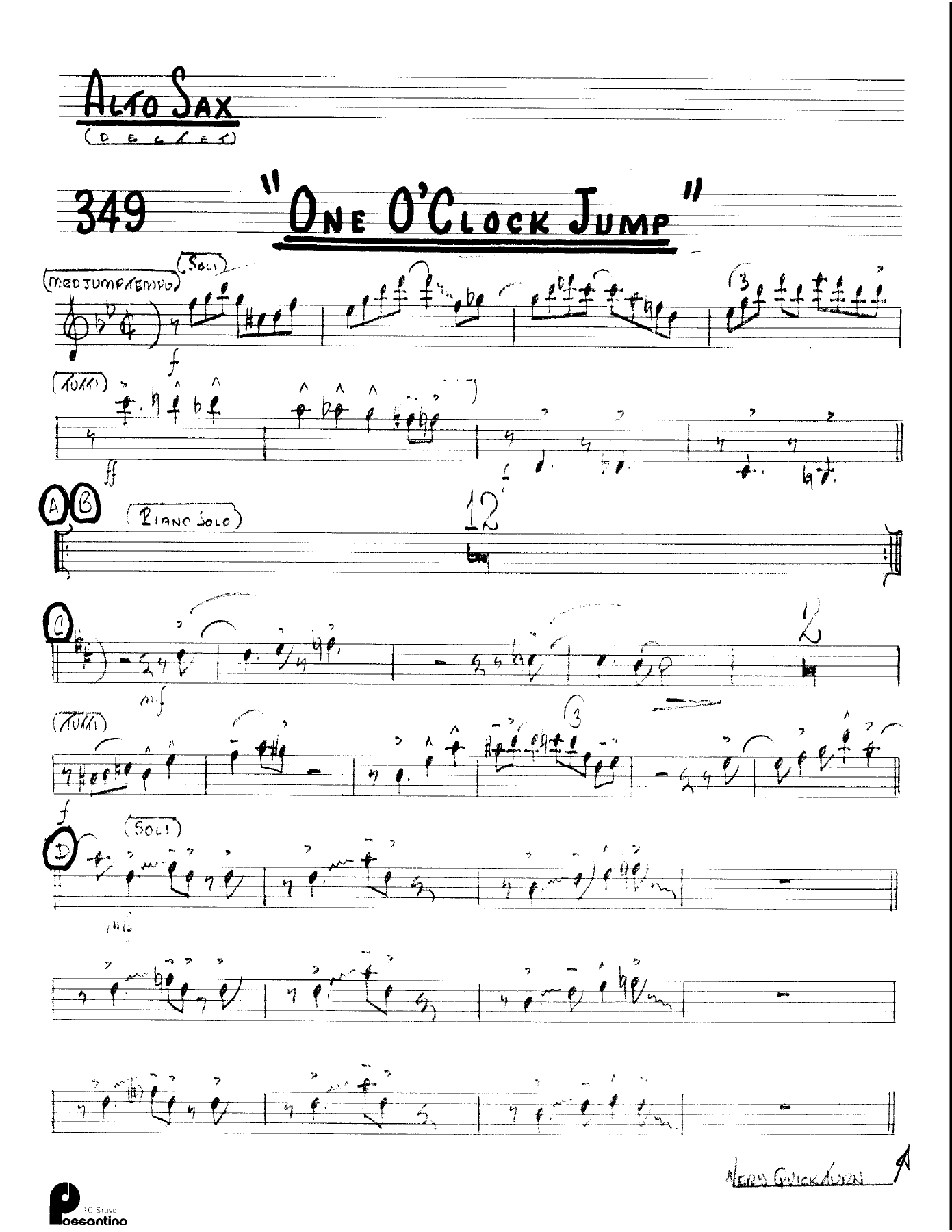
One O'Clock Jump (Kenton Dectet #349)
Composed by Count Basie
Arranged by Stan Kenton Dected 176
- Ensemble: Small Ensemble
- Style: Jazz Standard
- Pages: 33
- Instruments (9): Alto Saxophone, Tenor Saxophone, Baritone Saxophone, Trumpet 1, Trumpet 2, Trombone, Piano, Double Bass, Drums
- Difficulty: easy
- Content: Individual Parts
- Format: PDF Download (Instant)
- Price: $12.99
Count Basie's "One O'Clock Jump," a cornerstone of the big band era, emerged from the vibrant Kansas City jazz scene of the mid-1930s, first recorded in 1937. This iconic twelve-bar blues in C major, characterized by its infectious riff-based structure and irresistible swing feel, quickly became a signature tune for the Count Basie Orchestra and a definitive jazz standard. Its enduring appeal lies in its deceptively simple yet profoundly grooving foundation, built on call-and-response patterns and the improvisational brilliance of Basie's soloists. The piece embodies the raw energy and collective improvisation that defined early big band jazz, making it a timeless celebration of swing. Stan Kenton Dectet 176's arrangement of "One O'Clock Jump" offers a sophisticated reinterpretation of this classic, filtering Basie's accessible swing through Kenton's distinctive harmonic and textural lens. While retaining the original's medium swing tempo and blues-infused spirit, this arrangement elevates the harmonic palette with Kenton's signature voicings, often employing denser, more modern sonorities than Basie's original. The arrangement masterfully balances ensemble passages with opportunities for featured soloists, preserving the improvisational core of the piece. Expect intricate soli sections that showcase the Dectet's tight ensemble work, punctuated by powerful shout choruses that build intensity. The arrangement maintains a bright, energetic mood throughout, evoking both the joyous swing of the original and the progressive harmonic language Kenton was known for. This particular arrangement is a testament to Kenton's ability to reimagine established works with his unique artistic vision. The melody is predominantly carried by the trumpet and alto saxophone, often in unison or close harmony, providing a clear melodic statement before giving way to improvised solos over the familiar blues changes. Expect featured solo opportunities for trumpet, alto saxophone, and piano, allowing individual voices to shine within the structured framework. Technical challenges include navigating Kenton's characteristic extended harmonies and maintaining precise articulation within the driving swing feel. The rewarding aspect lies in the interplay between the ensemble and soloists, culminating in a powerful, harmonically rich shout chorus that is both exhilarating to play and to hear. This arrangement is ideally suited for college-level jazz ensembles, advanced community bands, or professional small groups seeking a challenging yet deeply satisfying performance experience. Its demands for precise ensemble playing, sophisticated harmonic understanding, and strong improvisational skills make it an excellent vehicle for developing musicianship. The blend of historical significance with Kenton's innovative arranging style offers a rich educational and performance opportunity, allowing musicians to explore the evolution of jazz arranging while delivering a powerful, grooving performance of a beloved standard. Conductors should emphasize a consistent, relaxed medium swing feel from the outset, ensuring the rhythm section lays down a solid, unhurried groove. The key technical challenges lie in the precise execution of Kenton's often dense voicings, particularly in the brass and saxophone soli sections. Encourage players to listen across sections to ensure balanced intonation and blend. Articulation is paramount; maintain a light, detached feel on eighth notes in the swing passages, contrasting with sustained, full-bodied notes in the shout choruses. Soloists should be encouraged to channel the bluesy, riff-based spirit of Basie while exploring the richer harmonic backdrop provided by Kenton. Rehearsal time should focus on isolating tricky harmonic passages, ensuring all members understand their role within the complex voicings, and building the dynamic arc towards the powerful final shout chorus. No special techniques like plunger mutes or doits are explicitly notated, allowing for a clean, focused ensemble sound. Q: What instruments and parts are included in the "One O'Clock Jump (Kenton Dectet #349)" arrangement? A: This arrangement for small ensemble typically includes parts for Trumpet, Alto Saxophone, Tenor Saxophone, Baritone Saxophone, Trombone, Piano, Bass, and Drums, consistent with a Dectet instrumentation. Q: What is the difficulty level of this arrangement? A: This arrangement is considered advanced, suitable for college-level jazz ensembles, advanced community bands, or professional small groups due to its sophisticated harmonic language, intricate voicings, and demands for precise ensemble playing and improvisational skill. Q: What is the musical style and historical context of this arrangement? A: This is a small ensemble arrangement of Count Basie's iconic jazz standard "One O'Clock Jump," originally composed in the mid-1930s. Stan Kenton Dectet 176 reinterprets this classic medium swing blues, infusing it with Kenton's characteristic progressive harmonies and textures. Q: What makes this particular arrangement unique compared to other versions of "One O'Clock Jump"? A: This arrangement is unique due to Stan Kenton Dectet 176's distinctive approach, which applies Kenton's signature dense voicings and extended harmonies to Basie's classic riff-based blues, creating a harmonically richer and more complex interpretation while retaining the original's infectious swing feel. Q: What is the typical performance duration and tempo for this arrangement? A: The typical performance duration for "One O'Clock Jump" in this arrangement is approximately 3 to 5 minutes, played at a medium swing tempo, generally around 120-140 beats per minute, depending on the soloists' improvisational length.
Questions and answers
- What is included in the One O'Clock Jump (Kenton Dectet #349) PDF?
- The verified current file contains individual parts across 33 pages.
- How many instruments or parts are listed for One O'Clock Jump (Kenton Dectet #349)?
- The verified instrumentation list contains 9 entries for this Small Ensemble arrangement.
- Who is credited for One O'Clock Jump (Kenton Dectet #349)?
- Composer: Count Basie. Arranger: Stan Kenton Dected 176.
- What difficulty is listed for One O'Clock Jump (Kenton Dectet #349)?
- The verified difficulty level is easy.
- What style is listed for One O'Clock Jump (Kenton Dectet #349)?
- The catalog lists the style as Jazz Standard.
- Can I preview One O'Clock Jump (Kenton Dectet #349) before buying?
- Yes. The product page provides a preview generated from the current PDF file.
- How is One O'Clock Jump (Kenton Dectet #349) delivered?
- After successful payment, the digital PDF is made available for download. The displayed price is $12.99.
Musicians Also Search For
One O'Clock Jump Stan Kenton Dected 176 PDF • One O'Clock Jump Stan Kenton Dected 176 sheet music • One O'Clock Jump arranged by Stan Kenton Dected 176 • Stan Kenton Dected 176 small ensemble charts • Stan Kenton Dected 176 jazz arrangements PDF • One O'Clock Jump Count Basie sheet music • One O'Clock Jump Count Basie small ensemble arrangements • Count Basie small ensemble charts • One O'Clock Jump small ensemble arrangements • One O'Clock Jump small ensemble PDF download • One O'Clock Jump jazz sheet music • small ensemble sheet music download • One O'Clock Jump individual parts download • One O'Clock Jump sheet music PDF • One O'Clock Jump Jazz Standard charts • Jazz Standard small ensemble arrangements • buy One O'Clock Jump sheet music • download One O'Clock Jump PDF • One O'Clock Jump jazz charts • best Stan Kenton Dected 176 small ensemble arrangements • Count Basie arranged by Stan Kenton Dected 176 • One O'Clock Jump printable sheet music • small ensemble repertoire PDF