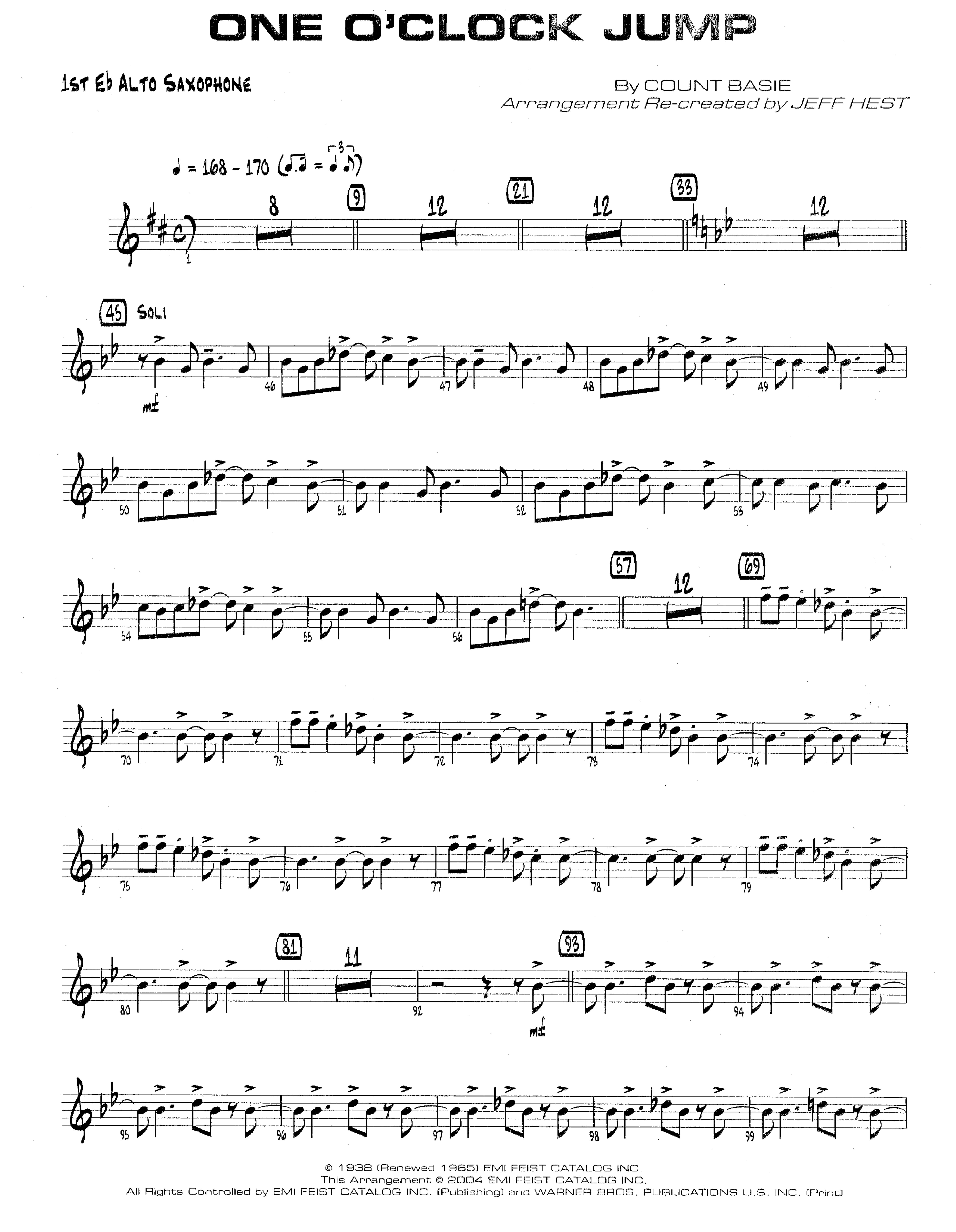
One O'Clock Jump (J.Hest)
Composed by Count Basie
Arranged by Jeff Hest
- Ensemble: Big Band
- Pages: 58
- Instruments (17): 1st Eb Alto Saxophone, 2nd Eb Alto Saxophone, 1st Bb Tenor Saxophone, 2nd Bb Tenor Saxophone, Eb Baritone Saxophone, 1st Bb Trumpet, 2nd Bb Trumpet, 3rd Bb Trumpet, 4th Bb Trumpet, 1st Trombone, 2nd Trombone, 3rd Trombone, 4th Trombone, Drums, Bass, Guitar, Piano
- Difficulty: advanced
- Content: Individual Parts
- Format: PDF Download (Instant)
- Price: $24.99
Count Basie’s signature theme song, "One O'Clock Jump," stands as one of the definitive cornerstones of Kansas City swing and big band history. First recorded by the Count Basie Orchestra in 1937, this infectious 12-bar blues instrumental quickly became the band's closing theme and a national sensation, epitomizing the driving, unpretentious rhythm section feel and electrifying head arrangements characteristic of the era. Built upon a deceptively simple blues progression in F major, the composition relies heavily on collective call-and-response interplay between the brass and reed sections, underscored by the unmistakable, propulsive "all-beats-equal" stride piano and walking bass foundation that defined the Basie legacy. Jeff Hest’s dynamic big band adaptation channels the raw, high-energy exuberance of the original 1930s Decca recordings while injecting a vibrant, contemporary polish tailored for modern ensembles. The chart drives forward with a infectious, medium-fast swing feel (approx. 160–168 BPM), maintaining an effortless, floating momentum that demands precise time-keeping from the rhythm section. The mood is celebratory, confident, and relentlessly swinging, driven by crisp rhythmic unisons and classic Kansas City-style riffing that builds in intensity from the understated head statement all the way to a thunderous, roof-raising shout chorus. Hest approaches the arrangement by honoring the time-tested head-arrangement ethos of the Basie library while expanding the dynamic palette and textural contrast for a full 17-piece modern jazz orchestra. The scoring cleverly utilizes sectional interdependence, pitting the saxophones against the brass in razor-sharp conversational phrases. Harmonically, Hest retains the earthy, blues-drenched tonality of the original while enriching the chord voicings in the ensemble passages to give the horns a lush, room-filling resonance. The rhythm section is treated as the heartbeat of the chart, with dedicated, idiomatic cues for piano, guitar, bass, and drums to lock into that elusive, laid-back Basie groove. Throughout the chart, melody and thematic material are shared democratically across the ensemble, highlighted by swinging woodwind solis and blistering brass counterlines. Solo opportunities are provided for featured improvisers, allowing soloists to stretch out over the timeless 12-bar blues form with classic background riffs pushing them along. Technical challenges lie primarily in maintaining a relaxed, driving swing eighth-note articulation at a brisk tempo, avoiding stiffness in the rhythm section, and executing dynamic swells with absolute uniformity. Advanced high school, collegiate, and community jazz ensembles will find this arrangement an exceptional vehicle for developing sectional cohesion, swing articulation, and blues vocabulary, making it an absolute showstopper for any concert program. Success with this arrangement hinges entirely on the rhythm section’s ability to establish a deep, relaxed swing groove without dragging or rushing. The drummer should favor a feathered bass drum and a crisp, bouncing ride cymbal pattern, keeping hi-hats sharp on beats two and four. Pianists must channel Basie’s economical, sparse comping style, avoiding cluttered voicings in favor of punchy, rhythmic interjections that leave plenty of breathing room. Horn players must master short, articulate staccato markings and classic swing phrasing, ensuring that upbeat accents ("and-of-two," "and-of-four") are crisp and well-supported by air rather than tongue-heavy. Pay close attention to dynamic gradations; the chart relies heavily on sudden drops to piano underneath soloists followed by massive, explosive ensemble crescendos leading into the shout choruses. Standard big band articulation rules apply: lower neighbor-tone slurs, natural tongue accents on downbeats, and controlled, non-abrasive falls where indicated in the brass. Q: What instruments and parts are included in this arrangement? A: This 17-instrument big band arrangement includes full instrumentation for Alto Saxophone 1 & 2, Tenor Saxophone 1 & 2, Baritone Saxophone, 4 Trumpets, 4 Trombones, Piano, Guitar, Bass, and Drums, accompanied by a comprehensive 58-page conductor score. Q: What is the difficulty level of this Jeff Hest arrangement? A: It is well-suited for advanced high school, collegiate, and professional community jazz bands, presenting moderate technical demands centered around stylistic swing articulation and endurance rather than extreme pyrotechnics. Q: What is the historical style and background of "One O'Clock Jump"? A: Originally composed and made famous by Count Basie in 1937, it is a quintessential Kansas City swing-era standard built upon a driving 12-bar blues form in F major. Q: What makes this specific arrangement by Jeff Hest unique? A: Hest successfully bridges vintage 1930s Kansas City head-arrangement traditions with modern big band scoring techniques, providing richer harmonic voicings while retaining the raw, infectious energy of the original Basie recordings. Q: What is the recommended performance duration and tempo for this piece? A: The arrangement is typically performed at a medium-fast swing tempo around 160 to 168 BPM, with a standard performance duration of approximately 3 to 4 minutes depending on solo choruses.
Questions and answers
- What is included in the One O'Clock Jump (J.Hest) PDF?
- The verified current file contains a conductor score and individual parts across 58 pages.
- How many instruments or parts are listed for One O'Clock Jump (J.Hest)?
- The verified instrumentation list contains 17 entries for this Big Band arrangement.
- Who is credited for One O'Clock Jump (J.Hest)?
- Composer: Count Basie. Arranger: Jeff Hest.
- What difficulty is listed for One O'Clock Jump (J.Hest)?
- The verified difficulty level is advanced.
- Can I preview One O'Clock Jump (J.Hest) before buying?
- Yes. The product page provides a preview generated from the current PDF file.
- How is One O'Clock Jump (J.Hest) delivered?
- After successful payment, the digital PDF is made available for download. The displayed price is $24.99.
Musicians Also Search For
One O'Clock Jump Jeff Hest PDF • One O'Clock Jump Jeff Hest sheet music • One O'Clock Jump arranged by Jeff Hest • Jeff Hest big band charts • Jeff Hest jazz arrangements PDF • One O'Clock Jump Count Basie sheet music • One O'Clock Jump Count Basie big band arrangements • Count Basie big band charts • One O'Clock Jump big band arrangements • One O'Clock Jump big band PDF download • One O'Clock Jump jazz sheet music • big band sheet music download • One O'Clock Jump conductor score PDF • One O'Clock Jump individual parts download • One O'Clock Jump sheet music PDF • buy One O'Clock Jump sheet music • download One O'Clock Jump PDF • One O'Clock Jump jazz charts • best Jeff Hest big band arrangements • Count Basie arranged by Jeff Hest • One O'Clock Jump printable sheet music • big band repertoire PDF