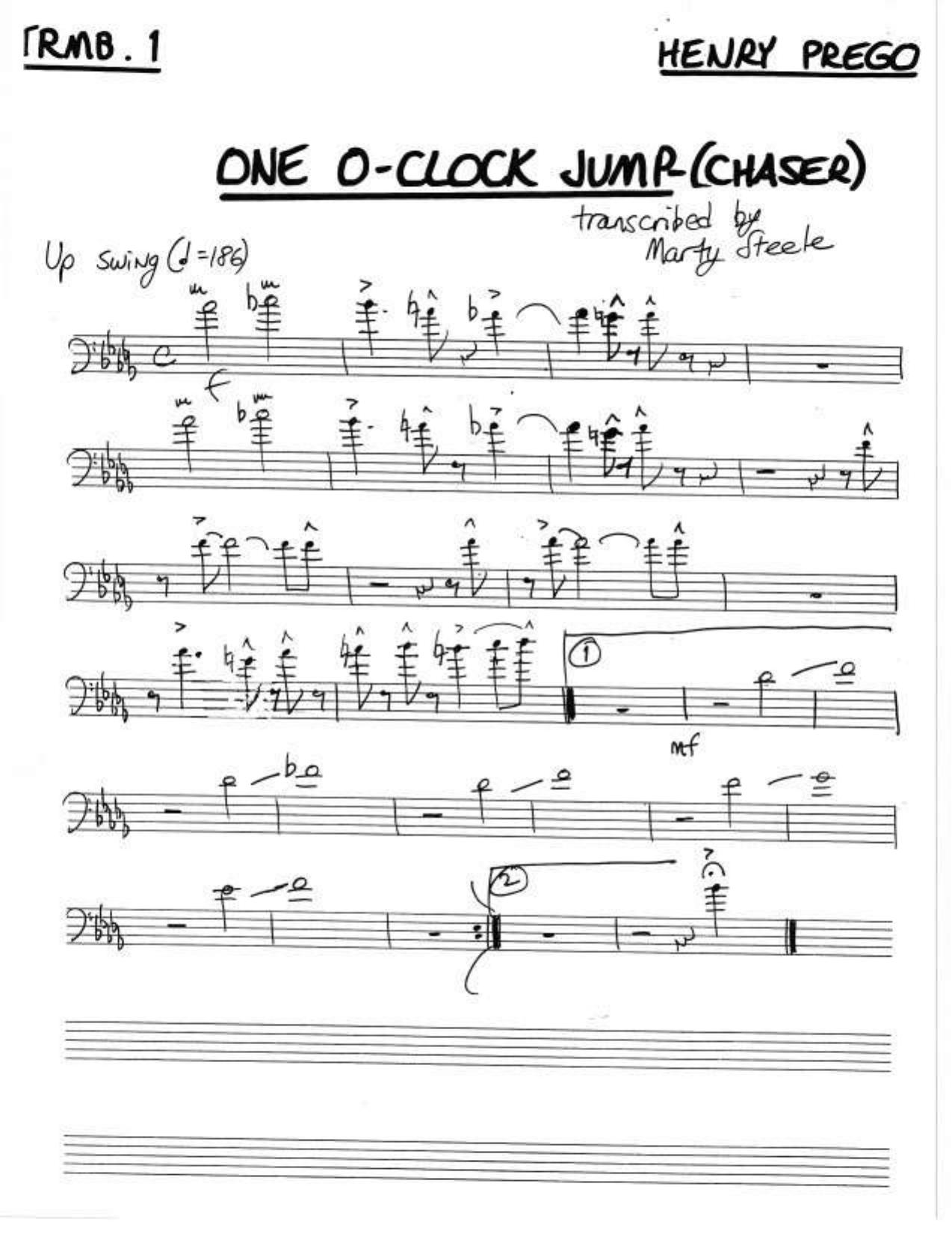
One O'Clock Jump (H.Prego) sheet music preview

One O'Clock Jump (H.Prego)

Composed by Count Basie

Arranged by H.Prego

  • Ensemble: Big Band
  • Style: Jazz Standard
  • Pages: 16
  • Instruments (16): Trombone 1, Trombone 2, Trombone 3, Trombone 4, Trumpet 1, Trumpet 2, Trumpet 3, Trumpet 4, Alto Saxophone 1, Alto Saxophone 2, Tenor Saxophone 1, Tenor Saxophone 2, Baritone Saxophone, Drums, Acoustic Bass, Piano
  • Difficulty: easy
  • Content: Individual Parts
  • Format: PDF Download (Instant)
  • Price: $24.99

Count Basie’s signature anthem, "One O'Clock Jump," stands as one of the definitive cornerstones of the 1930s Kansas City swing era and the big band canon at large. First recorded by the Count Basie Orchestra in 1937, this twelve-bar blues masterpiece emerged from the spontaneous, head-arrangement culture of mid-western jazz clubs, built upon an infectious riff-based framework that prioritized driving momentum, immaculate rhythmic pocket, and unbridled blues feeling. Originally serving as Basie’s radio theme song, the piece epitomizes the effortless, blues-drenched swing that catapulted the orchestra to international acclaim and forever defined the template for classic swing band propulsion. This dynamic big band adaptation by arranger H.Prego captures the raw, high-energy spirit of the original Basie recording while injecting a vibrant, contemporary vitality tailored for modern ensembles. Operating at a brisk, driving medium-up swing tempo, the arrangement opens with the iconic, cascading piano-style introduction before expanding into rich, interlocking horn riffs. The mood is celebratory, electrifying, and relentlessly driving, evoking the smoke-filled, high-energy atmosphere of a historic Kansas City dance hall. The harmonic language remains faithful to the blues roots while incorporating crisp, modern chromatic voice-leading in the brass and saxophones that heightens the dramatic tension during transitional moments. H.Prego’s approach brilliantly balances collective ensemble power with conversational call-and-response dynamics between the brass and reed sections. The arrangement features meticulously crafted soli sections where the saxophones and trombones weave tightly articulated melodic lines that demand absolute precision and rhythmic unity. A soaring, high-energy shout chorus serves as the structural climax, building layer upon layer of layered brass counterpoint and explosive rhythmic hits that test the band's endurance and dynamic control. Throughout the chart, featured solo sections provide ample space for individual expression, encouraging improvisers to stretch out over the traditional blues form in the classic Basie tradition. Advanced high school, collegiate, and professional community big bands will find this chart to be an exceptionally rewarding centerpiece for festival performances or concert programs. While the technical demands require crisp articulation, strong section playing, and stamina—particularly for the lead trumpet and rhythm section—the intuitive structure of the twelve-bar blues makes it accessible yet deeply challenging. Success with this chart hinges on the rhythm section's ability to lock into an authentic, unhurried swing feel, laying down a feather-light yet rock-solid foundation that allows the horns to breathe, swing, and soar with maximum authority. Achieving an authentic performance of H.Prego’s arrangement of "One O'Clock Jump" requires meticulous attention to articulation, balance, and rhythmic pocket. The tempo should be kept brisk and driving, but never rushed; the underlying swing feel must remain relaxed and buoyant to capture the true Kansas City groove. The rhythm section is the engine of this chart—the piano should lean into sparse, comping Basie-style rootless voicings, while the bassist walks a steady, acoustic-style quarter-note line that anchors the ensemble. Horn players must pay close attention to short, crisp articulation on eighth-note passages, utilizing natural tongue accents rather than heavy slurs to maintain clarity at high speeds. Brass players should incorporate stylistic devices such as subtle doits and falls where appropriate, but use them sparingly to preserve the dignity of the classic swing idiom. During rehearsal, isolate the call-and-response sections between the saxophones and brass to ensure seamless transitions and equal dynamic balance across the entire ensemble before tackling the high-energy shout chorus at full volume. Q: What instruments and parts are included in this arrangement? A: This chart is scored for a standard 16-instrument big band instrumentation, featuring a full saxophone section, four trumpets, four trombones (including Trombone 1 through 4), and a complete rhythm section with piano, guitar, bass, and drums, spanning a comprehensive 16-page score and parts format. Q: What is the difficulty level of this H.Prego arrangement? A: This arrangement is calibrated for advanced high school, collegiate, and professional jazz ensembles, presenting moderate-to-high technical demands in terms of endurance, up-tempo swing articulation, and section tightness. Q: What style and historical era does this piece represent? A: The arrangement is firmly rooted in the 1930s Kansas City swing tradition, transforming Count Basie’s legendary 12-bar blues masterpiece into an energetic, dynamic big band showcase. Q: What makes this specific arrangement by H.Prego unique? A: H.Prego bridges historical authenticity with modern big band arranging techniques, incorporating fresh harmonic voicings, tightly knit section solis, and a towering shout chorus while preserving the raw, riff-based energy of the original Basie recording. Q: What is the recommended performance duration and tempo for this chart? A: The piece is designed to be performed at a brisk, driving medium-up swing tempo, with an approximate duration of 3 to 4 minutes depending on the number and length of open solo choruses taken.

Questions and answers

What is included in the One O'Clock Jump (H.Prego) PDF?
The verified current file contains individual parts across 16 pages.
How many instruments or parts are listed for One O'Clock Jump (H.Prego)?
The verified instrumentation list contains 16 entries for this Big Band arrangement.
Who is credited for One O'Clock Jump (H.Prego)?
Composer: Count Basie. Arranger: H.Prego.
What difficulty is listed for One O'Clock Jump (H.Prego)?
The verified difficulty level is easy.
What style is listed for One O'Clock Jump (H.Prego)?
The catalog lists the style as Jazz Standard.
Can I preview One O'Clock Jump (H.Prego) before buying?
Yes. The product page provides a preview generated from the current PDF file.
How is One O'Clock Jump (H.Prego) delivered?
After successful payment, the digital PDF is made available for download. The displayed price is $24.99.

Musicians Also Search For

One O'Clock Jump H.Prego PDFOne O'Clock Jump H.Prego sheet musicOne O'Clock Jump arranged by H.PregoH.Prego big band chartsH.Prego jazz arrangements PDFOne O'Clock Jump Count Basie sheet musicOne O'Clock Jump Count Basie big band arrangementsCount Basie big band chartsOne O'Clock Jump big band arrangementsOne O'Clock Jump big band PDF downloadOne O'Clock Jump jazz sheet musicbig band sheet music downloadOne O'Clock Jump individual parts downloadOne O'Clock Jump sheet music PDFOne O'Clock Jump Jazz Standard chartsJazz Standard big band arrangementsbuy One O'Clock Jump sheet musicdownload One O'Clock Jump PDFOne O'Clock Jump jazz chartsbest H.Prego big band arrangementsCount Basie arranged by H.PregoOne O'Clock Jump printable sheet musicbig band repertoire PDF

All arrangements by H.Prego All Count Basie sheet music