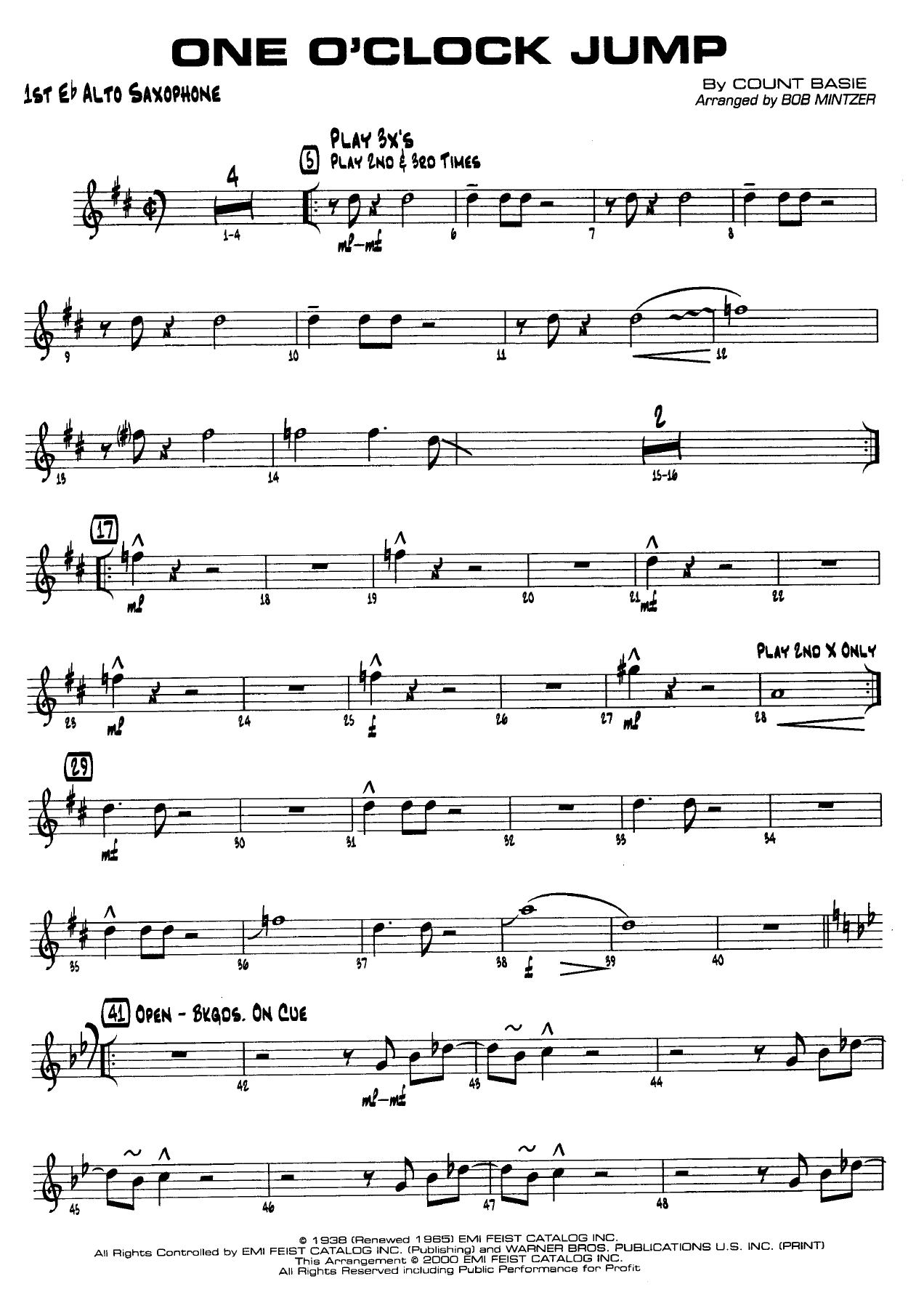
One O'Clock Jump (B.Mintzer) sheet music preview

One O'Clock Jump (B.Mintzer)

Composed by Count Basie

Arranged by Bob Mintzer

  • Ensemble: Big Band
  • Style: Jazz Standard
  • Pages: 62
  • Instruments (18): 1st Eb Alto Saxophone, 2nd Eb Alto Saxophone, 1st Bb Tenor Saxophone, 2nd Bb Tenor Saxophone, Eb Baritone Saxophone, 1st Bb Trumpet, 2nd Bb Trumpet, 3rd Bb Trumpet, 4th Bb Trumpet, 1st Trombone, 2nd Trombone, 3rd Trombone, 4th Trombone, Piano, Guitar, Bass, Drums, Conductor
  • Difficulty: advanced
  • Content: Individual Parts
  • Format: PDF Download (Instant)
  • Price: $24.99

Count Basie's "One O'Clock Jump" stands as an indelible landmark in jazz history, a quintessential 12-bar blues instrumental that defined the Kansas City swing style and became the signature theme song for his legendary orchestra. First recorded on July 7, 1937, for Decca Records, the tune was an immediate hit, solidifying Basie's place in the jazz pantheon. Its origins are rooted in the band's improvisational "head arrangements" at the Reno Club in Kansas City, where a riff tune, originally titled "Blue Balls," was renamed "One O'Clock Jump" by a radio announcer as it neared 1 AM during a broadcast. This piece epitomizes the Swing Era (roughly 1930s-1940s), characterized by its infectious medium-up tempo swing feel, call-and-response patterns, and a blues-based harmonic framework, primarily in F major, that is both accessible and endlessly engaging. It evokes a mood of unrestrained joy and propulsive energy, a true celebration of big band swing that continues to captivate audiences and performers alike. Bob Mintzer's arrangement of "One O'Clock Jump" offers a fresh yet deeply respectful homage to the Basie tradition, showcasing the distinctive blend of classic big band sounds with contemporary jazz influences that defines Mintzer's work. Mintzer, a Grammy-winning saxophonist, composer, and arranger, is renowned for his sophisticated compositions and intricate, powerful horn voicings. This arrangement, featured on his Big Band's album "Homage to Count Basie," retains the original's driving medium swing feel while injecting Mintzer's signature harmonic richness and rhythmic precision. While staying true to the 12-bar blues form, Mintzer masterfully re-orchestrates the iconic riffs, often employing denser voicings and more complex counterlines than the original, yet without sacrificing the essential Basie groove. The arrangement features a classic shout chorus that builds intensity, characteristic of both Basie's and Mintzer's styles. Performance of this arrangement is a rewarding experience, offering numerous opportunities for both ensemble cohesion and individual expression. The melody is typically carried by various sections in a call-and-response fashion, with the saxophones often initiating the iconic riffs, followed by brass responses. Solos are prominently featured for piano, tenor saxophone, trumpet, trombone, alto saxophone, and baritone saxophone, allowing multiple band members to shine creatively. Technical challenges include maintaining precise articulation and blend within the intricate sectional voicings, particularly in the brass, and navigating the driving rhythmic figures at a consistent medium-up swing tempo. The arrangement demands a tight rhythm section that can lay down a solid, agile groove. The rewarding aspect lies in the collective power generated by the ensemble, the thrill of the building shout choruses, and the opportunity to engage with a piece that is both historically significant and musically vibrant. This arrangement is ideally suited for college, community, and professional big bands. Its "Difficult" rating indicates that it requires a high level of musicianship, strong section leaders, and a rhythm section capable of navigating complex swing patterns with precision and feel. High school bands with exceptionally strong players and dedicated rehearsal time may also find it a challenging yet ultimately achievable and highly educational endeavor. The depth of Mintzer's writing provides ample material for musical growth and exploration, making it superb festival and concert material. Approaching Bob Mintzer's "One O'Clock Jump" requires meticulous attention to articulation, balance, and rhythmic precision to capture both the Basie essence and Mintzer's sophisticated layering. Maintain a consistent medium-up swing tempo, around 160-170 BPM, ensuring the rhythm section provides a propulsive, yet relaxed, four-beat feel. The primary technical challenge lies in the intricate sectional voicings and rapid-fire riff passages, particularly in the brass and saxophone sections. Encourage saxophones to play with a robust, blended sound, emphasizing precise cutoffs and attacks on the numerous short, punctuated figures. Brass players should focus on clean articulation and controlled dynamics, using falls and scoops judiciously to emulate the classic Basie style without overdoing it. Rehearsal tips include isolating challenging rhythmic figures and complex harmonies, practicing them slowly and gradually increasing tempo. Emphasize dynamic contrast, particularly in the shout choruses, building intensity through layered entries and increasing volume. The solo sections offer creative freedom, but soloists should be encouraged to listen to the ensemble and respond to the underlying groove. Ensure the rhythm section maintains a light, driving feel, with the bass providing a strong walking line and the drums utilizing a crisp ride cymbal pattern. The piano solo, if transcribed, should be practiced for its characteristic sparse yet impactful phrasing. Q: What instruments and parts are included in this arrangement? A: This arrangement is scored for a standard big band, including Alto Saxophone 1, Alto Saxophone 2, Tenor Saxophone 1, Tenor Saxophone 2, Baritone Saxophone, Trumpet 1-4, Trombone 1-4, Guitar, Piano, Bass, and Drums. It includes a full conductor score and individual parts for all 18 instruments. Q: What is the difficulty level of this arrangement? A: This arrangement is rated as "Difficult" or "Medium Advanced." It is best suited for college, community, and professional big bands due to its complex voicings, technical demands, and the need for a mature understanding of the swing idiom. Q: What is the musical style and historical context of "One O'Clock Jump"? A: "One O'Clock Jump" is a jazz standard from the Swing Era (1930s-1940s), originally composed by Count Basie. It's a quintessential 12-bar blues instrumental that defines the Kansas City swing style, known for its riff-based structure and improvisational focus. Q: What makes Bob Mintzer's arrangement of "One O'Clock Jump" unique? A: Bob Mintzer's arrangement pays tribute to Basie's original while infusing it with his signature modern harmonic language and intricate voicings. It provides a fresh, contemporary take on the classic, featuring extensive solo opportunities and a powerful, building shout chorus, making it both traditional and innovative. Q: What is the typical performance duration and tempo for this piece? A: While performance duration can vary with improvised solos, the original recording of "One O'Clock Jump" is around 3 minutes. This arrangement is typically performed at a medium-up swing tempo, ranging from approximately 160 to 170 beats per minute.

Questions and answers

What is included in the One O'Clock Jump (B.Mintzer) PDF?
The verified current file contains a conductor score and individual parts across 62 pages.
How many instruments or parts are listed for One O'Clock Jump (B.Mintzer)?
The verified instrumentation list contains 18 entries for this Big Band arrangement.
Who is credited for One O'Clock Jump (B.Mintzer)?
Composer: Count Basie. Arranger: Bob Mintzer.
What difficulty is listed for One O'Clock Jump (B.Mintzer)?
The verified difficulty level is advanced.
What style is listed for One O'Clock Jump (B.Mintzer)?
The catalog lists the style as Jazz Standard.
Can I preview One O'Clock Jump (B.Mintzer) before buying?
Yes. The product page provides a preview generated from the current PDF file.
How is One O'Clock Jump (B.Mintzer) delivered?
After successful payment, the digital PDF is made available for download. The displayed price is $24.99.

Musicians Also Search For

One O'Clock Jump Bob Mintzer PDFOne O'Clock Jump Bob Mintzer sheet musicOne O'Clock Jump arranged by Bob MintzerBob Mintzer big band chartsBob Mintzer jazz arrangements PDFOne O'Clock Jump Count Basie sheet musicOne O'Clock Jump Count Basie big band arrangementsCount Basie big band chartsOne O'Clock Jump big band arrangementsOne O'Clock Jump big band PDF downloadOne O'Clock Jump jazz sheet musicbig band sheet music downloadOne O'Clock Jump conductor score PDFOne O'Clock Jump individual parts downloadOne O'Clock Jump sheet music PDFOne O'Clock Jump Jazz Standard chartsJazz Standard big band arrangementsbuy One O'Clock Jump sheet musicdownload One O'Clock Jump PDFOne O'Clock Jump jazz chartsbest Bob Mintzer big band arrangementsCount Basie arranged by Bob MintzerOne O'Clock Jump printable sheet musicbig band repertoire PDF

All arrangements by Bob Mintzer All Count Basie sheet music