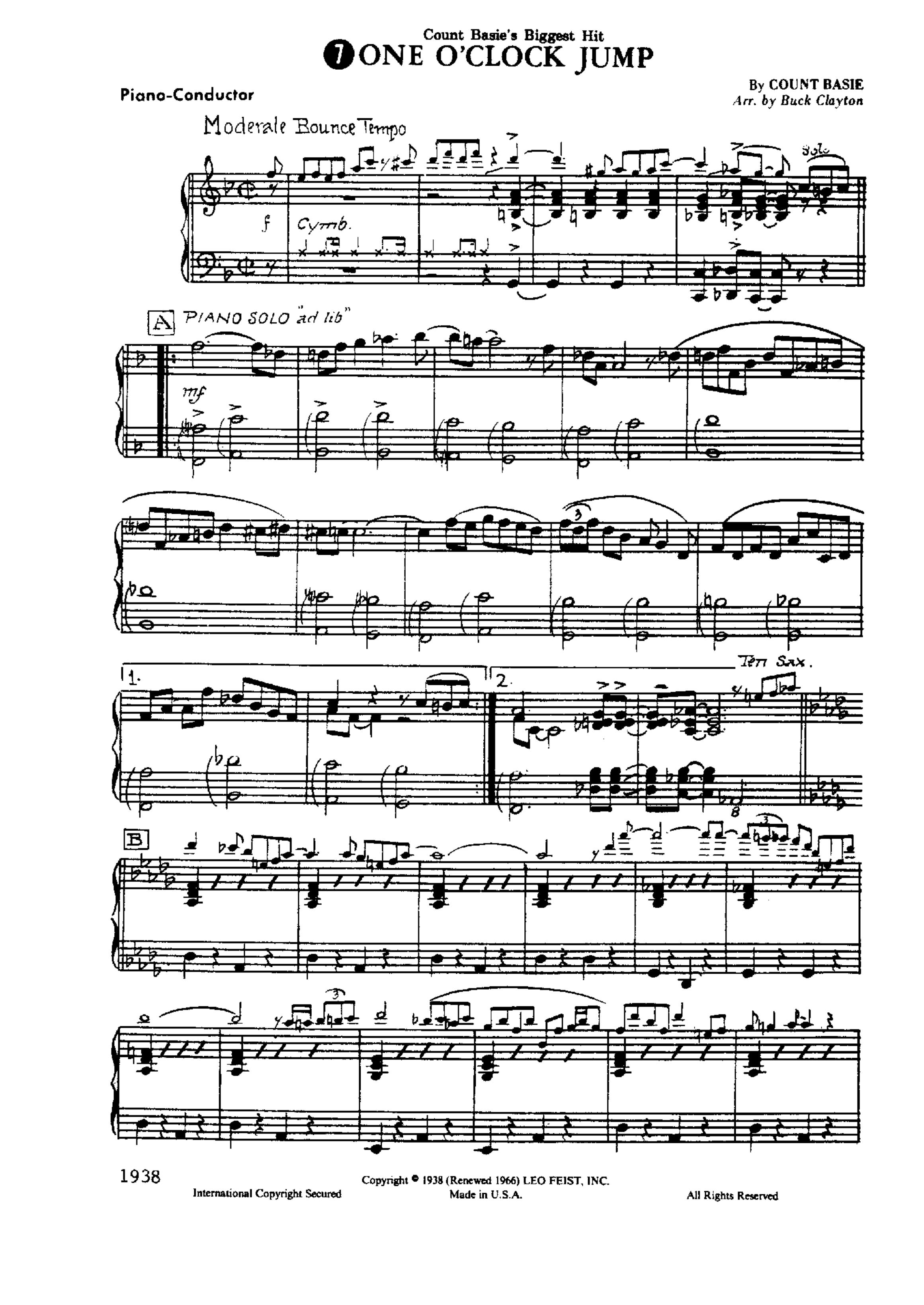
One O'Clock Jump (B.Clayton)
Composed by Count Basie
Arranged by Buck Clayton
- Ensemble: Big Band
- Pages: 40
- Instruments (17): Piano-Conductor, 1st Eb Alto Sax, 2nd Eb Alto Sax, 1st Bb Tenor Sax, 2nd Bb Tenor Sax, Eb Baritone Sax, 1st Trumpet, 2nd Trumpet, 3rd Trumpet, 4th Trumpet, 1st Trombone, 2nd Trombone, 3rd Trombone, 4th Trombone, Guitar, String Bass, Drums
- Difficulty: medium
- Content: Individual Parts
- Format: PDF Download (Instant)
- Price: $24.99
Count Basie’s signature theme song, "One O'Clock Jump," stands as a monumental pillar of Kansas City swing and big band history. First recorded by the Count Basie Orchestra in 1937, this quintessential blues-in-F masterpiece grew out of late-night head arrangements crafted collaboratively by the band members. It quickly became Basie’s radio theme song and a defining anthem of the swing era, celebrated for its infectious driving rhythm section, relaxed yet high-octane momentum, and quintessential riff-based architecture. This distinctive chart features the masterful arranging hand of Buck Clayton, the legendary Basie trumpeter whose deep insider knowledge of the orchestra's inner workings informs every measure. Clayton scales down the massive sonic footprint of the full Basie powerhouse into a lean, dynamic arrangement scored for a specialized 7-instrument ensemble (Alto Saxophone, Tenor Saxophone, Trumpet, Trombone, Piano, and rhythm section support). Maintaining the infectious medium-up swing tempo and the foundational 12-bar blues progression in F major, Clayton preserves the spontaneous, jam-session energy of the original 1937 recording while introducing clever countermelodies and crisp conversational interplay between the horns. The musical character is electric, swinging with an effortless, blues-drenched swagger that demands absolute precision from the rhythm section and an authentic, laid-back articulation from the horns. Clayton utilizes economical, hard-hitting horn voicings that give the small ensemble the punch and resonance of a much larger big band. Solos are seamlessly integrated into the form, allowing individual players to stretch out over the timeless Basie blues changes, supported by punchy background riffs from the surrounding horns. The tension builds organically across successive choruses, culminating in a spirited shout chorus that captures the ecstatic call-and-response spirit of the classic Kansas City style. Advanced high school, collegiate, and professional small jazz ensembles or reduced big bands will find this 40-page publication exceptionally rewarding. Because there is nowhere to hide in a 7-piece instrumentation, players must possess strong individual time, immaculate intonation, and a deep vocabulary of swing phrasing. Conductors and bandleaders looking to inject authentic, historical swing-era vitality into their repertoire will discover that Clayton’s chart offers an ideal vehicle for showcasing section cohesion, blues phrasing, and spirited improvisational flair. Achieving an authentic Kansas City swing feel is the primary challenge of this arrangement. The tempo should remain steady and driving, anchored by a buoyant walking bassline and a crisp ride cymbal pattern that never rushes. Horn players must internalize the classic late-1930s phrasing style: long notes are gently sustained with a warm, controlled vibrato, while shorter notes and off-beats are articulated with crisp, accented tongue strokes. Pay close attention to the dynamic contrast between the head statements and the background riffs behind the soloists; the accompanying horns must never overpower the featured improviser. Section leaders should ensure uniform execution of swing eighth notes, particularly during the fast-paced ensemble shout choruses where sloppy articulation will muddy the texture. Pianists should study Count Basie’s sparse, economic voicing style—utilizing clean comping and characteristic upper-register stabs rather than dense, modern chord clusters. Q: What instruments and parts are included in this arrangement? A: This publication is scored for a 7-instrument ensemble consisting of Alto Saxophone, Tenor Saxophone, Trumpet, Trombone, Piano, and rhythm section components across a comprehensive 40-page score and parts set. Q: What is the difficulty level of this Buck Clayton arrangement? A: It is targeted at advanced high school, collegiate, and professional small jazz ensembles. The reduced 7-piece instrumentation places individual technical and stylistic demands on every player, requiring strong sight-reading, solid time, and a mature command of swing phrasing. Q: What is the historical style and background of "One O'Clock Jump"? A: Originally composed and recorded by Count Basie in 1937, it is a definitive 12-bar blues in F major that represents the height of the Kansas City swing era and served as Basie's famous radio broadcast theme song. Q: What makes this specific arrangement by Buck Clayton unique? A: Arranged by Count Basie's own star trumpeter, this version brilliantly condenses the massive, riff-driven energy of the full Basie orchestra into a nimble 7-instrument format while retaining the spontaneous excitement of the original recordings. Q: What is the performance duration and tempo feel of the piece? A: The arrangement is performed at a driving medium-up swing tempo (typically around 160–172 BPM) and runs for approximately 3 to 4 minutes, depending on the number of improvised solo choruses taken.
Questions and answers
- What is included in the One O'Clock Jump (B.Clayton) PDF?
- The verified current file contains a conductor score and individual parts across 40 pages.
- How many instruments or parts are listed for One O'Clock Jump (B.Clayton)?
- The verified instrumentation list contains 17 entries for this Big Band arrangement.
- Who is credited for One O'Clock Jump (B.Clayton)?
- Composer: Count Basie. Arranger: Buck Clayton.
- What difficulty is listed for One O'Clock Jump (B.Clayton)?
- The verified difficulty level is medium.
- Can I preview One O'Clock Jump (B.Clayton) before buying?
- Yes. The product page provides a preview generated from the current PDF file.
- How is One O'Clock Jump (B.Clayton) delivered?
- After successful payment, the digital PDF is made available for download. The displayed price is $24.99.
Musicians Also Search For
One O'Clock Jump Buck Clayton PDF • One O'Clock Jump Buck Clayton sheet music • One O'Clock Jump arranged by Buck Clayton • Buck Clayton big band charts • Buck Clayton jazz arrangements PDF • One O'Clock Jump Count Basie sheet music • One O'Clock Jump Count Basie big band arrangements • Count Basie big band charts • One O'Clock Jump big band arrangements • One O'Clock Jump big band PDF download • One O'Clock Jump jazz sheet music • big band sheet music download • One O'Clock Jump conductor score PDF • One O'Clock Jump individual parts download • One O'Clock Jump sheet music PDF • buy One O'Clock Jump sheet music • download One O'Clock Jump PDF • One O'Clock Jump jazz charts • best Buck Clayton big band arrangements • Count Basie arranged by Buck Clayton • One O'Clock Jump printable sheet music • big band repertoire PDF