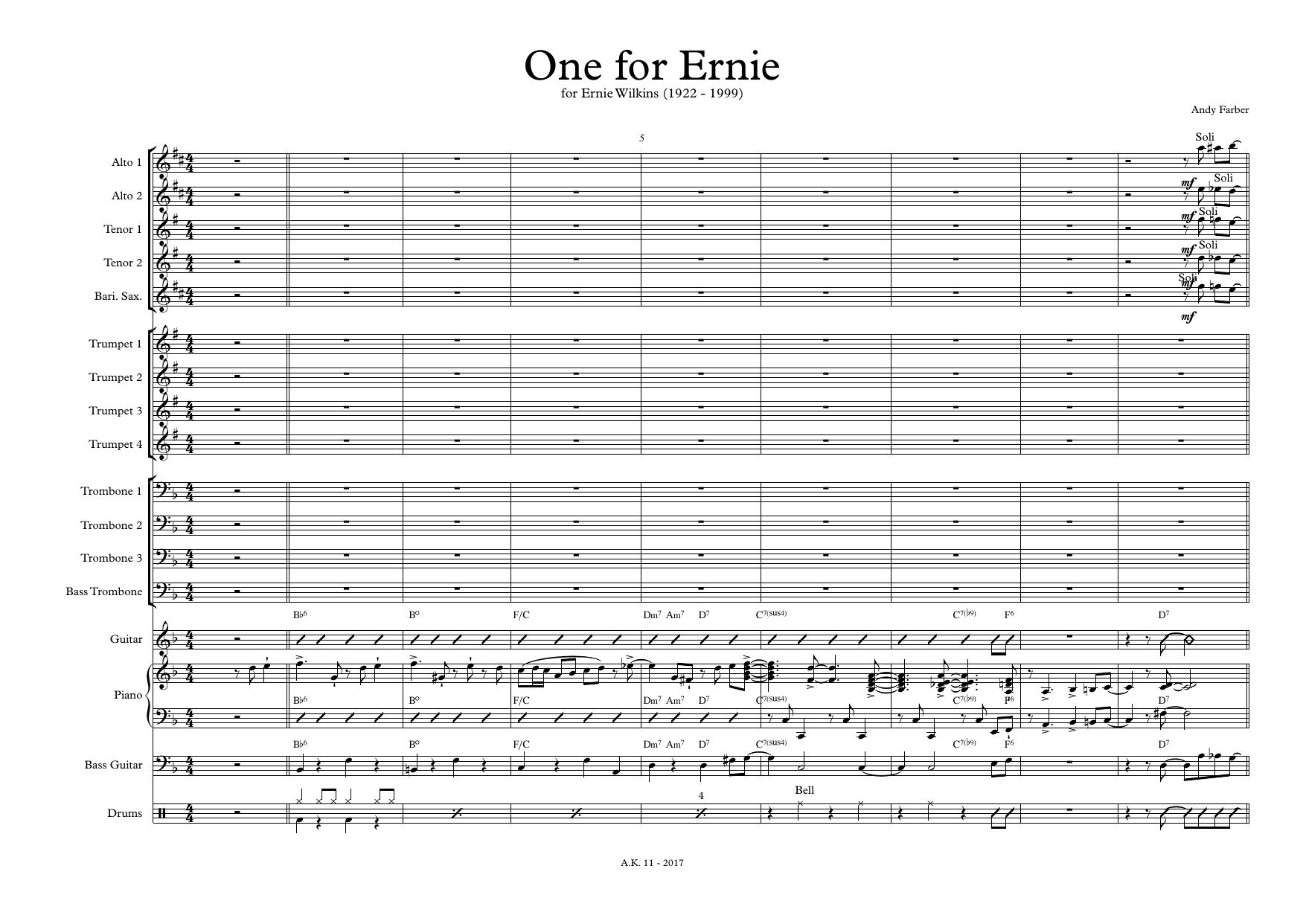
One For Ernie (A.Farber)
Composed by Andy Farber
Arranged by A.Farber
- Ensemble: Big Band
- Style: Jazz Standard
- Pages: 52
- Instruments (18): Alto Saxophone 1, Alto Saxophone 2, Tenor Saxophone 1, Flute, Tenor Saxophone 2, Baritone Saxophone, Trumpet 1, Trumpet 2, Trumpet 3, Trumpet 4, Trombone 1, Trombone 2, Trombone 3, Bass Trombone, Guitar, Piano, Bass Guitar, Drums
- Difficulty: advanced
- Content: Individual Parts
- Format: PDF Download (Instant)
- Price: $24.99
Composed and arranged by acclaimed saxophonist, composer, and Jazz at Lincoln Center stalwart Andy Farber, "One For Ernie" stands as a brilliant contemporary homage to the legendary Ernie Wilkins—the iconic saxophonist, arranger, and composer famous for his foundational writing contributions to the Count Basie Orchestra. Rooted deeply in the rich tradition of mid-century Kansas City swing, this composition channels the timeless aesthetic of the classic Basie big band era while filtering it through Farber's sophisticated, modern compositional lens. It captures the essence of classic mid-century jazz heritage, serving as both an educational masterclass in stylistic swing interpretation and a stellar concert piece for modern ensembles seeking authentic, hard-driving groove material. Musically, the chart settles into a comfortable, infectious medium-slow swing groove characterized by an unmistakable pocket feel. The harmonic language is built upon accessible yet rich blues-infused structures, evoking an atmosphere that is simultaneously relaxed and high-spirited. Farber avoids overly dense modern dissonance in favor of sparkling, transparent brass voicings and sultry, blues-soaked saxophone lines that breathe naturally. The emotional arc moves effortlessly from sultry, understated refrains to exuberant, full-ensemble climaxes, generating an authentic club-date warmth that engages listeners and performers alike. Farber’s signature arranging approach shines through the meticulous pacing of the orchestration, utilizing traditional big band sections like precision instruments. The arrangement features a beautifully crafted saxophone soli that sits right in the sweet spot of the horn registers, demanding tight blend, unified articulation, and an authentic stylistic lilt. Background figures behind the soloists are cleanly voiced, providing robust harmonic support without muddying the texture. The rhythm section is treated as the primary engine, anchored by a steady, buoyant walking bassline and crisp ride-cymbal pulsations that compel the entire 18-piece ensemble to swing effortlessly. Tailored ideally for advanced high school, collegiate, and competent community jazz orchestras, this chart bridges the gap between educational accessibility and professional performance polish. It features well-conceived improvised solo opportunities for tenor saxophone and trumpet, allowing developing soloists space to stretch out over standard changes while offering enough structural depth to satisfy seasoned players. Because the technical demands prioritize stylistic execution, phrasing, and dynamic control over blazing technical speed, it serves as an exceptionally rewarding vehicle for developing cohesive ensemble swing mechanics. Achieving an authentic performance of this arrangement hinges entirely on the rhythm section's ability to lock into a relaxed, behind-the-beat medium swing groove. Avoid rushing the tempo; the pocket must remain wide, steady, and unforced to let the blues elements breathe. For the wind sections, meticulous attention must be paid to articulation consistency. Unison and sectional passages require unified long-short phrasing, with deliberate emphasis placed on upbeat accents to simulate the classic Basie-style bounce. Saxophones should approach their soli section with a light, horizontal conception, ensuring that dynamic swells mirror the natural contour of the line rather than sticking out abruptly. Trumpets and trombones must balance their accompaniment figures carefully during the designated tenor saxophone and trumpet solo spaces, using warm, muted or open tones that support the soloists without obscuring the harmonic backdrop. Rehearsals should initially isolate the rhythm section to cement the groove before layering in the horns section by section. Q: What instruments and parts are included in this big band arrangement? A: This 18-instrument arrangement includes standard big band instrumentation: Alto Saxophone 1, Alto Saxophone 2, Tenor Saxophone 1, Tenor Saxophone 2, Baritone Saxophone, four trumpets, four trombones, and a full four-piece rhythm section (piano, guitar, bass, drums), complete with a 52-page conductor score. Q: What is the difficulty level of this piece? A: It is graded as a medium-level chart (approximately Grade 3 to 3.5), making it exceptionally well-suited for advanced high school ensembles, college groups, and community big bands looking to refine their swing style. Q: What is the musical style and historical context of the piece? A: Written by Andy Farber, it is a medium-groove swing chart conceived as a direct stylistic tribute to the legendary arranger and composer Ernie Wilkins of the Count Basie tradition. Q: What makes this specific arrangement unique? A: It stands out due to its masterful blend of transparent, idiomatic Basie-style voicings, a gorgeous written sax soli, and meticulously crafted background figures that support the featured soloists without cluttering the texture. Q: What are the featured solo opportunities and performance duration? A: The arrangement features built-in improvised solo sections specifically designed for tenor saxophone and trumpet, and typically runs for approximately 4 minutes at the indicated medium swing tempo.
Questions and answers
- What is included in the One For Ernie (A.Farber) PDF?
- The verified current file contains a conductor score and individual parts across 52 pages.
- How many instruments or parts are listed for One For Ernie (A.Farber)?
- The verified instrumentation list contains 18 entries for this Big Band arrangement.
- Who is credited for One For Ernie (A.Farber)?
- Composer: Andy Farber. Arranger: A.Farber.
- What difficulty is listed for One For Ernie (A.Farber)?
- The verified difficulty level is advanced.
- What style is listed for One For Ernie (A.Farber)?
- The catalog lists the style as Jazz Standard.
- Can I preview One For Ernie (A.Farber) before buying?
- Yes. The product page provides a preview generated from the current PDF file.
- How is One For Ernie (A.Farber) delivered?
- After successful payment, the digital PDF is made available for download. The displayed price is $24.99.
Musicians Also Search For
One For Ernie A.Farber PDF • One For Ernie A.Farber sheet music • One For Ernie arranged by A.Farber • A.Farber big band charts • A.Farber jazz arrangements PDF • One For Ernie Andy Farber sheet music • One For Ernie Andy Farber big band arrangements • Andy Farber big band charts • One For Ernie big band arrangements • One For Ernie big band PDF download • One For Ernie jazz sheet music • big band sheet music download • One For Ernie conductor score PDF • One For Ernie individual parts download • One For Ernie sheet music PDF • One For Ernie Jazz Standard charts • Jazz Standard big band arrangements • buy One For Ernie sheet music • download One For Ernie PDF • One For Ernie jazz charts • best A.Farber big band arrangements • Andy Farber arranged by A.Farber • One For Ernie printable sheet music • big band repertoire PDF