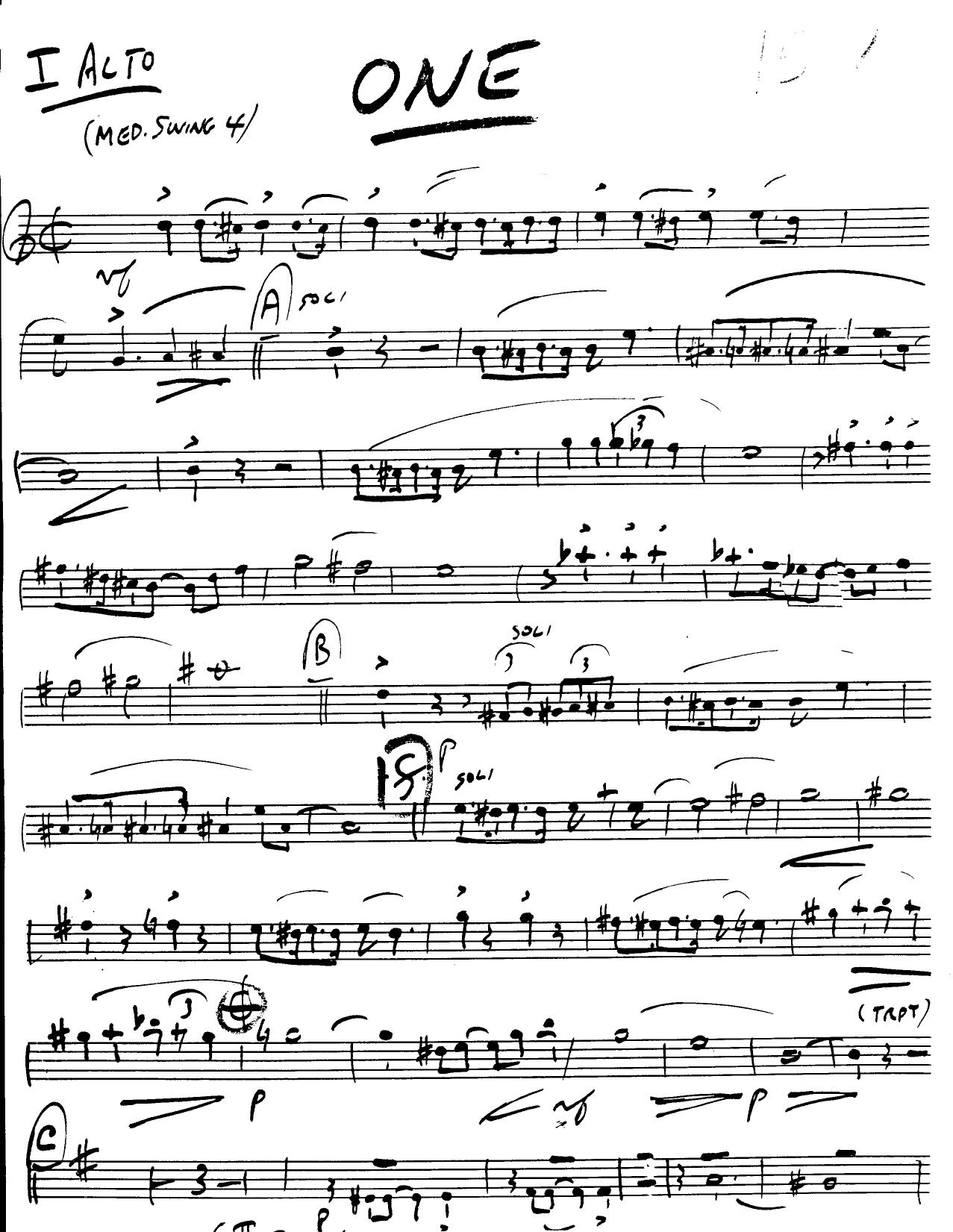
One (E.Graff)
Composed by Marvin Hamlisch
Arranged by E.Graff
- Ensemble: Big Band
- Style: Jazz Standard
- Pages: 31
- Instruments (16): I Alto Saxophone, II Alto Saxophone, I Tenor Saxophone, 4th Tenor Saxophone, Baritone Saxophone, I Trumpet, II Trumpet, III Trumpet, 4th Trumpet, I Trombone, II Trombone, III Trombone, 4th Trombone, Bass, Guitar, Drums
- Difficulty: medium
- Content: Individual Parts
- Format: PDF Download (Instant)
- Price: $24.99
Marvin Hamlisch and Edward Kleban’s iconic anthem "One" from the 1975 landmark Broadway musical *A Chorus Line* occupies a unique space in American musical theater, having quickly transcended its theatrical origins to become a versatile vehicle for jazz interpretation. Originally conceived as a dazzling, brass-heavy finale celebrating unity, ambition, and the relentless drive of the ensemble, the composition features a masterclass in motivic development, building from a sparse, vamp-driven introduction into an unstoppable, syncopated tour de force. While firmly rooted in the Broadway tradition, the harmonic sophistication and driving rhythmic undercurrent of the original score make it a natural fit for contemporary big band arranging, allowing jazz writers to inject fresh harmonic colors and sophisticated swing concepts into a globally recognized melody. In this masterful setting by E.Graff, "One" is reimagined as a high-energy, contemporary jazz standard that balances accessible theatrical flair with sophisticated big band writing. The arrangement opens with an atmospheric, tension-building vamp before settling into a crisp, driving medium-up swing groove characterized by crisp articulation and dynamic interplay between the brass and reed sections. The mood shifts fluidly between sophisticated, understated cool and exuberant, full-ensemble power, evoking a sense of theatrical drama paired with authentic jazz grit. Graff’s harmonic vocabulary utilizes extended tertian structures, clever secondary dominants, and subtle modal colorations that freshen the familiar changes without losing the instantly recognizable melodic hook that audiences anticipate. Graff’s structural approach showcases a dynamic distribution of thematic material across the entire 16-instrument ensemble. The arrangement features lush, tightly voiced sax soli sections that highlight the rich blend of two altos, two tenors, and baritone saxophone, contrasted sharply by bright, punchy brass counterlines. Trumpets and trombones share the heavy lifting during explosive ensemble shout choruses, while carefully placed textural drops allow the rhythm section to drive the momentum forward with crisp syncopation. Solo opportunities are thoughtfully integrated into the chart, providing a featured soloist—ideally on tenor saxophone or trumpet—ample room to stretch over a harmonically engaging modal or blues-infused backdrop before the arrangement rockets toward its thrilling, high-octane climax. Advanced high school ensembles with strong section players, as well as collegiate and professional community big bands, will find this 31-page chart to be an exceptionally rewarding addition to their repertoire. The arrangement demands strong section unity, particularly in balancing dynamic swells and maintaining a locked-in rhythmic feel during the intricate ensemble figures. While the technical demands are well within the grasp of skilled student musicians, the sophisticated voicing and nuanced stylistic requirements offer plenty of depth to challenge professional-tier groups, making it a standout concert opener, closer, or festival chart. Conductors approaching E.Graff’s arrangement of "One" should establish a crisp, energized medium-up swing tempo from the downbeat, ensuring the rhythm section maintains an unwavering, driving pulse without rushing the forward momentum. The primary technical challenge lies in the precise execution of short, staccato articulation figures that punctuate the melody; horn players must use clean tongue attacks rather than heavy accents to preserve the buoyant feel. Pay close attention to dynamic contrast, particularly during the transition from the subdued developmental sections into the massive, open shout choruses. Saxophones should focus on a unified, warm tone during the soli passages, blending carefully with the lead alto, while the brass section must keep their cup and straight mutes—where applied—projected and balanced against the rhythm section. Rehearsal time should be prioritized on locking in the syncopated ensemble hits between the rhythm section and horns, ensuring every accented beat snaps cleanly together. Q: What instruments and parts are included in this big band arrangement? A: The 31-page package is scored for a standard 16-instrument big band instrumentation, featuring Alto Saxophone 1, Alto Saxophone 2, Tenor Saxophone 1, Tenor Saxophone 4 [Note: standard tenor parts implied], Baritone Saxophone, a full brass section of trumpets and trombones, and a complete rhythm section. Q: What is the difficulty level of this arrangement? A: This chart is best suited for advanced high school, collegiate, and professional community big bands. It requires strong section interplay, precise articulation, and comfort with extended jazz harmonies, though individual technical demands are accessible for proficient players. Q: How does this arrangement adapt the theatrical original into a jazz style? A: E.Graff takes Marvin Hamlisch’s iconic Broadway melody from *A Chorus Line* and reframes it within a contemporary jazz standard framework, injecting sophisticated extended harmonies, a driving swing groove, and dynamic ensemble shout choruses. Q: What makes E.Graff’s treatment unique compared to other versions of this tune? A: This arrangement stands out through its clever integration of lush sax soli sections, sophisticated reharmonizations that honor the original melody, and a masterfully paced build that transitions from atmospheric tension to explosive big band power. Q: What is the recommended performance tempo and duration for this piece? A: The arrangement is set in a driving medium-up swing feel, typically clocking in at around 3.5 to 4.5 minutes depending on the length of the improvised solo sections taken during the performance.
Questions and answers
- What is included in the One (E.Graff) PDF?
- The verified current file contains individual parts across 31 pages.
- How many instruments or parts are listed for One (E.Graff)?
- The verified instrumentation list contains 16 entries for this Big Band arrangement.
- Who is credited for One (E.Graff)?
- Composer: Marvin Hamlisch. Arranger: E.Graff.
- What difficulty is listed for One (E.Graff)?
- The verified difficulty level is medium.
- What style is listed for One (E.Graff)?
- The catalog lists the style as Jazz Standard.
- Can I preview One (E.Graff) before buying?
- Yes. The product page provides a preview generated from the current PDF file.
- How is One (E.Graff) delivered?
- After successful payment, the digital PDF is made available for download. The displayed price is $24.99.
Musicians Also Search For
One E.Graff PDF • One E.Graff sheet music • One arranged by E.Graff • E.Graff big band charts • E.Graff jazz arrangements PDF • One Marvin Hamlisch sheet music • One Marvin Hamlisch big band arrangements • Marvin Hamlisch big band charts • One big band arrangements • One big band PDF download • One jazz sheet music • big band sheet music download • One individual parts download • One sheet music PDF • One Jazz Standard charts • Jazz Standard big band arrangements • buy One sheet music • download One PDF • One jazz charts • best E.Graff big band arrangements • Marvin Hamlisch arranged by E.Graff • One printable sheet music • big band repertoire PDF