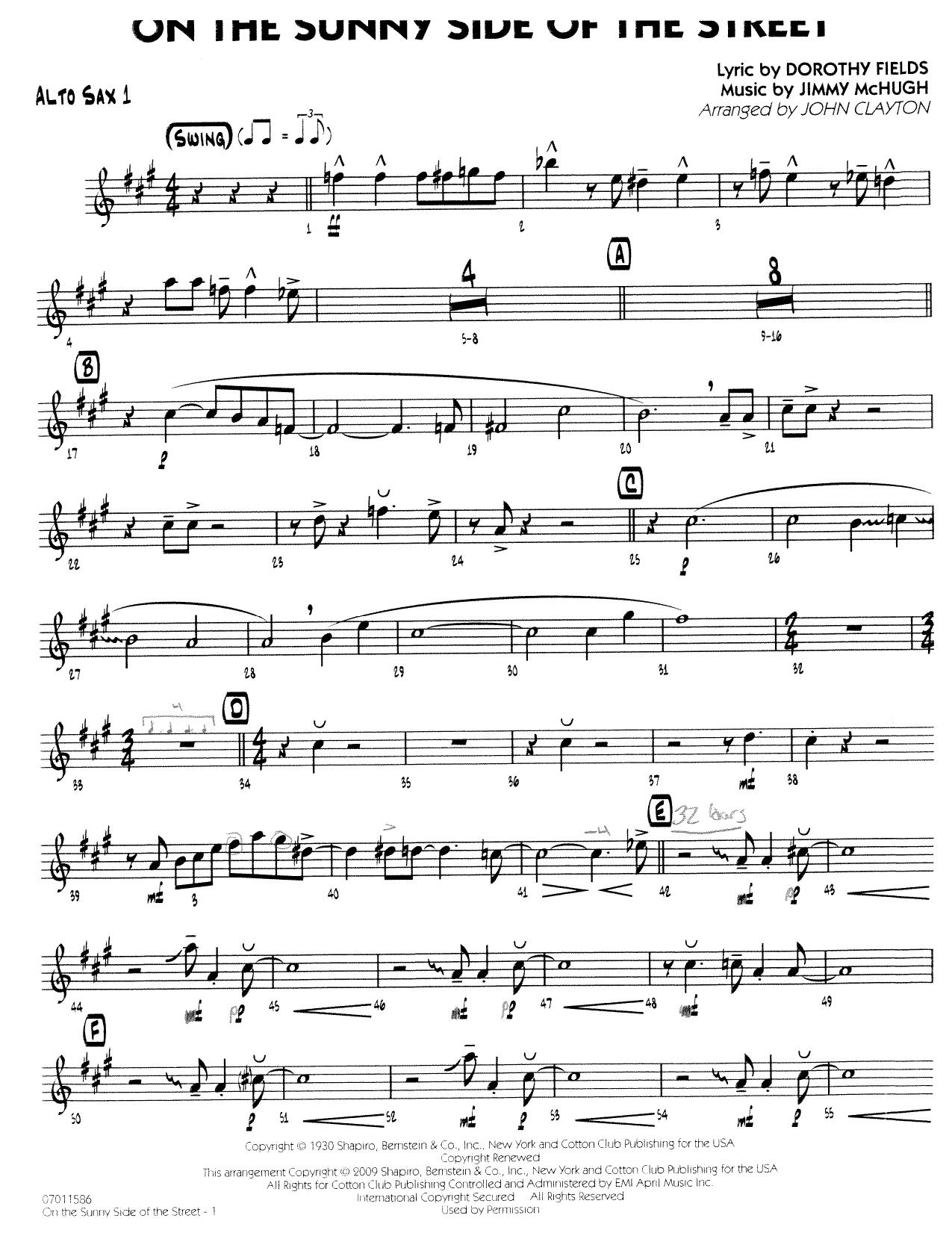
On The Sunny Side Of The Street (J.Clayton)
Composed by Jimmy McHugh
Arranged by John Clayton
- Ensemble: Big Band
- Pages: 42
- Instruments (18): Alto Sax 1, Alto Sax 2, Tenor Sax 1, Tenor Sax 2, Baritone Sax, Trumpet 1, Trumpet 2, Trumpet 3, Trumpet 4, Trumpet 5, Trombone 1, Trombone 2, Trombone 3, Trombone 4, Guitar, Piano, Bass, Drums
- Difficulty: medium
- Content: Individual Parts
- Format: PDF Download (Instant)
- Price: $24.99
Jimmy McHugh and Dorothy Fields penned "On the Sunny Side of the Street" in 1930 for the Broadway musical *Lew Leslie's International Revue*, cementing its status as one of the most enduring and uplifting anthems of the Great Depression era. Initially popularized by luminaries like Louis Armstrong, Ted Lewis, and later Count Basie and Dizzy Gillespie, the tune radiates unbridled optimism and swing-era buoyancy. As a quintessential jazz standard, its deceptively simple, 32-bar structure (AABA) offers a flexible canvas for harmonic exploration, making it a staple of the American Songbook that invites both joyous collective swing and sophisticated improvisation. Master bassist, composer, and arranger John Clayton brings his signature elegance, structural ingenuity, and deep-rooted Count Basie-inspired sensibilities to this definitive big band chart. Unfolding at a brisk, infectious medium-swing tempo, Clayton’s arrangement balances sophisticated, contemporary harmonic extensions with an infectious, foot-tapping groove. The mood shifts effortlessly from sultry, muted understatedness to explosive, high-energy shout choruses. Clayton utilizes rich, lush brass voicings and intricate saxophone solis that respect the traditional swing idiom while injecting modern harmonic sophistication, characterized by clever chromatic voice-leading and rich dominant alterations. The arrangement opens with a clever, engaging intro that sets up a relaxed yet driving pocket for the rhythm section. The melody is introduced with subtle interplay between the brass and reed sections before giving way to expansive, beautifully crafted soli sections that showcase the entire ensemble's section work and articulation precision. Featured solo space allows designated horn players to stretch out over standard changes, supported by a rhythm section part that demands an authoritative, driving swing feel (especially from the bass and drums). The climax of the chart features a meticulously crafted shout chorus that builds inexorably in dynamics and rhythmic complexity, driving the ensemble to a thrilling, high-spirited final cadence. Advanced high school ensembles, collegiate jazz orchestras, and professional big bands will find this 18-instrument chart an immensely rewarding centerpiece for a concert program or festival performance. While the technical demands require disciplined section playing, clean articulation, and a mature sense of swing phrasing rather than purely blinding speed, the payoff is a guaranteed audience favorite. Navigating Clayton's sophisticated scoring teaches students and seasoned players alike the value of dynamic contrast, transparent textures, and swing-era stylistic authenticity. Success with John Clayton’s chart hinges entirely on the rhythm section establishing a rock-solid, relaxed medium-swing feel from the downbeat. Avoid rushing the tempo; the groove must breathe to let the swinging eighth-note subdivisions feel natural and effortless. Brass players should master the art of dynamic control, utilizing cup and bucket mutes where indicated to create warm, intimate textures that contrast sharply with the open-horn powerhouse sections. Pay meticulous attention to articulation markings—short accents must be crisp and dry, while legato lines require smooth, connected air support. During the saxophone soli, the section must blend as a single voice, matching vibrato width and release lengths precisely. Rehearsal should prioritize sectional balance first, ensuring that background figures never obscure the primary melodic voice. Encourage soloists to build their statements organically, referencing the lyrical phrasing of the melody before expanding into advanced harmonic territory. Q: What instrumentation and parts are included in this arrangement? A: Scored for a standard 18-piece big band instrumentation, the package includes full scores and parts for 2 alto saxophones, 2 tenor saxophones, baritone saxophone, 4 trumpets, 3 trombones, bass trombone, guitar, piano, bass, and drums (plus optional auxiliary percussion). Q: What is the difficulty level of this John Clayton chart? A: This arrangement is graded as advanced (Level 4–5), making it best suited for accomplished high school jazz ensembles, university bands, and professional groups with strong section-playing capabilities and experienced soloists. Q: What is the historical and stylistic context of this piece? A: Based on Jimmy McHugh's 1930 standard, this arrangement reimagines the classic through a modern swing lens, heavily influenced by the swinging, dynamic arranging traditions of the Count Basie Orchestra and John Clayton's own contemporary big band aesthetic. Q: What makes this specific arrangement unique compared to other big band versions? A: Clayton’s chart stands out due to its sophisticated harmonic reharmonizations, clever dynamic contrast, brilliant use of counter-melodies, and a masterfully constructed shout chorus that elevates a familiar vocal standard into a thrilling instrumental tour de force. Q: What is the performance duration and tempo for this arrangement? A: The arrangement runs approximately 4 to 5 minutes in duration and is set at a vibrant medium-swing tempo designed to keep both the band and the audience thoroughly engaged.
Questions and answers
- What is included in the On The Sunny Side Of The Street (J.Clayton) PDF?
- The verified current file contains individual parts across 42 pages.
- How many instruments or parts are listed for On The Sunny Side Of The Street (J.Clayton)?
- The verified instrumentation list contains 18 entries for this Big Band arrangement.
- Who is credited for On The Sunny Side Of The Street (J.Clayton)?
- Composer: Jimmy McHugh. Arranger: John Clayton.
- What difficulty is listed for On The Sunny Side Of The Street (J.Clayton)?
- The verified difficulty level is medium.
- Can I preview On The Sunny Side Of The Street (J.Clayton) before buying?
- Yes. The product page provides a preview generated from the current PDF file.
- How is On The Sunny Side Of The Street (J.Clayton) delivered?
- After successful payment, the digital PDF is made available for download. The displayed price is $24.99.
Musicians Also Search For
On The Sunny Side Of The Street John Clayton PDF • On The Sunny Side Of The Street John Clayton sheet music • On The Sunny Side Of The Street arranged by John Clayton • John Clayton big band charts • John Clayton jazz arrangements PDF • On The Sunny Side Of The Street Jimmy McHugh sheet music • On The Sunny Side Of The Street Jimmy McHugh big band arrangements • Jimmy McHugh big band charts • On The Sunny Side Of The Street big band arrangements • On The Sunny Side Of The Street big band PDF download • On The Sunny Side Of The Street jazz sheet music • big band sheet music download • On The Sunny Side Of The Street individual parts download • On The Sunny Side Of The Street sheet music PDF • buy On The Sunny Side Of The Street sheet music • download On The Sunny Side Of The Street PDF • On The Sunny Side Of The Street jazz charts • best John Clayton big band arrangements • Jimmy McHugh arranged by John Clayton • On The Sunny Side Of The Street printable sheet music • big band repertoire PDF