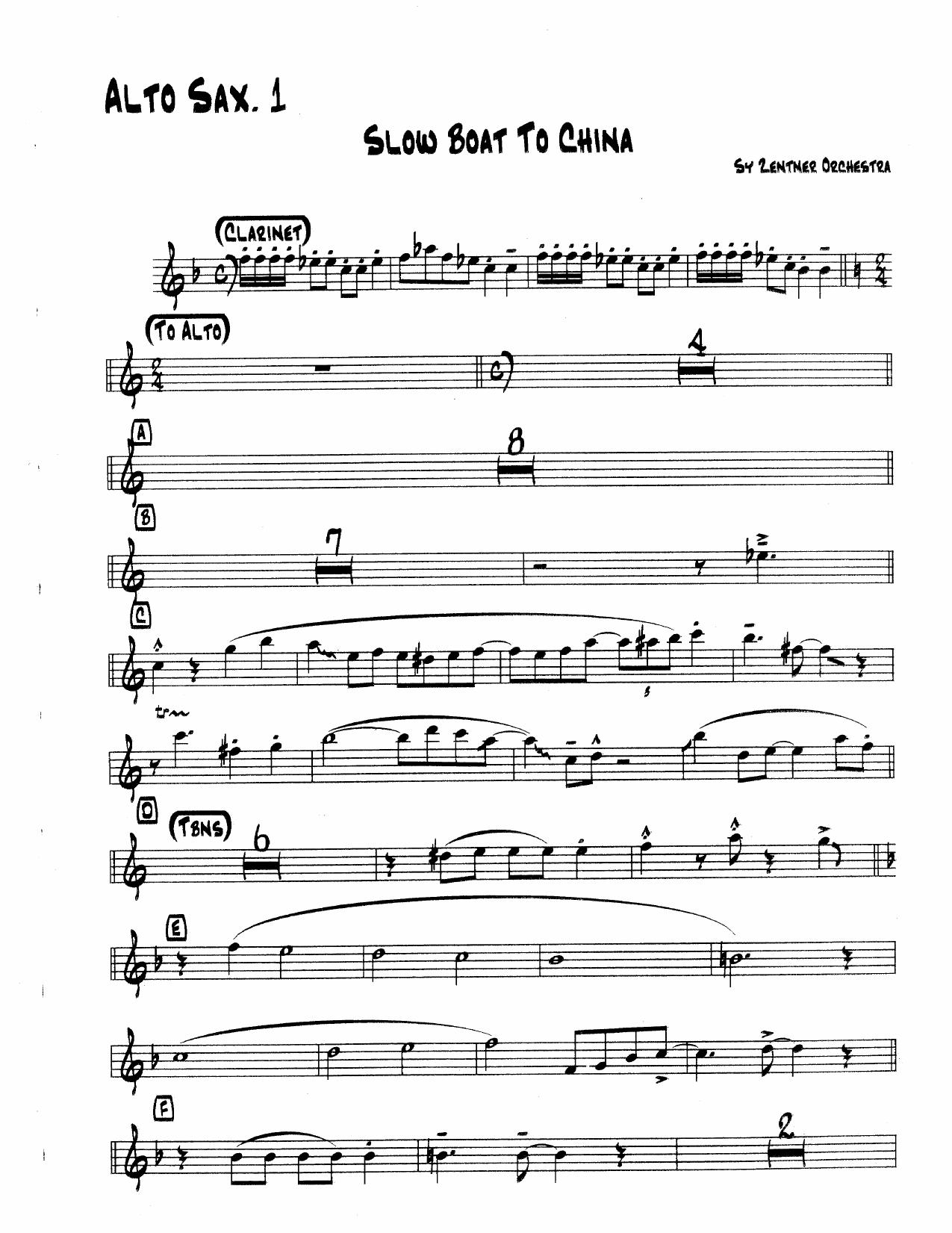
On A Slow Boat To China (S.Zentner) sheet music preview

On A Slow Boat To China (S.Zentner)

Composed by Frank Loesser

Arranged by Sy Zentner

  • Ensemble: Big Band
  • Style: Jazz Standard
  • Pages: 53
  • Instruments (16): Alto Sax. 1, Alto Sax. 2, Tenor Sax. 1, Tenor Sax. 2, Baritone Sax., Trumpet in Bb 1, Trumpet in Bb 2, Trumpet in Bb 3, Trumpet in Bb 4, Trombone 1, Trombone 2, Trombone 3, Trombone 4, Bass, Drum Set, Piano & Guitar
  • Difficulty: advanced
  • Content: Individual Parts
  • Format: PDF Download (Instant)
  • Price: $24.99

Frank Loesser penned the Tin Pan Alley classic "On a Slow Boat to China" in 1947, quickly establishing the whimsical, romantic standard as a favorite vehicle for jazz interpreters navigating the late swing and early bebop transition. While numerous vocalists and small groups embraced its infectious, travel-themed optimism, the tune found a formidable, brass-driven second life in the hands of big band leader and trombonist Sy Zentner. During the early 1960s, Zentner’s orchestra became synonymous with a lush, dynamically charged West Coast big band sound that married swinging propulsion with sophisticated, cinematic voicings. This arrangement captures that exact ethos, filtering a beloved popular song through the sophisticated lens of a master arranger who understood how to balance brute-force brass power with feather-light reed textures. Zentner’s chart operates on a buoyant, driving medium-swing groove that maintains an effortless forward momentum without ever rushing the relaxed cadence implied by the title. The harmonic language expands tastefully upon Loesser’s original changes, incorporating rich secondary dominants and passing chords that give the saxophones and brass ample room to weave dense, West Coast-inspired counterlines. The mood shifts fluidly between breezy, playful exposition and high-octane ensemble power. Zentner avoids a monotonous dynamic plateau; instead, he builds tension incrementally through clever rhythmic displacement, crisp section solis, and dynamic drops that showcase the ensemble's internal balance and articulation precision. Throughout the chart, the melody is traded inventively between sections, giving both the woodwinds and the brass a chance to carry the thematic weight before opening up for featured solo space. The rhythm section functions as the engine room, requiring a steady, buoyant walking bassline and crisp ride-cymbal definition to anchor the horn sections' syncopated punches. Technical challenges lie primarily in maintaining a lightweight, articulated swing eighth-note feel during faster transitional passages and executing the precise breath control required for Zentner's soaring brass climaxes. The arrangement rewards mature ensembles with a brilliant, crowd-pleasing shout chorus that builds organically to a brassy, high-register peak before resolving with a signature, understated punch. Advanced high school ensembles with strong section leaders, collegiate jazz orchestras, and professional big bands will find this chart an ideal centerpiece for a festival program or concert set. Because it demands refined dynamic control, precise intonation in the upper-register brass, and an authentic, relaxed medium-swing pocket, it serves as an exceptional pedagogical tool for teaching West Coast style big band dynamics. Musicians and audiences alike will appreciate how this chart transforms a familiar standard into a masterclass of swinging orchestration and sophisticated arranging craft. The primary technical challenge in mastering this Sy Zentner chart lies in maintaining a relaxed, driving medium-swing feel without letting the tempo drag or push. Conductors should emphasize a weightless eighth-note interpretation, avoiding overly heavy accents on the downbeats while keeping the backbeats crisp and clean. Section leaders must police intonation closely during the dense, harmonically rich soli sections, particularly when the saxophones and muted brass interlock in tight clusters. Pay careful attention to dynamic markings: the contrast between the hushed, sub-tone saxophone passages and the explosive ensemble shout choruses is what gives this arrangement its characteristic cinematic tension. Brass players should approach high-register passages with a focused, centered tone rather than forced volume, ensuring the chords blend rather than blast. The rhythm section needs a locked-in, understated groove; the drummer should utilize a feather bass drum technique and crisp hi-hat on beats two and four to keep the swing feel transparent and nimble. Q: What instruments and parts are included in this arrangement? A: This complete 17-instrument big band arrangement includes parts for two alto saxophones, two tenor saxophones, baritone saxophone, four trumpets, four trombones, piano, guitar, bass, drums, and a comprehensive 53-page conductor score. Q: What is the difficulty level of this arrangement? A: This chart is graded as advanced, making it best suited for college jazz orchestras, professional big bands, and top-tier high school ensembles with strong lead players and experienced section leaders. Q: What is the historical style and background of this chart? A: Written by Frank Loesser in 1947, the tune is arranged here in the distinctive West Coast swing style popularized by trombonist and bandleader Sy Zentner during the early 1960s. Q: What makes this specific arrangement unique? A: It stands out through Zentner’s signature blend of lush, cinematic harmonies, clever dynamic contrast, and a sophisticated approach to standard Tin Pan Alley changes that balances relaxed swing with brilliant brass power. Q: What is the typical performance tempo and duration? A: The arrangement is designed for a comfortable, driving medium-swing tempo (approximately quarter note = 120-126 BPM) and runs for roughly 3 to 4 minutes depending on solo extensions.

Questions and answers

What is included in the On A Slow Boat To China (S.Zentner) PDF?
The verified current file contains a conductor score and individual parts across 53 pages.
How many instruments or parts are listed for On A Slow Boat To China (S.Zentner)?
The verified instrumentation list contains 16 entries for this Big Band arrangement.
Who is credited for On A Slow Boat To China (S.Zentner)?
Composer: Frank Loesser. Arranger: Sy Zentner.
What difficulty is listed for On A Slow Boat To China (S.Zentner)?
The verified difficulty level is advanced.
What style is listed for On A Slow Boat To China (S.Zentner)?
The catalog lists the style as Jazz Standard.
Can I preview On A Slow Boat To China (S.Zentner) before buying?
Yes. The product page provides a preview generated from the current PDF file.
How is On A Slow Boat To China (S.Zentner) delivered?
After successful payment, the digital PDF is made available for download. The displayed price is $24.99.

Musicians Also Search For

On A Slow Boat To China Sy Zentner PDFOn A Slow Boat To China Sy Zentner sheet musicOn A Slow Boat To China arranged by Sy ZentnerSy Zentner big band chartsSy Zentner jazz arrangements PDFOn A Slow Boat To China Frank Loesser sheet musicOn A Slow Boat To China Frank Loesser big band arrangementsFrank Loesser big band chartsOn A Slow Boat To China big band arrangementsOn A Slow Boat To China big band PDF downloadOn A Slow Boat To China jazz sheet musicbig band sheet music downloadOn A Slow Boat To China conductor score PDFOn A Slow Boat To China individual parts downloadOn A Slow Boat To China sheet music PDFOn A Slow Boat To China Jazz Standard chartsJazz Standard big band arrangementsbuy On A Slow Boat To China sheet musicdownload On A Slow Boat To China PDFOn A Slow Boat To China jazz chartsbest Sy Zentner big band arrangementsFrank Loesser arranged by Sy ZentnerOn A Slow Boat To China printable sheet musicbig band repertoire PDF

All arrangements by Sy Zentner All Frank Loesser sheet music