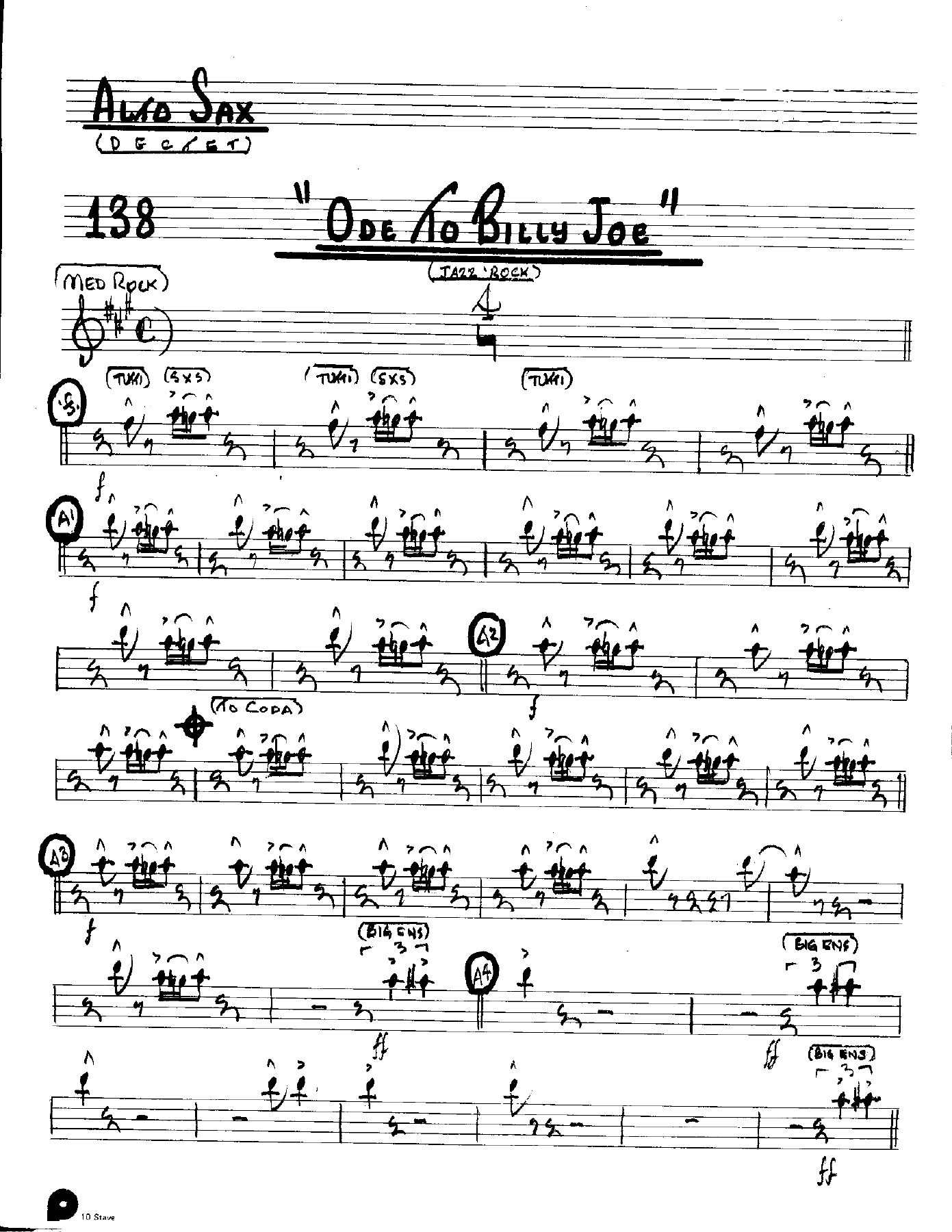
Ode To Billy Joe (Kenton Dectet #138)
Composed by Bobbie Gentry
Arranged by Stan Kenton Dected 176
- Ensemble: Small Ensemble
- Style: Jazz Standard
- Pages: 26
- Instruments (9): Alto Sax, Tenor Sax, Baritone Sax, Trumpet 1, Trumpet 2, Trombone, Piano, Bass, Drums
- Difficulty: easy
- Content: Individual Parts
- Format: PDF Download (Instant)
- Price: $12.99
Bobbie Gentry's enigmatic narrative ballad, "Ode to Billie Joe," first captivated audiences in 1967, quickly ascending to the top of the charts and becoming a cultural phenomenon. Its haunting melody and mysterious lyrics, hinting at a tragic secret on the Tallahatchie Bridge, transcended its country-folk origins to become a widely interpreted standard across various genres. While not traditionally a jazz standard from its inception, its compelling storytelling and harmonic depth have made it a fertile ground for jazz interpretation, drawing in artists who appreciate its evocative mood and potential for sophisticated reharmonization. This particular arrangement, "Ode To Billy Joe (Kenton Dectet #138)," reimagines Gentry's classic through the sophisticated lens of the Stan Kenton Dectet 176, offering a unique and compelling jazz interpretation. The musical character of this arrangement leans into a sophisticated, medium-slow swing feel, often bordering on a relaxed 4/4 ballad tempo, allowing ample space for harmonic exploration and nuanced phrasing. The primary key hovers around a comfortable concert F minor, though it navigates through various tonal centers with characteristic Kenton-esque harmonic ingenuity. The mood is introspective and melancholic, yet imbued with a subtle, underlying tension that mirrors the narrative's unresolved mystery. Listeners will experience a blend of lush, close voicings and moments of sparse, poignant melodicism, evoking a sense of wistful reflection. The energy is controlled and sophisticated, relying on harmonic color and dynamic contrast rather than overt power. Stan Kenton Dectet 176's approach to "Ode To Billy Joe" is unmistakably distinctive, showcasing the ensemble's renowned ability to infuse popular melodies with advanced jazz pedagogy. The arrangement features intricate, often dense voicings that are a hallmark of the Kenton sound, utilizing extended harmonies (9ths, 11ths, 13ths) and subtle dissonances to create a rich sonic tapestry. The melody is artfully distributed, initially carried by a solo trumpet with a warm, open tone, then transitioning to a saxophone soli section that weaves the theme through a labyrinth of counterpoint. There are no traditional shout choruses, but rather carefully constructed ensemble passages that build dynamic and harmonic intensity. A featured tenor saxophone solo provides a moment for improvisation, grounded in the arrangement's sophisticated harmonic progression. The technical challenges lie in maintaining precise intonation within the close voicings, executing nuanced dynamics, and navigating the rhythmic subtleties of the medium-slow swing feel. The reward, however, is a deeply expressive and harmonically rich performance that elevates the original material. This arrangement is ideally suited for college-level jazz ensembles, advanced community big bands, or professional small ensembles seeking a challenging yet profoundly rewarding piece. Its sophisticated harmonic language and intricate voicings demand a high level of musicianship and a mature understanding of jazz idiom. High school bands with exceptionally strong sight-reading and improvisational skills might approach it, but it truly shines with players who can articulate complex harmonies and maintain a cohesive ensemble sound through nuanced dynamics. The arrangement offers a unique opportunity to explore a well-known tune from a fresh, intellectually stimulating jazz perspective, providing both musical challenge and artistic satisfaction. Conductors should emphasize the importance of precise intonation, particularly within the close-voiced ensemble sections, as slight deviations can significantly impact the arrangement's rich harmonic tapestry. The medium-slow swing feel requires a relaxed, yet propulsive rhythmic foundation; avoid rushing the tempo, allowing the harmonic colors to unfold naturally. A starting tempo of quarter note = 88-96 BPM is recommended, but flexibility to explore a slightly slower, more reflective pace is encouraged. Dynamic contrasts are crucial; guide the ensemble to articulate the subtle swells and decays, especially in the sustained chords. There are no special techniques like plunger mutes or falls explicitly notated, but tasteful, expressive vibrato and nuanced phrasing from all instrumentalists will enhance the overall mood. Rehearsal time should be dedicated to isolating and balancing the inner voices of the voicings, ensuring clarity and blend, particularly in the saxophone soli and brass ensemble passages. The tenor saxophone soloist should be encouraged to explore the harmonic implications of the changes rather than relying on standard blues scales, embracing the sophisticated Kenton aesthetic. Q: What instruments and parts are included in the "Ode To Billy Joe (Kenton Dectet #138)" arrangement? A: This arrangement includes parts for a standard jazz dectet: Trumpet, Trombone, Alto Saxophone, Tenor Saxophone, Baritone Saxophone, Piano, Bass, Drums, and Guitar. Q: What is the difficulty level of this arrangement? A: This arrangement is considered advanced, best suited for college-level jazz ensembles, advanced community bands, or professional small groups due to its intricate voicings, harmonic complexity, and demands for precise intonation and nuanced dynamics. Q: What is the musical style and historical context of this arrangement? A: This arrangement is a jazz interpretation of Bobbie Gentry's 1967 country-folk hit "Ode to Billie Joe," reimagined in the sophisticated, harmonically rich style characteristic of the Stan Kenton Dectet 176. Q: What makes this particular arrangement unique compared to other versions of "Ode to Billie Joe"? A: This arrangement stands out for its distinctive Stan Kenton Dectet 176 voicings, sophisticated harmonic reinterpretation, and its transformation of the original narrative ballad into a medium-slow swing jazz piece with a featured tenor saxophone solo and intricate ensemble passages. Q: What is the approximate performance duration and recommended tempo for this piece? A: The approximate performance duration is around 4-5 minutes, depending on the soloist's improvisation. The recommended tempo is a medium-slow swing, ideally between quarter note = 88-96 BPM.
Questions and answers
- What is included in the Ode To Billy Joe (Kenton Dectet #138) PDF?
- The verified current file contains individual parts across 26 pages.
- How many instruments or parts are listed for Ode To Billy Joe (Kenton Dectet #138)?
- The verified instrumentation list contains 9 entries for this Small Ensemble arrangement.
- Who is credited for Ode To Billy Joe (Kenton Dectet #138)?
- Composer: Bobbie Gentry. Arranger: Stan Kenton Dected 176.
- What difficulty is listed for Ode To Billy Joe (Kenton Dectet #138)?
- The verified difficulty level is easy.
- What style is listed for Ode To Billy Joe (Kenton Dectet #138)?
- The catalog lists the style as Jazz Standard.
- Can I preview Ode To Billy Joe (Kenton Dectet #138) before buying?
- Yes. The product page provides a preview generated from the current PDF file.
- How is Ode To Billy Joe (Kenton Dectet #138) delivered?
- After successful payment, the digital PDF is made available for download. The displayed price is $12.99.
Musicians Also Search For
Ode To Billy Joe Stan Kenton Dected 176 PDF • Ode To Billy Joe Stan Kenton Dected 176 sheet music • Ode To Billy Joe arranged by Stan Kenton Dected 176 • Stan Kenton Dected 176 small ensemble charts • Stan Kenton Dected 176 jazz arrangements PDF • Ode To Billy Joe Bobbie Gentry sheet music • Ode To Billy Joe Bobbie Gentry small ensemble arrangements • Bobbie Gentry small ensemble charts • Ode To Billy Joe small ensemble arrangements • Ode To Billy Joe small ensemble PDF download • Ode To Billy Joe jazz sheet music • small ensemble sheet music download • Ode To Billy Joe individual parts download • Ode To Billy Joe sheet music PDF • Ode To Billy Joe Jazz Standard charts • Jazz Standard small ensemble arrangements • buy Ode To Billy Joe sheet music • download Ode To Billy Joe PDF • Ode To Billy Joe jazz charts • best Stan Kenton Dected 176 small ensemble arrangements • Bobbie Gentry arranged by Stan Kenton Dected 176 • Ode To Billy Joe printable sheet music • small ensemble repertoire PDF