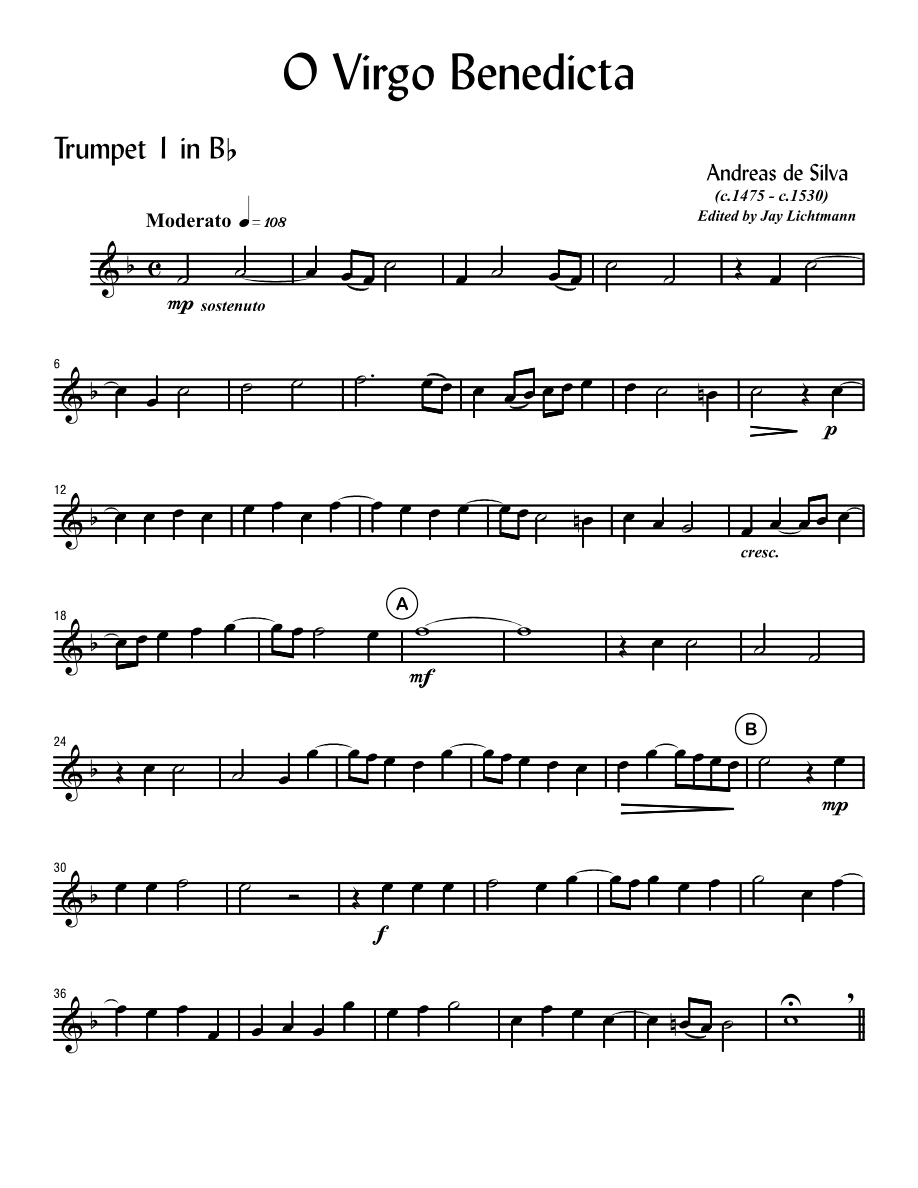
O Virgo Benedicta (J.Lichtmann) sheet music preview

O Virgo Benedicta (J.Lichtmann)

Composed by Andreas de Silva

Arranged by Jay Lichtmann

  • Ensemble: Small Ensemble
  • Style: Jazz Standard
  • Pages: 8
  • Difficulty: easy
  • Content: Sheet Music
  • Format: PDF Download (Instant)
  • Price: $12.99

"O Virgo Benedicta," originally composed by Andreas de Silva, transports listeners from its 16th-century Renaissance origins into a vibrant contemporary jazz idiom through Jay Lichtmann's masterful small ensemble arrangement. Andreas de Silva, a prolific composer active between approximately 1510 and 1530, was a significant figure in the transition from the late 15th-century Netherlandish style to the more modern schools of thought in the early 16th century. His sacred motets and masses were highly regarded, with some of his works even parodied by later luminaries like Palestrina. While the original "O Virgo Benedicta" is a contemplative motet for voices or instruments, steeped in the rich polyphonic traditions of its era, Lichtmann reimagines this historical work, bringing its inherent beauty and melodic grace into the dynamic world of jazz. This arrangement is not a jazz standard in the conventional sense of a piece originating in the jazz repertoire, but rather a standard of Renaissance sacred music recontextualized through a jazz lens, offering a unique bridge between eras. Jay Lichtmann's distinctive arranging style shines through in this small ensemble treatment, transforming the Renaissance motet into a medium swing chart. The arrangement maintains a sophisticated, reverent mood, yet it pulses with an understated energy, driven by a classic jazz rhythm section. Lichtmann, known for his meticulous attention to detail and deep understanding of both classical and jazz idioms, employs rich, extended harmonies that breathe new life into de Silva's melodic lines. His voicings are characteristically lush, often featuring close-knit harmonies that create a warm, inviting texture. While the original work is polyphonic, Lichtmann skillfully translates this into a layered jazz texture, where individual lines emerge and recede, contributing to a cohesive yet intricate soundscape. The key chosen for this arrangement allows for both instrumental comfort and a bright, yet mellow, sonic palette, evoking a sense of reflective joy. The arrangement unfolds with the melody primarily carried by the lead voices, often weaving through different instruments to highlight their unique timbres. Soli sections are thoughtfully integrated, showcasing the ensemble's blend and precision, while maintaining the lyrical integrity of de Silva's original composition. Lichtmann avoids a traditional "shout chorus" in favor of a more nuanced build-up of texture and intensity, culminating in moments of harmonic richness rather than overt power. Featured solo sections are strategically placed, offering improvisational opportunities that encourage melodic development rooted in the piece's harmonic framework, rather than simply showcasing technical prowess. The technical challenges lie in maintaining the precise rhythmic feel of the medium swing, executing the nuanced dynamics, and navigating the extended jazz harmonies with clarity and musicality. Performing this piece is rewarding for its unique blend of historical reverence and contemporary jazz expression, allowing musicians to explore a rich musical narrative that spans centuries. This arrangement is ideally suited for college-level jazz ensembles, advanced community big bands, or professional small groups seeking a sophisticated and distinctive addition to their repertoire. Its blend of historical depth and jazz interpretation demands musicians with a solid grasp of jazz theory, improvisation, and ensemble playing. The arrangement provides an excellent educational opportunity to explore harmonic reinterpretation and stylistic transformation, making it particularly valuable for academic settings. Its moderate difficulty level, coupled with its profound musicality, ensures that it is both challenging and highly gratifying to perform, offering a truly unique concert experience for both performers and audiences. Conductors should emphasize a relaxed, yet precise, medium swing feel throughout the arrangement, avoiding any tendency to rush or drag the tempo. The suggested tempo marking is around 120-132 BPM. Special attention should be paid to the articulation, which should be light and legato in the melodic lines, contrasting with crisp, defined accents in rhythmic figures. The extended harmonies are crucial to Lichtmann's interpretation; therefore, intonation must be meticulously rehearsed, particularly in the close voicings. Rehearsal should focus on balancing the ensemble to allow the intricate inner voices to be heard without overpowering the melodic lead. There are no specific extended techniques like plunger mutes or falls required, allowing the ensemble to focus on pure tone and blend. Encourage soloists to approach their improvisations melodically, drawing inspiration from de Silva's original thematic material and Lichtmann's harmonic re-imagining, rather than relying solely on blues-based vocabulary. Q: What instruments/parts are included in this arrangement? A: This small ensemble arrangement typically includes parts for a lead instrument (e.g., trumpet, alto saxophone), a harmony instrument (e.g., trombone, tenor saxophone), and a standard jazz rhythm section (piano, bass, drums). Specific instrumentation may vary slightly but will be clearly indicated. Q: What is the difficulty level of "O Virgo Benedicta (J.Lichtmann)"? A: This arrangement is rated as moderately difficult, suitable for college-level jazz ensembles, advanced community bands, or professional small groups. It requires a solid understanding of jazz harmony, rhythmic precision, and ensemble balance. Q: What is the musical style and historical context of this arrangement? A: This arrangement reimagines Andreas de Silva's 16th-century Renaissance motet "O Virgo Benedicta" as a jazz piece, specifically in a medium swing style. It blends the historical reverence of the original with contemporary jazz harmonies and rhythms. Q: What makes Jay Lichtmann's arrangement of "O Virgo Benedicta" unique? A: Lichtmann's arrangement is unique for its skillful transformation of a Renaissance sacred motet into a sophisticated jazz small ensemble piece. It features lush, extended harmonies, nuanced voicings, and a reverent yet energetic medium swing feel, offering a distinctive blend of historical and contemporary styles. Q: What is the approximate performance duration or tempo for this piece? A: The arrangement is designed for a medium swing tempo, typically around 120-132 beats per minute. The total performance duration will depend on the length of improvised solos, but generally falls within the 4-6 minute range.

Musicians Also Search For

O Virgo Benedicta Jay Lichtmann PDFO Virgo Benedicta Jay Lichtmann sheet musicO Virgo Benedicta arranged by Jay LichtmannJay Lichtmann small ensemble chartsJay Lichtmann jazz arrangements PDFO Virgo Benedicta Andreas de Silva sheet musicO Virgo Benedicta Andreas de Silva small ensemble arrangementAndreas de Silva small ensemble chartsO Virgo Benedicta small ensemble arrangementO Virgo Benedicta small ensemble PDF downloadO Virgo Benedicta jazz ensemble sheet musicsmall ensemble sheet music instant downloadO Virgo Benedicta sheet music with partsO Virgo Benedicta Jazz Standard chartJazz Standard small ensemble arrangementsbuy O Virgo Benedicta sheet music onlinedownload O Virgo Benedicta PDFO Virgo Benedicta jazz chartbest Jay Lichtmann small ensemble arrangementsAndreas de Silva songs arranged by Jay LichtmannO Virgo Benedicta printable sheet musicsmall ensemble repertoire PDF

All arrangements by Jay Lichtmann All Andreas de Silva sheet music