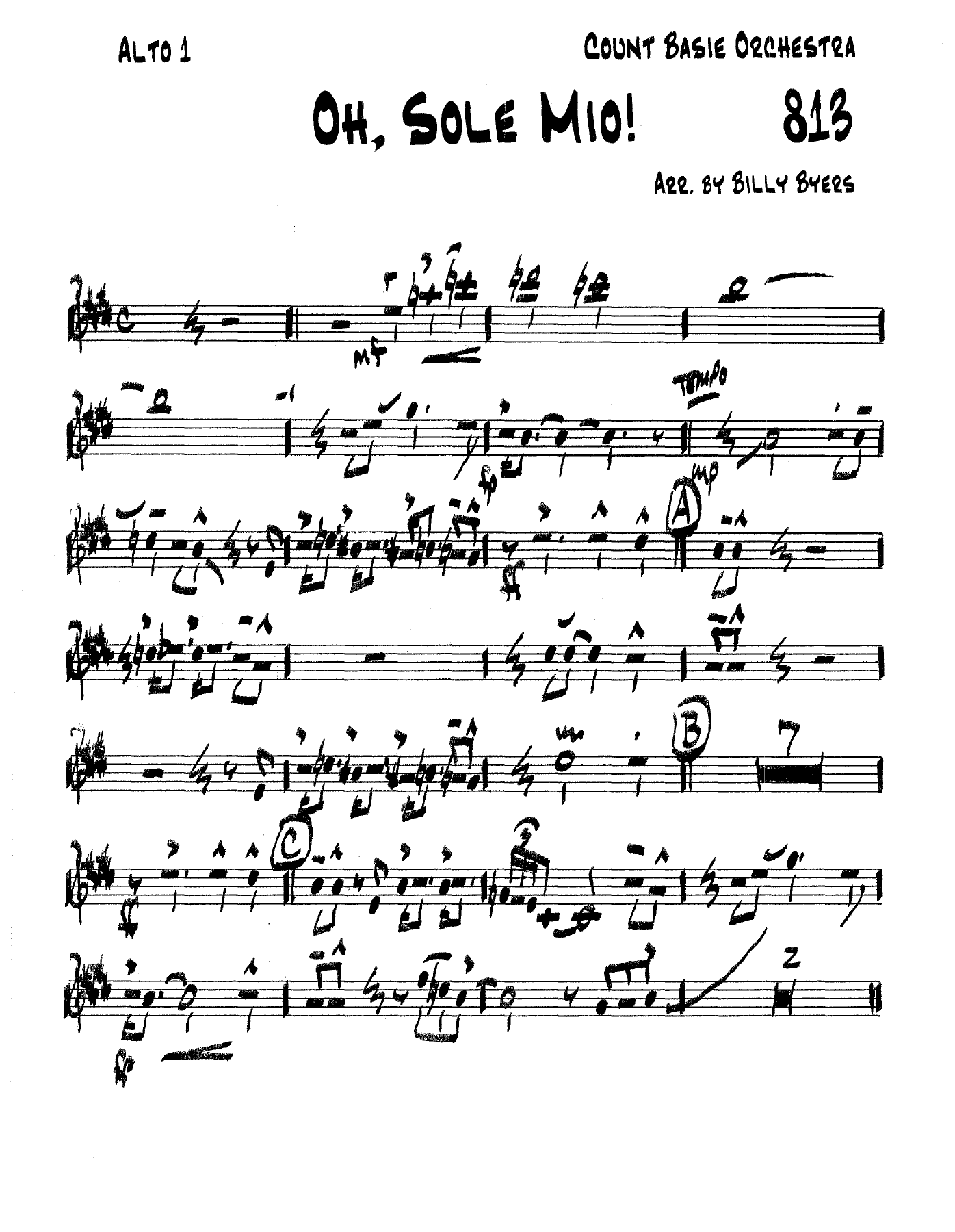
O Sole Mio (B.Byers) sheet music preview

O Sole Mio (B.Byers)

Composed by Eduardo di Capua

Arranged by Billy Byers

  • Ensemble: Big Band
  • Style: Jazz Standard
  • Pages: 51
  • Instruments (17): Alto Saxophone 1, Alto Saxophone 2, Tenor Saxophone 1, Tenor Saxophone 2, Baritone Saxophone, Trumpet 1, Trumpet 2, Trumpet 3, Trumpet 4, Trombone 1, Trombone 2, Trombone 3, Bass Trombone, Piano, Guitar, Bass, Drums
  • Difficulty: advanced
  • Content: Individual Parts
  • Format: PDF Download (Instant)
  • Price: $24.99

"O Sole Mio," originally composed by Eduardo di Capua in 1898, stands as one of the most iconic Neapolitan songs, embodying the romantic spirit and sun-drenched landscapes of Southern Italy. While deeply rooted in Italian classical and folk traditions, its enduring melody and universal appeal have transcended genres, leading to countless interpretations across popular music, opera, and even rock and roll. Elvis Presley's "It's Now or Never" famously adapted its tune, showcasing its incredible versatility. In the jazz idiom, "O Sole Mio" has been embraced as a standard not through a single definitive jazz recording, but through its melodic strength and harmonic adaptability, inviting creative reharmonization and rhythmic transformation by countless improvisers and arrangers. Billy Byers's rendition for big band transforms this beloved classic into a sophisticated jazz vehicle, demonstrating how a traditional melody can be reimagined with contemporary jazz sensibilities while retaining its inherent charm. Billy Byers, a master orchestrator known for his work with Count Basie, Neal Hefti, and many others, brings his distinctive touch to "O Sole Mio" with an arrangement that is both elegant and exhilarating. This big band chart is conceived as a medium-swing exploration, typically performed in a bright, yet relaxed 4/4 feel, often in the key of F major or a closely related key, allowing for rich brass and saxophone voicings. Byers's signature is evident in the lush, often harmonically adventurous voicings, particularly in the saxophone soli sections, which feature intricate counterpoint and close-knit harmonies that demand precision from the ensemble. The arrangement builds through dynamic contrasts, moving from a lyrical initial statement to more powerful, brass-driven shout choruses, all underpinned by a driving rhythm section. The emotional arc is one of joyful exuberance, capturing the song's inherent optimism through a jazz lens. The arrangement opens with a captivating statement of the melody, often shared between the lead alto saxophone and muted trumpets, establishing a warm and inviting atmosphere. Featured solo opportunities are strategically placed, typically for tenor saxophone and/or trumpet, allowing skilled improvisers to explore the familiar harmonic progression with creative freedom. These solo sections are often supported by subtle, yet engaging, ensemble figures that provide harmonic depth without overshadowing the soloist. Technical challenges include navigating Byers's often dense and chromatic voicings, particularly in the saxophones, and maintaining precise articulation and balance across the full 17-piece ensemble. The brass sections will need strong lead players and excellent blend for the powerful shout sections. The rewarding aspect lies in the sheer joy of performing such a beautifully crafted chart, experiencing the interplay of sections, and presenting a familiar melody in a fresh, sophisticated jazz context. This arrangement is ideally suited for advanced high school, college, community, and professional big bands looking to add a unique and engaging piece to their repertoire that showcases both technical prowess and musicality. Conductors should emphasize a consistent, relaxed medium-swing feel from the outset, ensuring the rhythm section lays down a solid, unhurried groove. Key technical challenges include the precise execution of Billy Byers's characteristic close voicings, particularly within the saxophone soli passages; meticulous attention to intonation and balance is paramount here. Brass players should focus on clean attacks and releases, especially in the punchy shout choruses, and be prepared for dynamic contrasts. Muted trumpet passages, often requiring cup or straight mutes, demand careful control of tone and projection. Rehearsal time should be dedicated to dissecting the intricate rhythmic figures and harmonic subtleties, ensuring all sections articulate with uniformity. Encourage soloists to embrace the melodic beauty of the original tune while exploring modern jazz improvisation techniques. Q: What instruments are included in this arrangement? A: This big band arrangement of "O Sole Mio (B.Byers)" is scored for 17 instruments, typically including Alto Saxophone 1 & 2, Tenor Saxophone 1 & 2, Baritone Saxophone, Trumpet 1-4, Trombone 1-4, Piano, Bass, and Drums. Q: What is the difficulty level of this arrangement? A: This arrangement is considered advanced, suitable for experienced high school, college, community, or professional big bands. It demands strong technical proficiency, excellent ensemble blend, and a solid understanding of jazz articulation and phrasing. Q: What is the musical style and historical context of this arrangement? A: This is a medium-swing jazz big band arrangement of the classic Neapolitan song "O Sole Mio," originally composed in 1898. Billy Byers transforms the traditional melody into a sophisticated jazz standard, showcasing his mastery of orchestration and harmonic ingenuity. Q: What makes this particular arrangement unique compared to other versions of "O Sole Mio"? A: Billy Byers's arrangement is unique for its sophisticated medium-swing jazz treatment, featuring his signature lush voicings, intricate saxophone soli sections, powerful brass shout choruses, and well-crafted solo opportunities, all while maintaining the melodic integrity of the original. Q: What is the typical performance duration and tempo for this piece? A: The typical performance duration for this arrangement is approximately 4-5 minutes, depending on the length of improvised solos. It is designed to be performed at a medium-swing tempo, generally around 120-144 beats per minute.

Questions and answers

What is included in the O Sole Mio (B.Byers) PDF?
The verified current file contains individual parts across 51 pages.
How many instruments or parts are listed for O Sole Mio (B.Byers)?
The verified instrumentation list contains 17 entries for this Big Band arrangement.
Who is credited for O Sole Mio (B.Byers)?
Composer: Eduardo di Capua. Arranger: Billy Byers.
What difficulty is listed for O Sole Mio (B.Byers)?
The verified difficulty level is advanced.
What style is listed for O Sole Mio (B.Byers)?
The catalog lists the style as Jazz Standard.
Can I preview O Sole Mio (B.Byers) before buying?
Yes. The product page provides a preview generated from the current PDF file.
How is O Sole Mio (B.Byers) delivered?
After successful payment, the digital PDF is made available for download. The displayed price is $24.99.

Musicians Also Search For

O Sole Mio Billy Byers PDFO Sole Mio Billy Byers sheet musicO Sole Mio arranged by Billy ByersBilly Byers big band chartsBilly Byers jazz arrangements PDFO Sole Mio Eduardo di Capua sheet musicO Sole Mio Eduardo di Capua big band arrangementsEduardo di Capua big band chartsO Sole Mio big band arrangementsO Sole Mio big band PDF downloadO Sole Mio jazz sheet musicbig band sheet music downloadO Sole Mio individual parts downloadO Sole Mio sheet music PDFO Sole Mio Jazz Standard chartsJazz Standard big band arrangementsbuy O Sole Mio sheet musicdownload O Sole Mio PDFO Sole Mio jazz chartsbest Billy Byers big band arrangementsEduardo di Capua arranged by Billy ByersO Sole Mio printable sheet musicbig band repertoire PDF

All arrangements by Billy Byers All Eduardo di Capua sheet music