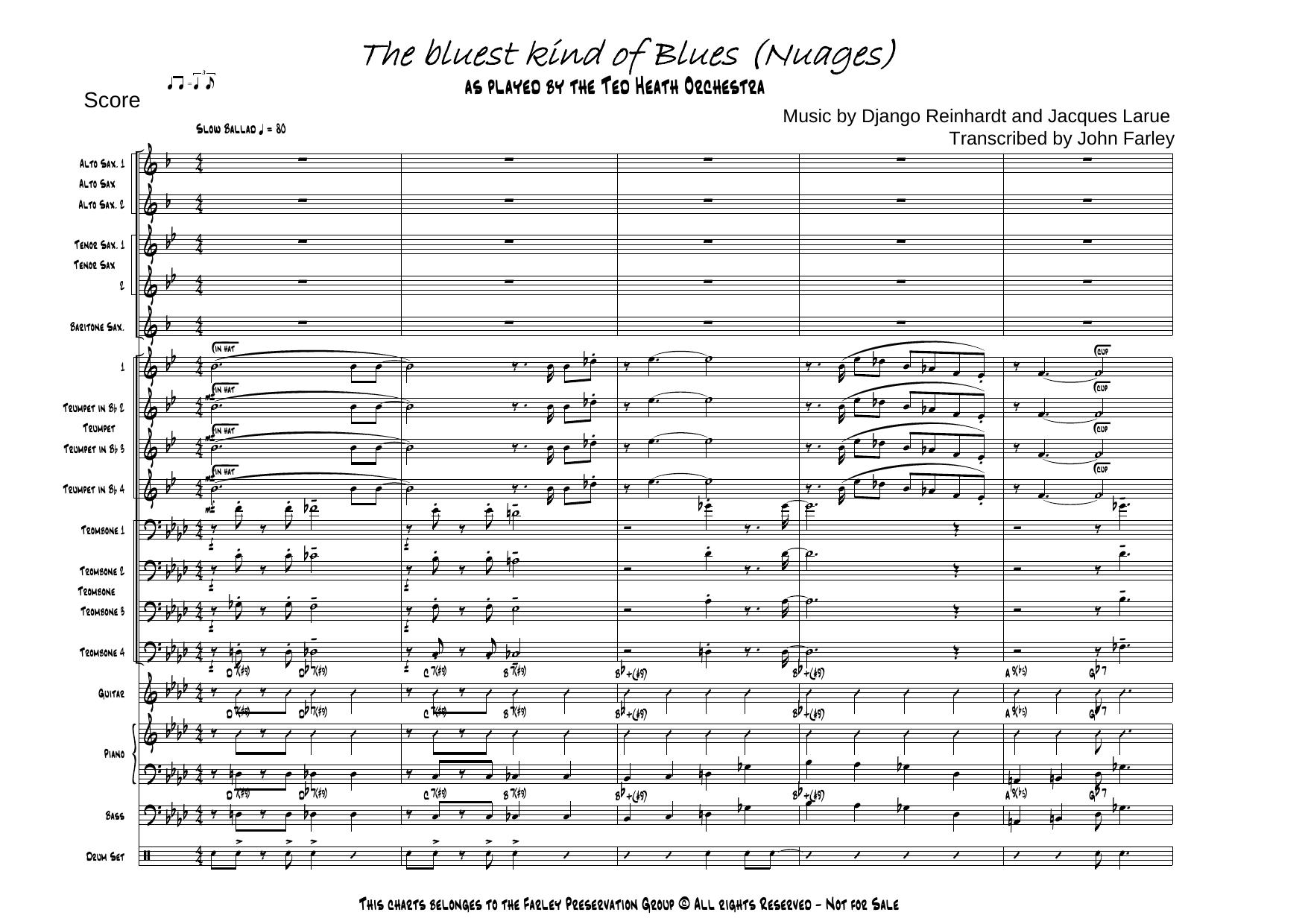
Nuages (J.Farley)
Composed by Django Reinhardt
Arranged by John Farley
- Ensemble: Big Band
- Pages: 51
- Instruments (17): Alto Saxophone 1, Alto Saxophone 2, Tenor Saxophone 1, Tenor Saxophone 2, Baritone Saxophone, Trumpet 1, Trumpet 2, Trumpet 3, Trumpet 4, Trombone 1, Trombone 2, Trombone 3, Trombone 4, Guitar, Piano, Bass, Drum Set
- Difficulty: advanced
- Content: Individual Parts
- Format: PDF Download (Instant)
- Price: $24.99
Django Reinhardt’s immortal 1940 composition "Nuages" stands as the quintessential masterpiece of Gypsy jazz, capturing the melancholic beauty, impressionistic harmony, and romantic yearning of pre-war Paris. Originally recorded by the Quintette du Hot Club de France with violinist Stéphane Grappelli, the tune translates the floating, ethereal quality of drifting clouds into a cascading sequence of suspended chords and descending chromatic lines. Over the decades, it has evolved from a Parisian caf anthem into a global jazz standard, interpreted by vocalists and instrumentalists across every stylistic spectrum. Its enduring appeal lies in its sophisticated yet deeply accessible melodic contour, which bridges the gap between traditional swing-era nostalgia and early modal sophistication. John Farley’s sophisticated big band interpretation reimagines Reinhardt’s intimate guitar-and-violin masterpiece into a lush, dynamic canvas for a 9-piece ensemble. Set in a relaxed, flowing medium-swing feel (approx. quarter note = 112), the arrangement opens with a misty, harmonically rich introduction that establishes the nocturnal, impressionistic mood before settling into a warm two-beat groove. Farley masterfully balances transparent, wind-ensemble-style voicings in the saxophones (Alto, Tenor, Baritone) with muted brass textures in the trumpet and trombone, creating a transparent acoustic space that honors the chamber-jazz origins of the tune while delivering the rich acoustic weight of a jazz orchestra. The melodic narrative unfolds through carefully sculpted soli sections where the saxophones weave intricate counterpoint beneath the lead trumpet, evoking the iconic interplay of Reinhardt and Grappelli. As the chart progresses through its 51 pages of meticulously engraved parts, it builds toward a tasteful, yearning shout chorus that expands the harmonic vocabulary with extended dominant colors and subtle chord substitutions without ever disrupting the melancholic tranquility of the source material. Featured solo space allows a mature improviser to stretch out over changes that demand a delicate touch, favoring lyrical phrasing and motivic development over rapid-fire execution. Advanced high school ensembles with strong section players, as well as collegiate and professional chamber jazz groups, will find this arrangement an exceptional vehicle for developing ensemble blend, intonation, and stylistic nuance. Because the chart relies heavily on dynamic control, rubato pacing within the head, and sensitive time-keeping rather than brute volume, it serves as a masterclass in ensemble listening. Directors seeking a sophisticated change-of-pace ballad or concert centerpiece that highlights nuance, historical reverence, and harmonic beauty will discover an immensely rewarding addition to their library. Balancing transparency and warmth is the primary challenge in performing this 9-piece setting of "Nuages." Conductors must insist on absolute rhythmic precision during the rubato intro before locking into an unhurried, relaxed medium swing. The rhythm section should anchor the groove with a light, pulsing two-beat feel that avoids heavy downbeat hammering on the bass; the drummer should utilize brushed snare patterns that mimic the acoustic sweep of gypsy jazz rhythm guitars. Horn players must prioritize a smooth, connected legato phrasing, avoiding harsh articulations on the descending scalar passages. Pay close attention to internal balance within the saxophone soli; the baritone sax provides a crucial anchor for the low-register harmonic roots, while the alto and tenor voice-leading requires careful ear-training to blend cleanly. Dynamic shading is paramount—never let the ensemble push past a comfortable mezzo-forte during the climax, preserving the introspective, nocturnal atmosphere that defines Reinhardt’s original conception. Q: What specific instruments and parts are included in this 9-instrument arrangement? A: The arrangement is scored for a 9-piece ensemble featuring a three-piece saxophone section (Alto Saxophone, Tenor Saxophone, Baritone Saxophone), Trumpet, Trombone, and a standard four-piece rhythm section (Piano, Guitar, Bass, Drums), complete with full conductor score and individual parts across its 51 pages. Q: What is the official difficulty level of John Farley’s arrangement of "Nuages"? A: This chart is graded as advanced-intermediate to advanced, primarily due to the demands for precise intonation, blend, sophisticated harmonic awareness, and mature stylistic phrasing rather than extreme technical velocity. Q: What is the historical background and musical style of this piece? A: Based on Django Reinhardt’s legendary 1940 Gypsy jazz standard, this arrangement translates the intimate, impressionistic Parisian swing style into a modern chamber big band context while preserving its melancholy character. Q: What makes John Farley’s arrangement unique compared to other big band versions? A: Farley scales down the traditional big band footprint to a nimble 9-instrument format, utilizing transparent impressionistic voicings, clever counterpoint, and subtle harmonic expansions that evoke the original Quintette du Hot Club de France aesthetic. Q: What is the recommended performance duration and tempo for this arrangement? A: The arrangement is typically performed at a relaxed medium-swing tempo of around 112 beats per minute, resulting in a total performance duration of approximately 4 to 5 minutes depending on solo choruses.
Questions and answers
- What is included in the Nuages (J.Farley) PDF?
- The verified current file contains a conductor score and individual parts across 51 pages.
- How many instruments or parts are listed for Nuages (J.Farley)?
- The verified instrumentation list contains 17 entries for this Big Band arrangement.
- Who is credited for Nuages (J.Farley)?
- Composer: Django Reinhardt. Arranger: John Farley.
- What difficulty is listed for Nuages (J.Farley)?
- The verified difficulty level is advanced.
- Can I preview Nuages (J.Farley) before buying?
- Yes. The product page provides a preview generated from the current PDF file.
- How is Nuages (J.Farley) delivered?
- After successful payment, the digital PDF is made available for download. The displayed price is $24.99.
Musicians Also Search For
Nuages John Farley PDF • Nuages John Farley sheet music • Nuages arranged by John Farley • John Farley big band charts • John Farley jazz arrangements PDF • Nuages Django Reinhardt sheet music • Nuages Django Reinhardt big band arrangements • Django Reinhardt big band charts • Nuages big band arrangements • Nuages big band PDF download • Nuages jazz sheet music • big band sheet music download • Nuages conductor score PDF • Nuages individual parts download • Nuages sheet music PDF • buy Nuages sheet music • download Nuages PDF • Nuages jazz charts • best John Farley big band arrangements • Django Reinhardt arranged by John Farley • Nuages printable sheet music • big band repertoire PDF