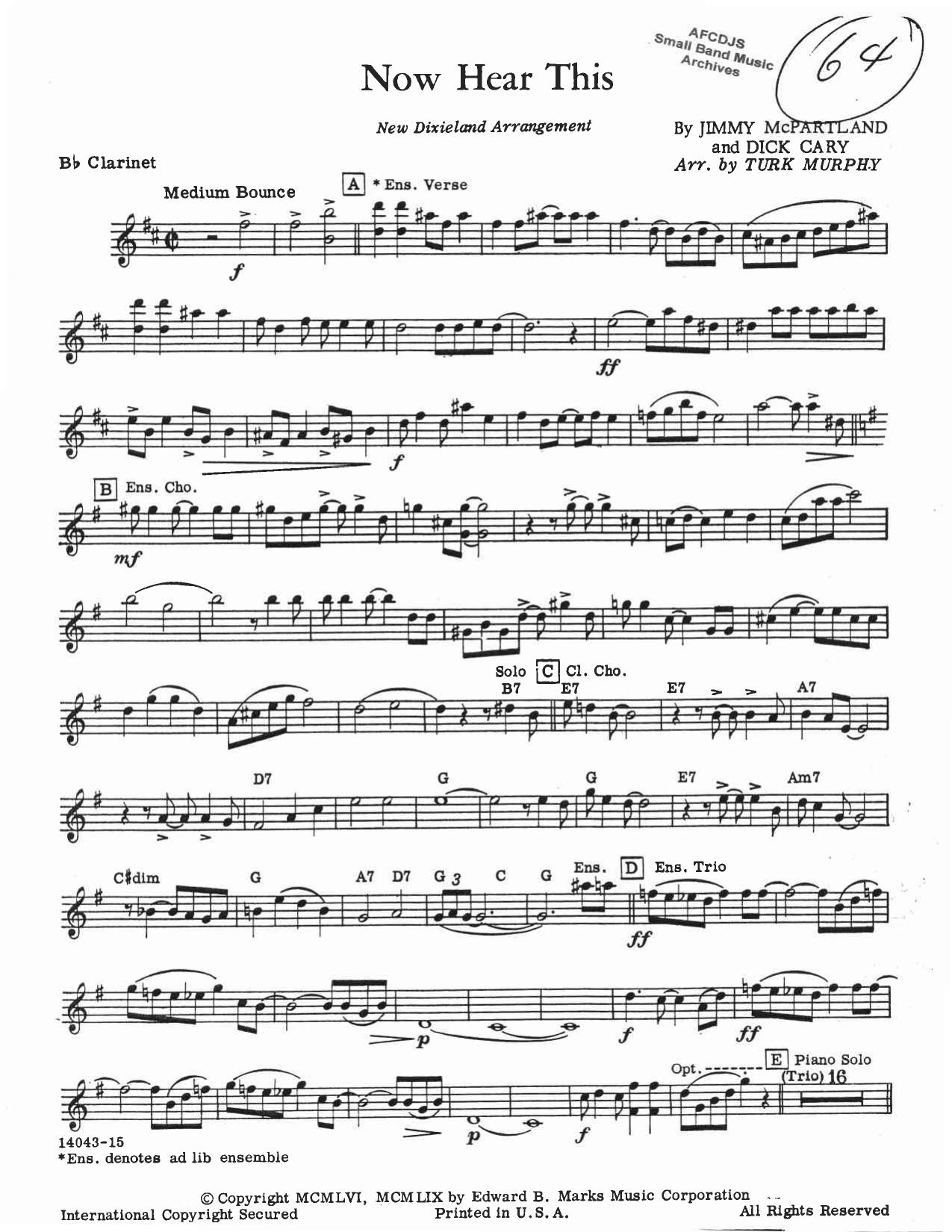
Now Hear This (T.Murphy)
Composed by Jimmy McPartland, Dick Cary
Arranged by Turk Murphy
- Ensemble: Small Ensemble
- Style: Jazz Standard
- Pages: 15
- Instruments (7): Bb Clarinet, Bb Trumpet, Trombone, Piano, Guitar or Banjo, Bass, Drums
- Difficulty: easy
- Content: Individual Parts
- Format: PDF Download (Instant)
- Price: $12.99
"Now Hear This" is an invigorating small ensemble arrangement by the legendary Turk Murphy, a pivotal figure in the West Coast Traditional Jazz revival. While the title "Now Hear This" has been used for various jazz recordings and compositions by artists such as Hal Galper and Bill Barron, this particular arrangement by Turk Murphy draws its inspiration from the vibrant, polyphonic traditions championed by original composers like Jimmy McPartland and Dick Cary, who were deeply embedded in the Dixieland and Traditional Jazz scenes. McPartland, a cornetist known for his Chicago-style jazz, and Cary, an arranger and multi-instrumentalist who worked extensively with figures like Louis Armstrong and Eddie Condon, contributed significantly to the repertoire and arranging techniques of this era. Murphy, who himself played with Lu Watters' Yerba Buena Jazz Band in the 1940s, was instrumental in defining what he termed "Traditional Jazz," distinguishing it from other styles by emphasizing its New Orleans roots and a strong ensemble focus. Musically, this arrangement captures the exhilarating spirit of a medium-up tempo Traditional Jazz piece. Expect a bright, driving 4/4 swing feel, characteristic of the San Francisco style that Murphy helped to forge. The mood is unequivocally joyful and energetic, designed to evoke the lively atmosphere of a 1920s or 30s jazz hall. The piece is likely set in a bright, accessible key, facilitating the characteristic brassiness and collective improvisation often associated with this genre. The energy is consistently high, propelled by a robust rhythm section and intertwining melodic lines from the front-line instruments. Turk Murphy's arranging approach is distinctive, prioritizing ensemble work over extended individual solos, a hallmark of the "San Francisco Style" that modeled itself on early New Orleans jazz. While individual voices shine, they do so within a tightly woven polyphonic texture. Expect rich, often surprising dynamics, building from softer passages to powerful, collective shout choruses. Murphy's charts are known for their deliberate, "swaggering" rhythm and a clear emphasis on the interplay between instruments, rather than showcasing virtuosic individual displays. This arrangement will feature intricate ensemble passages, potentially with a driving trumpet, a New Orleans-tinged clarinet, and a gruff trombone, all contributing to a unified sound. The rhythmic foundation often features a strong two-beat feel in the piano's left hand and tuba, while the banjo might accent the second and fourth beats, creating a unique rhythmic propulsion. Performing "Now Hear This" is immensely rewarding, offering musicians the chance to engage with a historically rich and musically vibrant style. The melody will likely be shared among the front-line instruments, with the cornet or trumpet often leading, followed by clarinet and trombone counter-melodies and obbligatos. While extended improvised solos may be brief or integrated into the ensemble texture, opportunities for collective improvisation and breaks will be present, requiring strong listening skills and stylistic authenticity. Technical challenges include maintaining rhythmic precision within the polyphonic texture, executing tight ensemble figures, and articulating the characteristic phrasing of Traditional Jazz. This arrangement is ideally suited for college-level ensembles, community jazz bands with experienced musicians, or professional small ensembles specializing in Traditional Jazz. Its authentic sound and engaging structure make it an excellent choice for groups looking to delve into the foundational elements of jazz history and performance. Conductors should emphasize the authentic "San Francisco Style" feel, characterized by a deliberate, yet driving, medium-up swing tempo. Aim for a tempo that allows for clarity in the polyphonic lines while maintaining a lively energy. A metronome marking around quarter note = 180-200 BPM would be a good starting point, but adjust to ensure the "swaggering" rhythm is felt, not rushed. Key technical challenges include maintaining precise rhythmic alignment within the collective improvisation sections and ensuring balanced voicings in the ensemble passages. Encourage musicians to listen across the section, particularly between the trumpet, clarinet, and trombone, to achieve the characteristic intertwining melodic lines. Brass players should explore a range of articulations, from crisp attacks to subtle falls and scoops, integral to the style. The rhythm section should focus on a strong, consistent two-beat feel from the bass/tuba on beats one and three, complemented by a banjo or guitar emphasizing beats two and four, creating a buoyant rhythmic foundation. Rehearsal time should be dedicated to sectional work on ensemble figures and then to full ensemble listening and blending, focusing on dynamic contrasts and the overall unified sound that Turk Murphy championed. **Q: What instruments are included in this small ensemble arrangement?** A: This arrangement is typically scored for a small ensemble, often including a front line of trumpet (or cornet), clarinet, and trombone, supported by a rhythm section consisting of piano, banjo or guitar, bass (or tuba), and drums. Specific parts may vary slightly but adhere to the classic Traditional Jazz instrumentation. **Q: What is the difficulty level of "Now Hear This (T.Murphy)"?** A: This arrangement is rated as Medium to Advanced, suitable for college-level ensembles, experienced community bands, or professional small groups. It requires proficiency in sight-reading, strong rhythmic interpretation, and an understanding of Traditional Jazz stylistic nuances. **Q: What is the musical style and historical context of this arrangement?** A: This arrangement is firmly rooted in the Traditional Jazz (often referred to as Dixieland or San Francisco Style) genre, drawing heavily from the New Orleans jazz traditions of the early 20th century. Turk Murphy was a key figure in preserving and popularizing this style, emphasizing collective improvisation and a robust ensemble sound. **Q: What makes Turk Murphy's treatment of "Now Hear This" unique?** A: Turk Murphy's arrangements are distinguished by their emphasis on polyphonic ensemble playing, dynamic contrasts, and a driving, "swaggering" rhythmic feel, often featuring a prominent two-beat rhythm section and intricate horn interplay over extended individual solos. **Q: What is the typical performance duration and tempo for this piece?** A: While exact duration can vary with interpretation, "Now Hear This" is generally performed at a medium-up to up-tempo swing, typically around 180-200 BPM. A performance usually lasts between 3 to 5 minutes, depending on the inclusion and length of any improvised sections or breaks.
Questions and answers
- What is included in the Now Hear This (T.Murphy) PDF?
- The verified current file contains individual parts across 15 pages.
- How many instruments or parts are listed for Now Hear This (T.Murphy)?
- The verified instrumentation list contains 7 entries for this Small Ensemble arrangement.
- Who is credited for Now Hear This (T.Murphy)?
- Composer: Jimmy McPartland, Dick Cary. Arranger: Turk Murphy.
- What difficulty is listed for Now Hear This (T.Murphy)?
- The verified difficulty level is easy.
- What style is listed for Now Hear This (T.Murphy)?
- The catalog lists the style as Jazz Standard.
- Can I preview Now Hear This (T.Murphy) before buying?
- Yes. The product page provides a preview generated from the current PDF file.
- How is Now Hear This (T.Murphy) delivered?
- After successful payment, the digital PDF is made available for download. The displayed price is $12.99.
Musicians Also Search For
Now Hear This Turk Murphy PDF • Now Hear This Turk Murphy sheet music • Now Hear This arranged by Turk Murphy • Turk Murphy small ensemble charts • Turk Murphy jazz arrangements PDF • Now Hear This Jimmy McPartland, Dick Cary sheet music • Now Hear This Jimmy McPartland, Dick Cary small ensemble arrangements • Jimmy McPartland, Dick Cary small ensemble charts • Now Hear This small ensemble arrangements • Now Hear This small ensemble PDF download • Now Hear This jazz sheet music • small ensemble sheet music download • Now Hear This individual parts download • Now Hear This sheet music PDF • Now Hear This Jazz Standard charts • Jazz Standard small ensemble arrangements • buy Now Hear This sheet music • download Now Hear This PDF • Now Hear This jazz charts • best Turk Murphy small ensemble arrangements • Jimmy McPartland, Dick Cary arranged by Turk Murphy • Now Hear This printable sheet music • small ensemble repertoire PDF