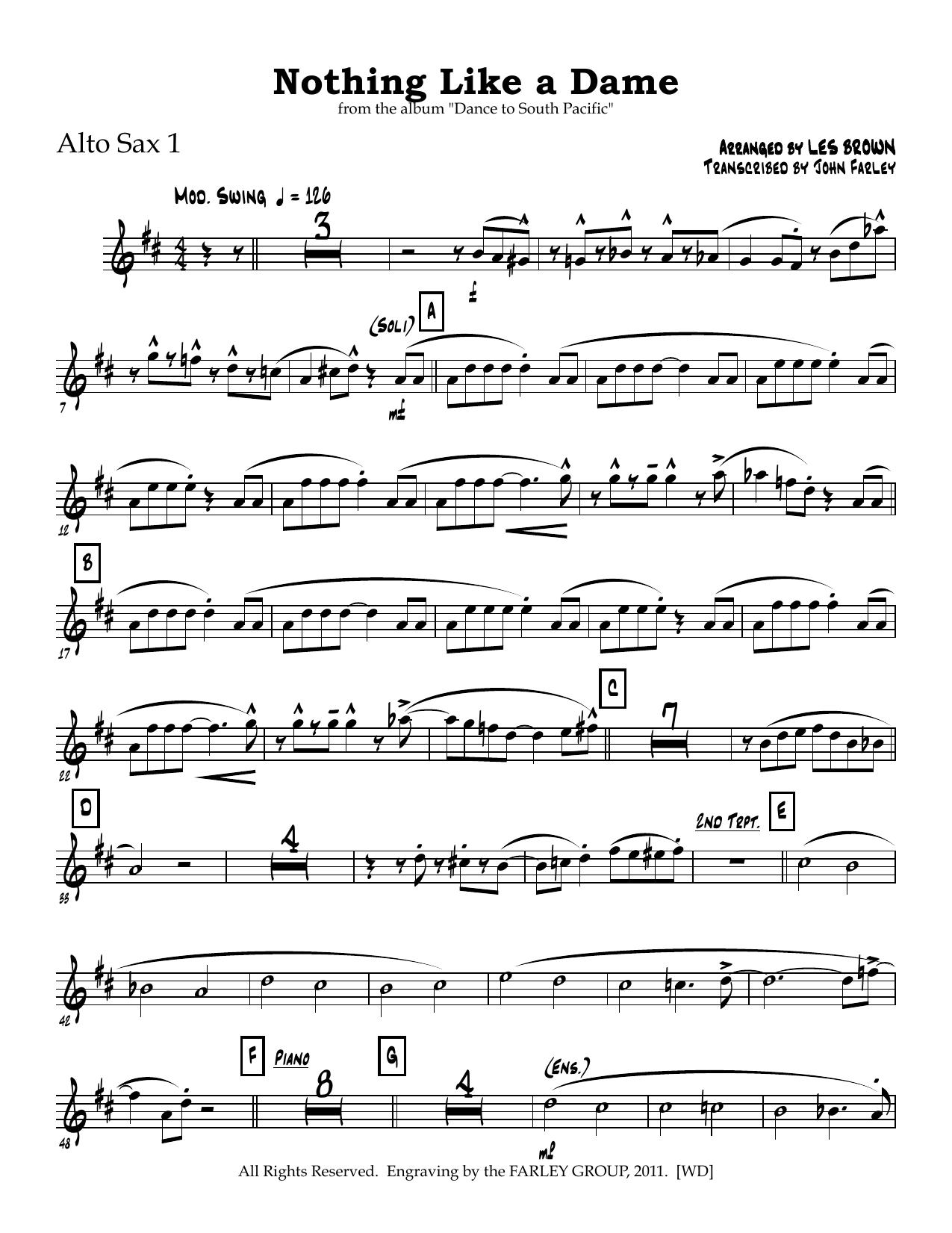
Nothing Like A Dame (J.Farley)
Composed by Richard Rodgers
Arranged by John Farley
- Ensemble: Big Band
- Pages: 51
- Instruments (17): Alto Sax 1, Alto Sax 2, Tenor Sax 1, Tenor Sax 2, Baritone, Trumpet 1, Trumpet 2, Trumpet 3, Trumpet 4, Trombone 1, Trombone 2, Trombone 3, Trombone 4, Guitar, Piano, Bass, Drums
- Difficulty: advanced
- Content: Individual Parts
- Format: PDF Download (Instant)
- Price: $24.99
Richard Rodgers and Oscar Hammerstein II originally introduced "There Is Nothin' Like a Dame" in their landmark 1949 Broadway masterpiece, *South Pacific*. While conceived as a buoyant, high-energy sailor's anthem celebrating camaraderie and the absence of women on a tropical island, the infectious melody and driving rhythmic architecture have long invited jazz interpretation. Over the decades, the tune's modal twists and expansive melodic leaps have transitioned from the theatrical stage into the broader jazz repertoire, serving as a fertile framework for creative big band arranging that bridges classic American musical theater with mid-century swinging bravura. John Farley’s sophisticated big band treatment reimagines the familiar Broadway standard as a high-octane, swinging tour de force set in a bright, driving medium-up tempo. The arrangement bursts with vibrant brass stabs, rich saxophone soli lines, and an irrepressible rhythmic momentum that evokes the golden era of Basie and Nelson Riddle while injecting contemporary harmonic color. The mood is celebratory, witty, and relentlessly energetic, driven by crisp swing subdivisions and snappy counterpoint. Farley expertly balances the inherent theatricality of the original composition with authentic jazz vernacular, utilizing extended dominant voicings and chromatic passing chords that elevate the harmonic sophistication without ever sacrificing the tune's innate charm and accessibility. Throughout the chart, instrumental responsibilities shift dynamically across the standard 17-piece big band instrumentation. The woodwind section, featuring dual altos, tenors, and baritone, frequently drives the thematic material with interlocking soli passages that demand crisp articulation and unified phrasing. The brass sections answer with potent, punchy counter-melodies and soaring background figures that build tension toward a thunderous, harmonically rich shout chorus. Featured solo space allows improvisers to stretch out over changes that cleverly reference the original verse structure while opening up for modern jazz exploration. Technical demands center on rhythmic precision, stamina across the brass registers, and the ability to maintain a relaxed, forward-driving swing feel at a brisk tempo. Advanced high school ensembles, collegiate jazz orchestras, and professional community big bands will find this arrangement an exceptionally rewarding centerpiece for concert programs or festival sets. The 51-page comprehensive package includes a meticulously marked conductor score and all necessary instrumental parts, ensuring seamless preparation. Its clever blend of nostalgic familiarity and fresh, inventive arranging makes it an instant crowd-pleaser that challenges the rhythm section, showcases section unity, and provides a thrilling showcase for a featured horn soloist. Conductors should approach John Farley’s arrangement with a strict focus on rhythmic crispness and dynamic contrast. The core tempo should sit comfortably around a bright swing feel (approx. quarter note = 180–192 BPM), ensuring the eighth notes remain fluid and never rushed. Key technical challenges include executing the fast-moving saxophone soli passages with uniform articulation and balancing the dense brass voicings during the climactic shout chorus. Trumpets should pay careful attention to stylistic consistency, utilizing controlled half-valve effects or subtle plunger work where indicated, while trombones must anchor the lower-mid register with warm, assertive intonation. Rehearsals should begin by isolating the rhythm section; the drummer must maintain a steady, unhurried ride cymbal pulse while trading crisp hi-hat comping on beats two and four to keep the heavy swing propulsion alive. Horn sections should practice their interplay slowly at first, locking in the syncopated accents before pushing up to performance tempo. Emphasize the dynamic peaks and valleys written into the score to let the comedic and dramatic elements of the arrangement truly shine. Q: What instruments and parts are included in this publication? A: The 51-page package contains a full conductor score and individual parts for a standard 17-instrument big band lineup: Alto Saxophone 1, Alto Saxophone 2, Tenor Saxophone 1, Tenor Saxophone 2, Baritone Saxophone, 4 Trumpets, 4 Trombones, Piano, Guitar, Bass, and Drums. Q: What is the difficulty level of this arrangement? A: This chart is graded as advanced (appropriate for upper-level high school, collegiate, and professional big bands), primarily due to the brisk tempo, intricate section solis, and sustained endurance required across the brass and woodwind sections. Q: What is the musical style and historical background of the piece? A: It is a dynamic jazz big band adaptation of the classic Richard Rodgers and Oscar Hammerstein II theater tune from the 1949 musical *South Pacific*, reimagined here in a swinging, high-energy contemporary big band style. Q: What makes John Farley’s arrangement unique compared to other versions? A: Farley brilliantly fuses Broadway theatricality with authentic mid-century jazz arranging techniques, featuring sophisticated extended harmonies, interlocking saxophone solis, and a towering shout chorus that revitalizes a familiar melody. Q: What is the recommended performance duration and tempo for this arrangement? A: The arrangement is designed as a bright, driving swing chart with a recommended tempo around quarter note = 180–192 BPM, resulting in a performance duration of approximately 4 to 5 minutes depending on open solo sections.
Questions and answers
- What is included in the Nothing Like A Dame (J.Farley) PDF?
- The verified current file contains a conductor score and individual parts across 51 pages.
- How many instruments or parts are listed for Nothing Like A Dame (J.Farley)?
- The verified instrumentation list contains 17 entries for this Big Band arrangement.
- Who is credited for Nothing Like A Dame (J.Farley)?
- Composer: Richard Rodgers. Arranger: John Farley.
- What difficulty is listed for Nothing Like A Dame (J.Farley)?
- The verified difficulty level is advanced.
- Can I preview Nothing Like A Dame (J.Farley) before buying?
- Yes. The product page provides a preview generated from the current PDF file.
- How is Nothing Like A Dame (J.Farley) delivered?
- After successful payment, the digital PDF is made available for download. The displayed price is $24.99.
Musicians Also Search For
Nothing Like A Dame John Farley PDF • Nothing Like A Dame John Farley sheet music • Nothing Like A Dame arranged by John Farley • John Farley big band charts • John Farley jazz arrangements PDF • Nothing Like A Dame Richard Rodgers sheet music • Nothing Like A Dame Richard Rodgers big band arrangements • Richard Rodgers big band charts • Nothing Like A Dame big band arrangements • Nothing Like A Dame big band PDF download • Nothing Like A Dame jazz sheet music • big band sheet music download • Nothing Like A Dame conductor score PDF • Nothing Like A Dame individual parts download • Nothing Like A Dame sheet music PDF • buy Nothing Like A Dame sheet music • download Nothing Like A Dame PDF • Nothing Like A Dame jazz charts • best John Farley big band arrangements • Richard Rodgers arranged by John Farley • Nothing Like A Dame printable sheet music • big band repertoire PDF