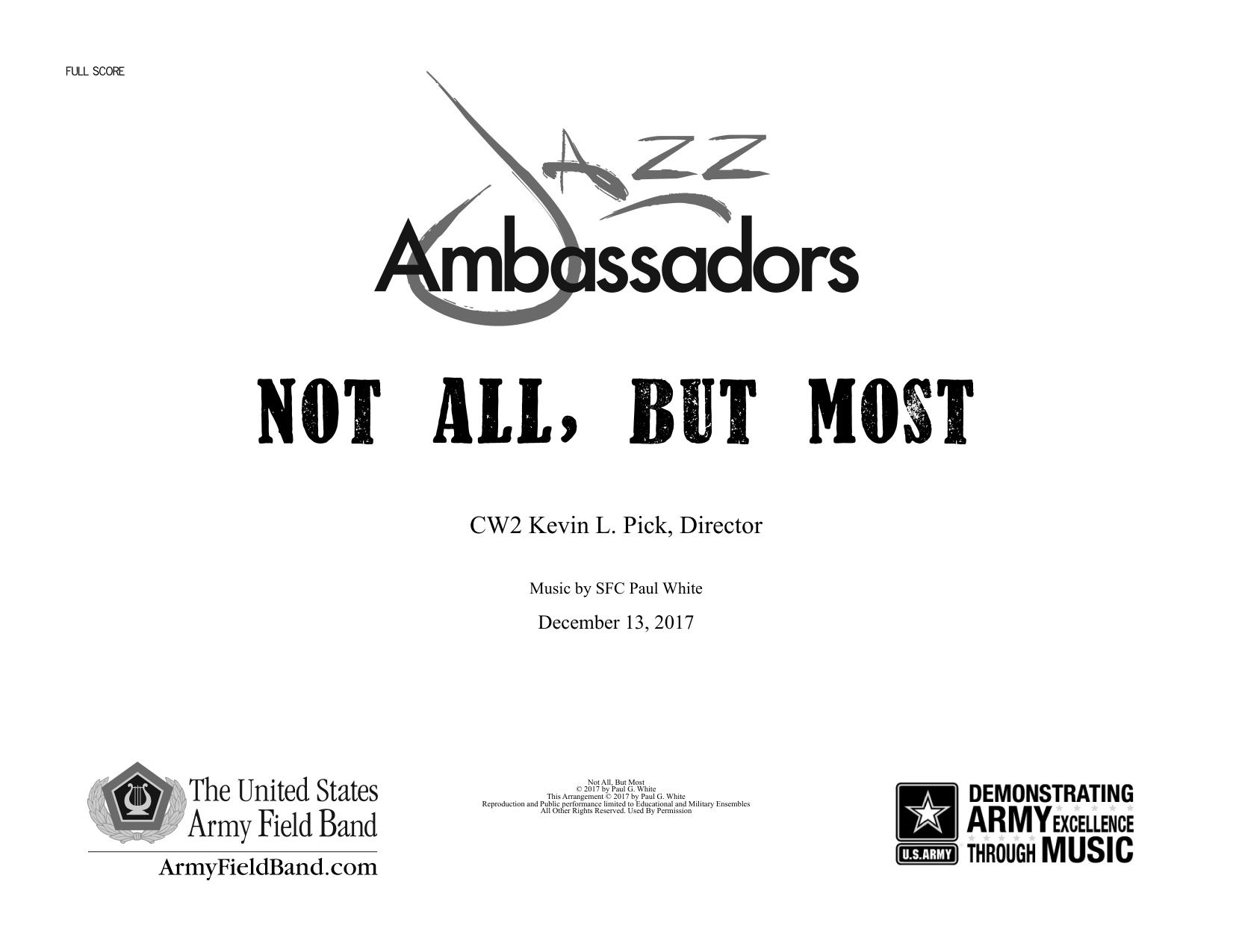
Not All,But Most (P.White)
Composed by P. White
Arranged by P.White
- Ensemble: Big Band
- Style: Jazz Standard
- Pages: 15
- Instruments (17): Alto Saxophone 1, Alto Saxophone 2, Tenor Saxophone 1, Tenor Saxophone 2, Baritone Saxophone, Trumpet 1, Trumpet 2, Trumpet 3, Trumpet 4, Trombone 1, Trombone 2, Trombone 3, Bass Trombone, Guitar, Piano, Bass, Drum Set
- Difficulty: easy
- Content: Individual Parts
- Format: PDF Download (Instant)
- Price: $24.99
Rooted in the rich lineage of modern acoustic jazz composition, "Not All, But Most" captures the sophisticated harmonic palette and driving rhythmic pulse characteristic of contemporary big band writing. Conceived as an homage to mid-century post-bop idioms while incorporating forward-thinking harmonic extensions, the work bridges the gap between classic swing-era ensemble textures and the adventurous spirit of modern jazz innovators. The composition has steadily earned a reputation among working conductors as a sophisticated showcase for ensemble interplay, rewarding groups that prioritize pristine articulation, dynamic contrast, and deep stylistic cohesion. Driven by an infectious, propulsive medium-up swing groove in 4/4 time, the arrangement opens with a taut, rhythmically interlocking vamp that immediately establishes an energetic, forward-leaning mood. The primary thematic material is introduced through a brilliant brass-and-woodwind counterpoint, featuring rich, altered chord voicings that evoke a sense of urbane tension and release. P.White’s arranging style shines through in the clever distribution of melodic fragments across different sections, utilizing tight sax solis and punctuated brass stabs to create a dense, highly textured sonic landscape. As the chart builds toward a powerful, high-energy shout chorus, the harmonic framework expands through striking modulation, forcing the ensemble to lean into the altered dominants and sharp chromatic ascents with absolute conviction. Melodic duties are shared fluidly across the ensemble, though the primary heads are anchored by the lead alto saxophone and first trumpet, supported by lush, open-voicing backgrounds in the lower reeds and trombones. Dedicated solo space is provided over accessible yet stimulating changes, allowing featured improvisers on tenor saxophone and piano to stretch out within a secure, harmonically rich big band context. Technical demands center on clean execution of syncopated bebop-oriented figures, precise section blending at dynamic extremes, and maintaining a relaxed, driving macro-tempo across extended blowing sections. The rhythm section acts as the ultimate engine, requiring a sensitive drummer adept at conversational ride-cymbal phrasing and a bassist capable of walking a robust, quarter-note pulse with authority. Advanced high school ensembles with strong section leaders, collegiate jazz orchestras, and professional community big bands will find this chart an ideal centerpiece for festival programs or formal concert sets. The 15-page conductor score provides crystal-clear visibility into the intricate counterlines and dynamic markings, ensuring that directors can efficiently balance the dense orchestration. Performing "Not All, But Most" demands technical focus and stylistic maturity, offering an immensely rewarding experience for musicians eager to sink their teeth into sophisticated contemporary big band writing. Success with "Not All, But Most" hinges on maintaining a relaxed, forward-moving medium-up swing feel (suggested quarter note = 208) that never feels rushed. Conductors should emphasize the importance of light, articulate eighth-note phrasing, ensuring that the backbeats on beats two and four are crisp without being clipped. The primary technical challenge lies in the execution of chromatic passing tones and altered dominant voicings; saxophones and brass must spend dedicated sectional rehearsal time locking in their intonation on upper-structure extensions. Dynamics must be strictly observed, particularly during the transition from the subdued, harmon-muted brass backgrounds into the roaring full-ensemble shout chorus. Drummers should avoid overplaying during the head, driving the ensemble with a crisp ride pattern and well-placed interactive fills rather than heavy-handed crash cymbals. Horn players should utilize natural, unforced articulation, employing subtle falls and doits only where explicitly marked to preserve the chart's sophisticated, post-bop aesthetic. Q: What instrumentation and parts are included in this publication? A: The arrangement is scored for a standard 17-instrument big band lineup—comprising 5 saxophones (2 altos, 2 tenors, 1 baritone), 4 trumpets, 4 trombones, piano, guitar, bass, and drums—along with a comprehensive 15-page conductor score. Q: What is the overall difficulty level of this arrangement? A: This piece is graded as advanced-intermediate to advanced, making it best suited for college jazz orchestras, advanced high school bands, and professional community ensembles with strong section players and confident soloists. Q: What is the musical style and historical context of the piece? A: Written by P.White, the piece is a contemporary jazz standard drawing heavily from the post-bop and modern big band traditions, blending classic swing propulsion with sophisticated, harmonically rich modal voicings. Q: What makes this specific arrangement by P.White unique? A: The chart stands out due to its intricate counterpoint, clever distribution of thematic material across disparate sections, and a high-energy shout chorus that utilizes striking modulations and dense chromatic ascents. Q: What is the performance duration and suggested tempo for the piece? A: The arrangement runs approximately 5 to 6 minutes at its target tempo of a medium-up swing feel with the quarter note operating around 208 BPM.
Questions and answers
- What is included in the Not All,But Most (P.White) PDF?
- The verified current file contains a conductor score across 15 pages.
- How many instruments or parts are listed for Not All,But Most (P.White)?
- The verified instrumentation list contains 17 entries for this Big Band arrangement.
- Who is credited for Not All,But Most (P.White)?
- Composer: P. White. Arranger: P.White.
- What difficulty is listed for Not All,But Most (P.White)?
- The verified difficulty level is easy.
- What style is listed for Not All,But Most (P.White)?
- The catalog lists the style as Jazz Standard.
- Can I preview Not All,But Most (P.White) before buying?
- Yes. The product page provides a preview generated from the current PDF file.
- How is Not All,But Most (P.White) delivered?
- After successful payment, the digital PDF is made available for download. The displayed price is $24.99.
Musicians Also Search For
Not All,But Most P.White PDF • Not All,But Most P.White sheet music • Not All,But Most arranged by P.White • P.White big band charts • P.White jazz arrangements PDF • Not All,But Most P. White sheet music • Not All,But Most P. White big band arrangements • P. White big band charts • Not All,But Most big band arrangements • Not All,But Most big band PDF download • Not All,But Most jazz sheet music • big band sheet music download • Not All,But Most conductor score PDF • Not All,But Most sheet music PDF • Not All,But Most Jazz Standard charts • Jazz Standard big band arrangements • buy Not All,But Most sheet music • download Not All,But Most PDF • Not All,But Most jazz charts • best P.White big band arrangements • P. White arranged by P.White • Not All,But Most printable sheet music • big band repertoire PDF