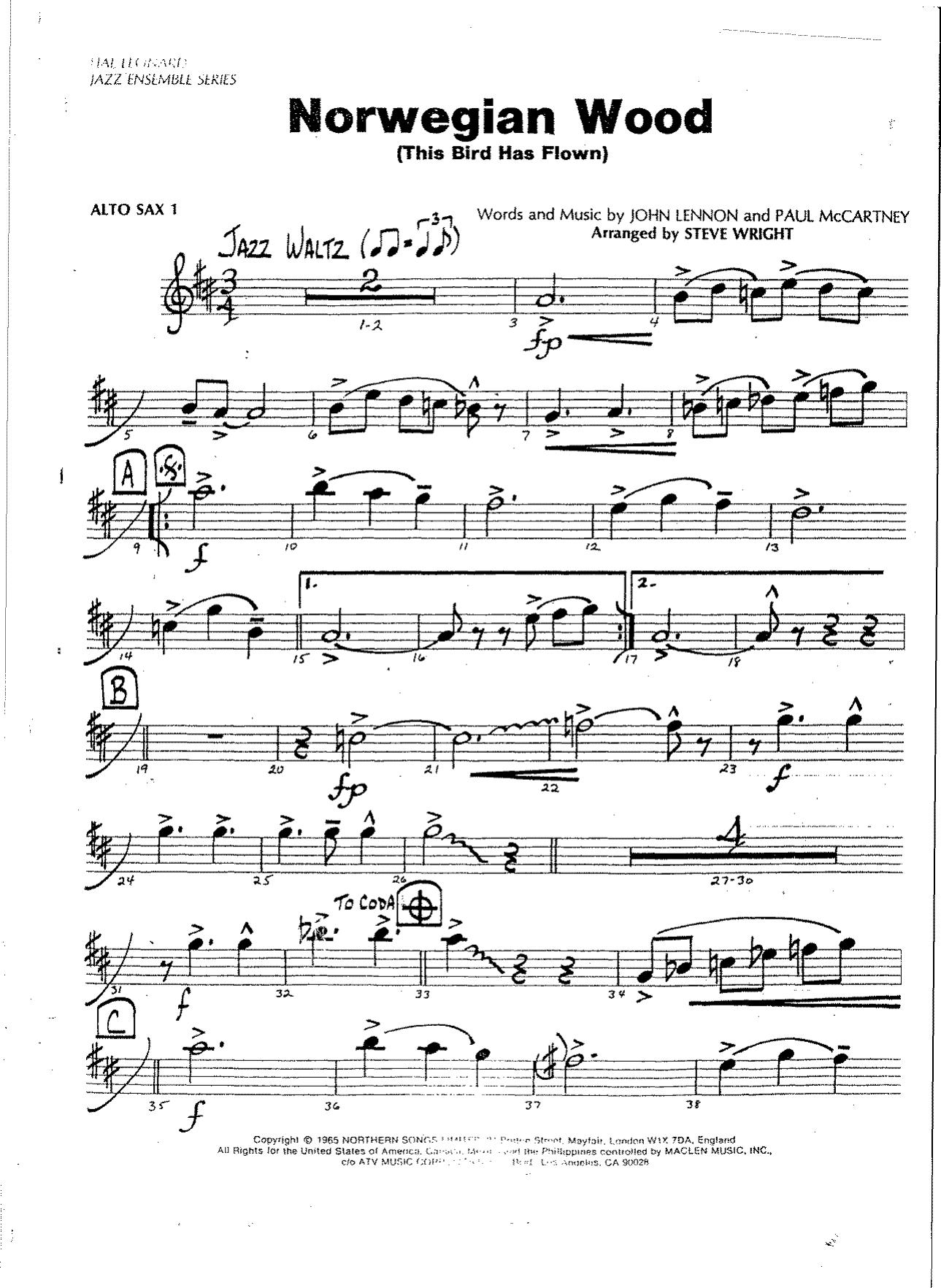
Norwegian Wood (S.Wright)
Composed by Lennon-McCartney
Arranged by S.Wright
- Ensemble: Big Band
- Style: Jazz Standard
- Pages: 53
- Instruments (17): Alto Sax 1, Alto Sax 2, Tenor Sax 1, Tenor Sax 2, Baritone Sax, Trumpet 1, Trumpet 2, Trumpet 3, Trumpet 4, Trombone 1, Trombone 2, Trombone 3, Trombone 4, Piano, Guitar, Bass, Drums
- Difficulty: advanced
- Content: Individual Parts
- Format: PDF Download (Instant)
- Price: $24.99
Originally penned by John Lennon and Paul McCartney and released on the Beatles' landmark 1965 album *Rubber Soul*, "Norwegian Wood (This Bird Has Flown)" occupies a fascinating intersection where pop history meets modal jazz exploration. Driven originally by George Harrison's pioneering sitar lines and written in an evocative 6/8 meter with a distinct folk-rock flavor, the composition's haunting melody and unique harmonic movement in E major/minor naturally caught the attention of jazz innovators. Over the decades, it transitioned from a counterculture anthem into a sophisticated jazz standard, famously interpreted by artists like Buddy Rich and Herbie Mann, who recognized that its asymmetrical phrasing and melancholy charm provided an ideal canvas for extended jazz improvisation. In this masterful big band adaptation by S.Wright, the composition is re-imagined through a sophisticated contemporary lens, blending traditional swing sensibilities with modern harmonic coloring. The arrangement opens with an atmospheric, tension-building intro before settling into a hypnotic, medium-tempo groove that cleverly plays with the tune's original metric feel. Wright expertly balances rich, impressionistic brass voicings with lush saxophone solis, creating an introspective yet deeply swinging mood. The arrangement evokes a cool, autumnal ambiance, shifting dynamically from quiet, delicate textural interplay in the rhythm section to powerful, harmonically adventurous ensemble climaxes that showcase the full expressive range of a standard 17-piece big band. Wright’s signature arranging approach shines through the clever re-harmonization of the bridge and the seamless integration of counterpoint within the woodwind section. Rather than relying on a straightforward head arrangement, Wright builds momentum through shifting textural layers, giving individual sections distinct conversational roles. The melody is initially introduced by a featured alto saxophone and muted trumpet over a pulsing rhythm section backdrop, gradually drawing the full ensemble into a dense, interwoven web of sound. A standout feature of the chart is an expansive shout chorus that takes the familiar melodic fragments and expands them into a towering wall of brass sound, utilizing upper-structure triads and modern dominant extensions before dropping back down to a sultry, understated coda. Advanced high school ensembles, collegiate jazz orchestras, and professional big bands will find this chart to be an exceptionally rewarding addition to their repertoire. While rhythmically accessible, the arrangement demands precise articulation, mature balance, and a strong sense of internal time, particularly during the subtle tempo fluctuations and rubato-tinged transitions. Solos are opened up for tenor saxophone and piano, allowing featured improvisers to stretch out over modal vamps and sophisticated chord changes. Conductor and band alike will appreciate how the chart reinterprets a familiar pop-culture touchstone into a substantive, modern jazz masterwork that commands audience attention from the first downbeat. Success with this arrangement hinges on the rhythm section’s ability to anchor the hybrid groove without overplaying. The drummer should maintain a crisp, understated ride cymbal pattern that respects the tune's folk-rock origins while leaning into an authentic jazz swing feel, particularly during the expanded sections. Brass players must pay close attention to dynamic markings; the transition from the muted, introspective intro to the open-horn ensemble passages requires absolute dynamic control. Trumpets should utilize harmon mutes (stem in) where indicated to achieve the signature translucent timbre required in the opening choruses. Saxes need to focus on a unified, homogeneous blend during the soli passages, ensuring that inner-voice movement does not overpower the lead alto. Rehearsal should begin slowly, locking in the articulation of the syncopated figures before introducing the intended tempo. Encourage the soloists to explore both modal scalar passages and blues-inflected phrases to match the stylistic duality inherent in Wright's writing. Q: What specific instrumentation and parts are included in this big band arrangement? A: The chart is scored for a standard 17-piece big band instrumentation consisting of 5 saxophones (Alto 1, Alto 2, Tenor 1, Tenor 2, Baritone), 4 trumpets, 4 trombones, and a 4-piece rhythm section (piano, bass, drums, and guitar), totaling 53 pages of score and parts. Q: What is the difficulty level of this arrangement? A: This arrangement is graded as advanced, making it ideal for skilled high school jazz bands, collegiate ensembles, and professional big bands that possess strong section cohesion and mature rhythmic reading abilities. Q: What musical style and historical context does this chart draw from? A: It adapts the classic 1965 Lennon-McCartney composition—originally a milestone of folk-rock and early modal exploration—and transforms it into a contemporary jazz standard steeped in modern big band harmony and groove. Q: What makes S.Wright’s arrangement of "Norwegian Wood" unique? A: Wright’s treatment stands out through its clever re-harmonization, innovative use of metric nuance, shifting woodwind counterpoint, and a towering shout chorus that reinterprets the familiar melody using sophisticated upper-structure extensions. Q: What is the performance duration and recommended tempo for this piece? A: While performance time can vary slightly based on the length of improvised solos, the arrangement is designed to be performed at a comfortable, driving medium-tempo groove that typically lasts between 4 to 5 minutes.
Questions and answers
- What is included in the Norwegian Wood (S.Wright) PDF?
- The verified current file contains individual parts across 53 pages.
- How many instruments or parts are listed for Norwegian Wood (S.Wright)?
- The verified instrumentation list contains 17 entries for this Big Band arrangement.
- Who is credited for Norwegian Wood (S.Wright)?
- Composer: Lennon-McCartney. Arranger: S.Wright.
- What difficulty is listed for Norwegian Wood (S.Wright)?
- The verified difficulty level is advanced.
- What style is listed for Norwegian Wood (S.Wright)?
- The catalog lists the style as Jazz Standard.
- Can I preview Norwegian Wood (S.Wright) before buying?
- Yes. The product page provides a preview generated from the current PDF file.
- How is Norwegian Wood (S.Wright) delivered?
- After successful payment, the digital PDF is made available for download. The displayed price is $24.99.
Musicians Also Search For
Norwegian Wood S.Wright PDF • Norwegian Wood S.Wright sheet music • Norwegian Wood arranged by S.Wright • S.Wright big band charts • S.Wright jazz arrangements PDF • Norwegian Wood Lennon-McCartney sheet music • Norwegian Wood Lennon-McCartney big band arrangements • Lennon-McCartney big band charts • Norwegian Wood big band arrangements • Norwegian Wood big band PDF download • Norwegian Wood jazz sheet music • big band sheet music download • Norwegian Wood individual parts download • Norwegian Wood sheet music PDF • Norwegian Wood Jazz Standard charts • Jazz Standard big band arrangements • buy Norwegian Wood sheet music • download Norwegian Wood PDF • Norwegian Wood jazz charts • best S.Wright big band arrangements • Lennon-McCartney arranged by S.Wright • Norwegian Wood printable sheet music • big band repertoire PDF