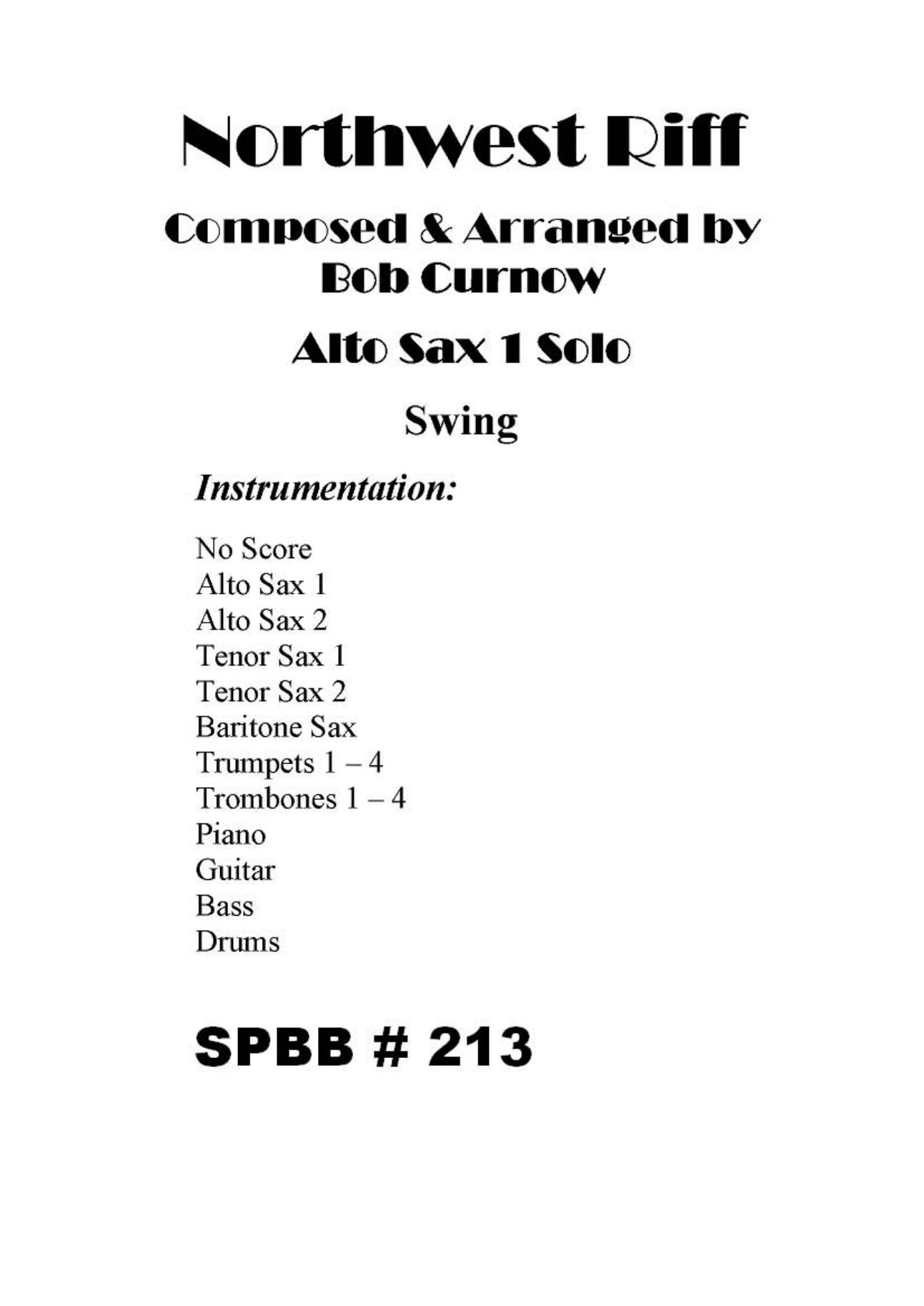
Northwest Riff (B.Curnow)
Composed by Bob Curnow
Arranged by Bob Curnow
- Ensemble: Big Band
- Pages: 54
- Instruments (17): Alto Saxophone 1 (Solo), Alto Saxophone 2, Tenor Saxophone 1, Tenor Saxophone 2, Baritone Saxophone, Trumpet 1, Trumpet 2, Trumpet 3, Trumpet 4, Trombone 1, Trombone 2, Trombone 3, Trombone 4 (Bass Trombone), Piano (Solo), Guitar, Bass (Solo), Drums
- Difficulty: advanced
- Content: Individual Parts
- Format: PDF Download (Instant)
- Price: $24.99
Composed and arranged by renowned writer and educator Bob Curnow, "Northwest Riff" stands as a brilliant testament to the sophisticated, West Coast-inflected contemporary big band tradition. Emerging from Curnow’s deep commitment to rich compositional structures and lush harmonic landscapes—traits that defined his celebrated work with the Stan Kenton Orchestra catalog and his own big band projects—this chart captures the invigorating, crisp energy of the Pacific Northwest. Rather than relying on simple head arrangements, Curnow approaches the big band canvas with a symphonic ear, treating the 17-piece ensemble as a unified organism capable of shifting textures, intricate counterpoint, and overwhelming dynamic power. From the opening downbeat, the composition establishes a driving, confident groove characterized by a contemporary medium-up swing feel propelled by interlocking rhythmic figures in the brass and rhythm sections. The harmonic language is distinctly advanced, featuring extended and altered dominant chords, surprising modal colorations, and dense voicings that give the ensemble a modern jazz orchestral weight. The mood shifts effortlessly from muscular, punchy ensemble statements to spacious, lyrical interludes that highlight Curnow’s masterclass-level understanding of dynamic contrast. The energy is relentless yet controlled, demanding absolute precision and rhythmic unity across all sections. Curnow’s signature arranging style shines through the meticulous distribution of melodic material and sophisticated sectional solis. The saxophones, anchored by two altos, two tenors, and baritone, frequently navigate intricate, interwoven lines that require nimble fingerwork and uniform articulation. Meanwhile, the brass section—comprising four trumpets and four trombones—is utilized not just for brute force, but for warm, choir-like harmonic cushions and razor-sharp, aggressive staccato punches. A standout feature of the arrangement is its masterfully constructed shout chorus, which builds organically through clever motivic development, cross-rhythms, and a gradual expansion of the band's dynamic ceiling before resolving into a triumphant, high-energy climax. Solo opportunities are thoughtfully integrated, providing designated soloists a harmonically rich landscape to stretch out over standard changes while the ensemble provides dynamic, reactive backing figures. Advanced high school, collegiate, and professional jazz ensembles will find this 54-page publication an immensely rewarding challenge. The primary technical hurdles lie in executing complex syncopated rhythms cleanly at tempo, maintaining accurate intonation within dense Curnow voicings, and balancing the inner voices so that counter-melodies cut through the ensemble texture. Conductors will appreciate how the chart teaches modern big band literacy, requiring students to listen across sections and master subtle stylistic nuances. Ultimately, "Northwest Riff" offers a sophisticated programming choice that brings both intellectual depth and visceral excitement to any serious jazz concert. Conductors tackling "Northwest Riff" should prioritize rhythmic precision and articulation uniformity across all sections, as Curnow’s intricate charts rely heavily on exact placement of syncopated figures. The tempo should be kept locked and steady—avoid rushing during louder ensemble passages. Saxophones must focus on a smooth, modern linear concept, ensuring that fast passing tones blend seamlessly without sticking out. Brass players need exceptional endurance and breath support to navigate the upper-register demands and dynamic swells safely, particularly in the lead trumpet chair. When rehearsing, isolate the rhythm section first to lock in the underlying groove before layering in the horns. Pay close attention to dynamic markings: the contrast between whispered background figures and explosive full-ensemble hits defines the emotional arc of the piece. Ensure that the rhythm section pianist and guitarist voice the extended chords cleanly without muddying the low end, leaving ample sonic space for the bass and drums to drive the ensemble forward. Q: What instruments and parts are included in this 54-page publication? A: The arrangement is scored for a standard 17-piece big band, including 2 alto saxophones, 2 tenor saxophones, 1 baritone saxophone, 4 trumpets, 4 trombones, and a standard rhythm section of piano, guitar, bass, and drums. Q: What is the difficulty level of "Northwest Riff"? A: This arrangement is designated as advanced, making it ideal for top-tier high school, collegiate, and professional jazz ensembles due to its dense harmonies and complex syncopation. Q: What is the musical style and historical context of this piece? A: Written by Bob Curnow, the piece represents the sophisticated contemporary West Coast big band tradition, blending modern jazz harmony with driving swing grooves and orchestral depth. Q: What makes Bob Curnow’s arrangement unique? A: Curnow’s writing stands out for its symphonic approach to big band orchestration, featuring lush extended voicings, intricate counterpoint, and a masterfully structured shout chorus that builds intense dynamic contrast. Q: What is the performance tempo and duration of the chart? A: The piece is performed at a driving, medium-up swing tempo and typically runs between 4 to 6 minutes, depending on the length of the open improvised solos.
Questions and answers
- What is included in the Northwest Riff (B.Curnow) PDF?
- The verified current file contains individual parts across 54 pages.
- How many instruments or parts are listed for Northwest Riff (B.Curnow)?
- The verified instrumentation list contains 17 entries for this Big Band arrangement.
- Who is credited for Northwest Riff (B.Curnow)?
- Composer: Bob Curnow. Arranger: Bob Curnow.
- What difficulty is listed for Northwest Riff (B.Curnow)?
- The verified difficulty level is advanced.
- Can I preview Northwest Riff (B.Curnow) before buying?
- Yes. The product page provides a preview generated from the current PDF file.
- How is Northwest Riff (B.Curnow) delivered?
- After successful payment, the digital PDF is made available for download. The displayed price is $24.99.
Musicians Also Search For
Northwest Riff Bob Curnow PDF • Northwest Riff Bob Curnow sheet music • Northwest Riff arranged by Bob Curnow • Bob Curnow big band charts • Bob Curnow jazz arrangements PDF • Northwest Riff Bob Curnow big band arrangements • Northwest Riff big band arrangements • Northwest Riff big band PDF download • Northwest Riff jazz sheet music • big band sheet music download • Northwest Riff individual parts download • Northwest Riff sheet music PDF • buy Northwest Riff sheet music • download Northwest Riff PDF • Northwest Riff jazz charts • best Bob Curnow big band arrangements • Northwest Riff printable sheet music • big band repertoire PDF