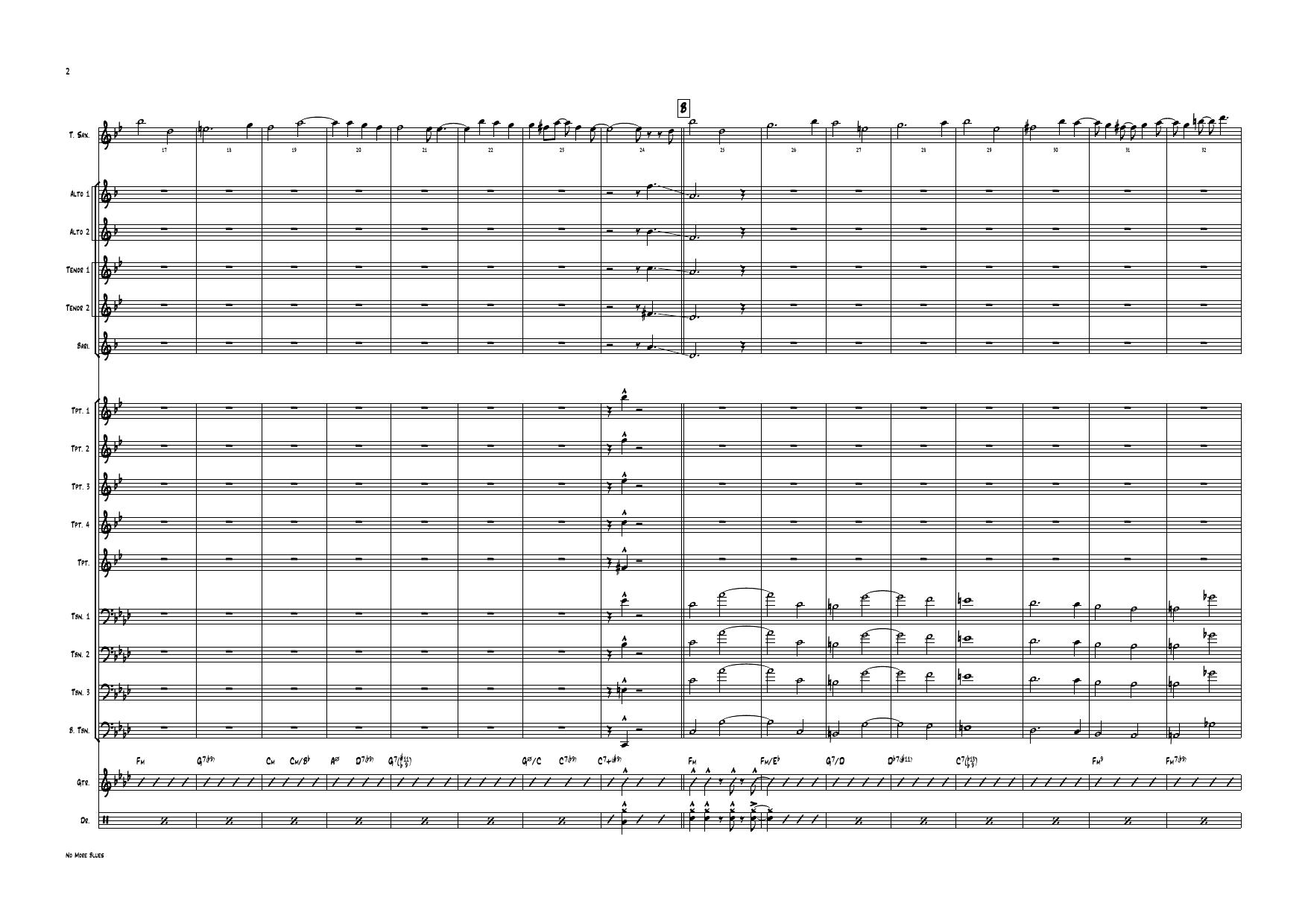
No More Blues (H.Hermann)
Composed by Antonio Carlos Jobim
Arranged by H.Hermann
- Ensemble: Big Band
- Style: Jazz Standard
- Pages: 32
- Instruments (17): Tenor Saxophone (Solo), Alto Saxophone 1, Alto Saxophone 2, Tenor Saxophone 1, Tenor Saxophone 2, Baritone Saxophone, Trumpet 1, Trumpet 2, Trumpet 3, Trumpet 4, Trumpet 5, Trombone 1, Trombone 2, Trombone 3, Bass Trombone, Guitar / Piano / Bass, Drums
- Difficulty: medium
- Content: Individual Parts
- Format: PDF Download (Instant)
- Price: $24.99
"Chega de Saudade," internationally known as "No More Blues," stands as a foundational masterpiece of the Bossa Nova movement, originally composed by Antônio Carlos Jobim with Portuguese lyrics by Vinícius de Moraes. Emerging in the late 1950s and popularized globally by Stan Getz, João Gilberto, and jazz interpreters alike, the composition bridges traditional Brazilian samba rhythms with sophisticated American jazz harmonies. It captures a distinct melancholic yet uplifting ethos—*saudade*—translating an intense longing for an absent love into a vibrant, infectious musical language that permanently altered the DNA of modern jazz repertoire. In this sophisticated big band adaptation by H.Hermann, the chart honors Jobim's Brazilian roots while injecting a high-energy, contemporary jazz ensemble vitality. Operating primarily in a bright, driving Latin-swing hybrid feel, the arrangement establishes an immediate sense of warmth and forward momentum. The harmonic landscape is lush and expansive, utilizing extended ninth, eleventh, and altered dominant chords that give the brass and reed sections a rich, modern texture. The mood shifts effortlessly from breezy, rhythmic syncopation during the head statements to an exhilarating, dynamic peak during the ensemble passages, evoking both the sun-drenched coasts of Rio de Janeiro and the sophisticated ambiance of a New York jazz club. H.Hermann’s arranging approach prioritizes intricate counterpoint and vibrant sectional contrast. The melody is initially introduced through tightly-voiced saxophone solis featuring the Alto and Tenor Saxophones, characterized by smooth, interconnected lines that mimic the fluidity of a vocal delivery. Brass interventions are used judiciously, providing punchy counter-melodies without overpowering the delicate rhythmic undercurrent established by the rhythm section. A standout feature of the chart is its inventive modulation leading into the open solo section, which provides ample space for featured horn soloists to stretch out over standard changes before building into a roaring, high-octane shout chorus that showcases the full power of the 18-piece ensemble. Advanced high school, collegiate, and professional big bands will find this arrangement an exceptional vehicle for developing stylistic versatility. While the rhythm section must maintain an authentic, driving bossa/latin groove with precise subdivision, the horn players will encounter technical demands centered around immaculate intonation, balance within dense chordal voicings, and agile articulation during fast-moving intervallic leaps. Rewarding from the first downbeat to the final chord, this 37-page publication—complete with a comprehensive conductor score—offers a brilliant synthesis of Brazilian lyricism and powerhouse big band arranging that commands audience attention. Achieving an authentic reading of H.Hermann's chart requires striking the right balance between relaxed Brazilian phrasing and aggressive jazz articulation. The rhythm section is the engine: the drummer should utilize a subtle bossa nova or modified samba foot pattern combined with crisp cross-stick work on the rim, avoiding heavy backbeats until the shout chorus. Horn players must internalize sixteenth-note subdivisions to ensure syncopated figures lock tightly with the bass and piano. Pay close attention to dynamic markings within the chordal backgrounds; the saxophones and brass must dynamically shade their accompaniment to allow soloists space to breathe. During the shout chorus, open up the sound with vibrant, resonant tones, ensuring that high-register brass leads project effortlessly over the full ensemble texture without forcing their sound. Directors should rehearse the ensemble in sections first, ensuring that the interplay between the sax solis and brass punches is clean, balanced, and rhythmically unified. Q: What instrumentation and parts are included in this publication? A: This arrangement is scored for a standard 18-instrument big band lineup, featuring Alto Saxophone 1, Alto Saxophone 2, Tenor Saxophone 1, Tenor Saxophone 2, Baritone Saxophone, four trumpets, four trombones, guitar, piano, bass, drums, and auxiliary percussion, accompanied by a comprehensive 37-page conductor score. Q: What is the difficulty level of this arrangement? A: This piece is graded as advanced, making it best suited for college, advanced high school, community, and professional big bands that possess strong section playing capabilities and familiarity with Latin-jazz idioms. Q: What is the historical and stylistic background of the music? A: Based on Antônio Carlos Jobim's iconic composition that helped ignite the late-1950s Bossa Nova movement, this arrangement honors the traditional Brazilian samba-jazz aesthetic while incorporating modern big band harmonic extensions and dynamic structures. Q: What makes H.Hermann's arrangement unique? A: It stands out through its sophisticated harmonic voicings, intricate saxophone solis that mirror vocal phrasing, a seamless modulation into the open solo section, and a high-energy shout chorus that brilliantly bridges Brazilian lyricism with powerful big band jazz. Q: What is the recommended tempo and performance duration? A: The arrangement is set in a bright, driving Latin-swing feel with a recommended tempo around 160–174 BPM, yielding a performance duration of approximately 4 to 5 minutes depending on solo extensions.
Questions and answers
- What is included in the No More Blues (H.Hermann) PDF?
- The verified current file contains a conductor score and individual parts across 32 pages.
- How many instruments or parts are listed for No More Blues (H.Hermann)?
- The verified instrumentation list contains 17 entries for this Big Band arrangement.
- Who is credited for No More Blues (H.Hermann)?
- Composer: Antonio Carlos Jobim. Arranger: H.Hermann.
- What difficulty is listed for No More Blues (H.Hermann)?
- The verified difficulty level is medium.
- What style is listed for No More Blues (H.Hermann)?
- The catalog lists the style as Jazz Standard.
- Can I preview No More Blues (H.Hermann) before buying?
- Yes. The product page provides a preview generated from the current PDF file.
- How is No More Blues (H.Hermann) delivered?
- After successful payment, the digital PDF is made available for download. The displayed price is $24.99.
Musicians Also Search For
No More Blues H.Hermann PDF • No More Blues H.Hermann sheet music • No More Blues arranged by H.Hermann • H.Hermann big band charts • H.Hermann jazz arrangements PDF • No More Blues Antonio Carlos Jobim sheet music • No More Blues Antonio Carlos Jobim big band arrangements • Antonio Carlos Jobim big band charts • No More Blues big band arrangements • No More Blues big band PDF download • No More Blues jazz sheet music • big band sheet music download • No More Blues conductor score PDF • No More Blues individual parts download • No More Blues sheet music PDF • No More Blues Jazz Standard charts • Jazz Standard big band arrangements • buy No More Blues sheet music • download No More Blues PDF • No More Blues jazz charts • best H.Hermann big band arrangements • Antonio Carlos Jobim arranged by H.Hermann • No More Blues printable sheet music • big band repertoire PDF