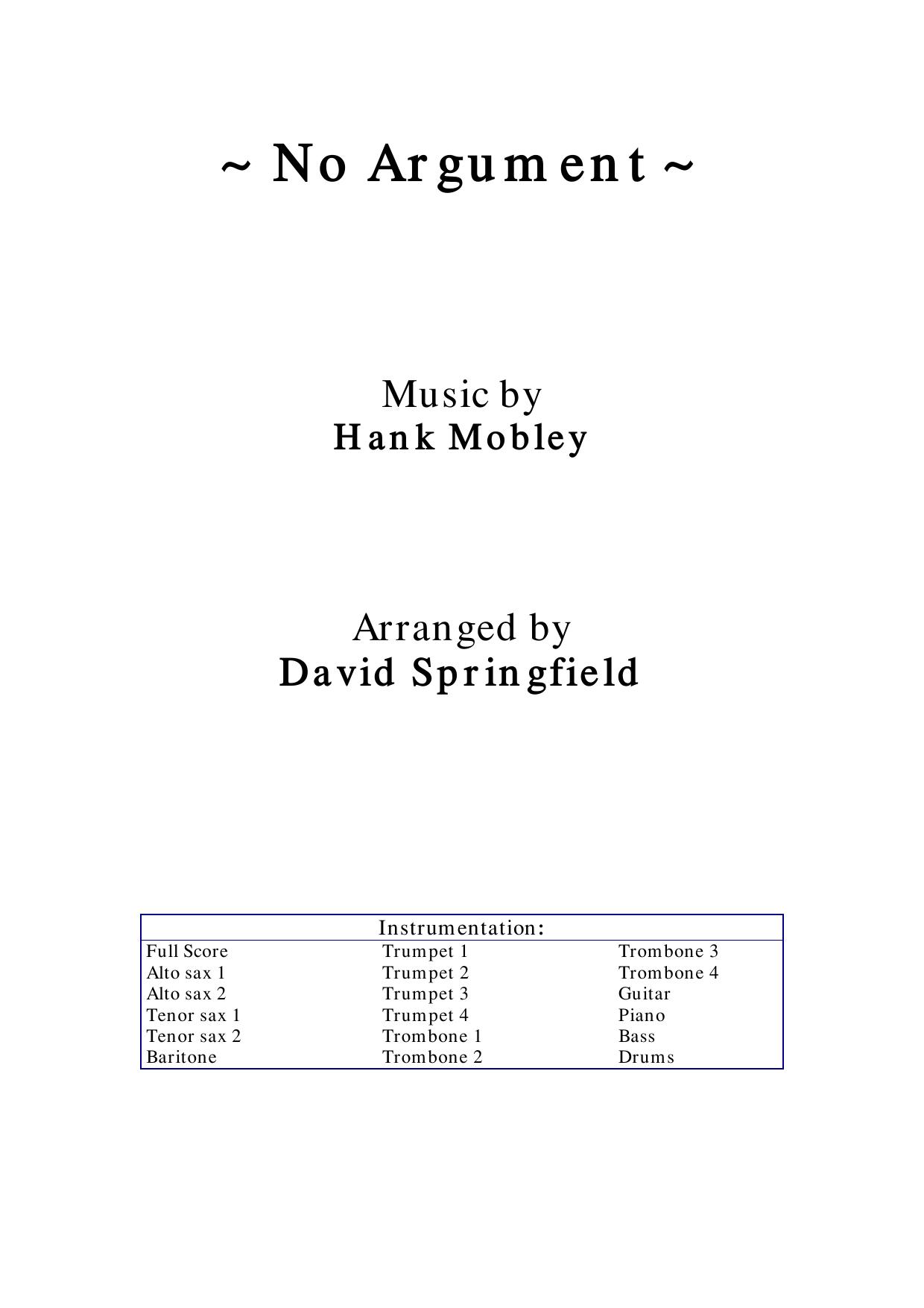
No Argument (D.Springfield) sheet music preview

No Argument (D.Springfield)

Composed by D. Springfield

Arranged by D.Springfield

  • Ensemble: Big Band
  • Style: Jazz Standard
  • Pages: 97
  • Instruments (17): Alto Sax 1, Alto Sax 2, Tenor Sax 1, Tenor Sax 2, Baritone Sax, Trumpet 1, Trumpet 2, Trumpet 3, Trumpet 4, Trombone 1, Trombone 2, Trombone 3, Trombone 4, Guitar, Piano, Bass, Drums
  • Difficulty: advanced
  • Content: Individual Parts
  • Format: PDF Download (Instant)
  • Price: $24.99

Capturing the sophisticated harmonic language of mid-century modern jazz while maintaining an undeniable, foot-tapping pulse, "No Argument" stands as a brilliant contemporary nod to the classic big band era. Originally conceived by composer and arranger D. Springfield, the composition bridges the gap between post-bop harmonic complexity and accessible, swinging orchestration reminiscent of the Thad Jones or Bob Mintzer libraries. Springfield’s writing captures a mood of confident swagger and urbane cool, driven by clever syncopation and rich, extended chord voicings that push modern big band boundaries without alienating traditional audiences. The underlying aesthetic evokes late-night smoke-filled lounges paired with high-energy festival stages, creating an emotional landscape that swings fiercely one moment and opens up into lush, cinematic introspection the next. Springfield’s arrangement utilizes a sophisticated palette, opening with a seductive, unhurried medium-swing tempo in 4/4 time before expanding into rolling developmental sections. The chart is anchored by a walking bassline and crisp ride-cymbal pocket that propels the 17-piece ensemble forward. Distinctive harmonic signatures include tightly clustered upper-structure triads in the brass and interlocking woodwind countermelodies that create a dense, shimmering texture. A standout feature of the chart is a sweeping, harmonically adventurous saxophone soli that tests the section's blend and intonation, followed by a roaring, dynamic shout chorus that builds tension through clever metric displacement and ascending dynamic plateaus. Melodic responsibility is shared democratically across the ensemble, though the primary thematic material is introduced by the lead alto saxophone and first trumpet before being tossed playfully to the trombones. Open solo sections are provided for tenor saxophone and piano, complete with suggested background figures that build in intensity behind the soloist to naturally encourage dynamic interaction. Technically, the chart demands crisp articulation, accurate section blend, and mature time-feel, particularly in maintaining the relaxed yet driving backbeat of the medium-swing groove. High register demands for the lead trumpet peak at written high D, while the trombone section navigates elegant, sliding voicings that require precise slide technique and unified tuning. Advanced high school, collegiate, and professional jazz ensembles will find this comprehensive 147-page package exceptionally rewarding to prepare and perform. The inclusion of a meticulously edited conductor score ensures that directors can easily navigate the dense polyphonic layers and dynamic contours. "No Argument" functions equally well as a sophisticated festival chart or a striking centerpiece for a formal concert program, offering ample opportunity for both ensemble showcase and individual improvisational brilliance. Achieving the authentic, relaxed drive of "No Argument" requires strict attention to the underlying medium-swing groove; avoid rushing the tempo, as the chart relies heavily on a heavy, grounded backbeat on beats two and four. The brass section should employ subtle plunger mutes and controlled falls during the transition into the second chorus to capture Springfield's intended textural contrast. Articulation is paramount: eighth notes must be swung naturally with appropriate weight given to the upbeats, particularly in the saxophone soli where unison passages demand absolute rhythmic synchronization. Directors should rehearse the rhythm section independently first, ensuring the piano comping leaves ample space and avoids cluttering the sparse, modal-leaning background figures. Pay close attention to dynamic markings during the shout chorus, reigning in the brass initially to allow the lower reeds to project their counter-line before opening up the full ensemble sound for the final climactic release. Q: What specific instrumentation and parts are included in this publication? A: This complete big band arrangement is scored for 17 instruments, including standard configurations for 5 saxophones (2 altos, 2 tenors, 1 baritone), 4 trumpets, 4 trombones, guitar, piano, bass, and drums, along with a comprehensive conductor score. Q: What is the overall difficulty level of this arrangement? A: This chart is rated as advanced, making it best suited for college, advanced high school, and professional big bands that possess strong section-playing capabilities and mature rhythm sections. Q: What is the musical style and historical context of "No Argument"? A: Written by D. Springfield, this piece is a modern jazz standard that draws heavily from the post-bop and contemporary big band traditions, blending classic swing aesthetics with rich, extended modern harmonies. Q: What makes this specific arrangement by D. Springfield unique? A: It features Springfield's signature harmonic voice, highlighted by an intricate, harmonically adventurous saxophone soli, tightly voiced brass interjections, and a meticulously crafted shout chorus that utilizes clever metric displacement. Q: What is the performance duration and tempo feel of the piece? A: The arrangement runs approximately 5 to 6 minutes in length and is set to a confident, driving medium-swing tempo that demands a relaxed yet precise time-feel from the entire ensemble.

Questions and answers

What is included in the No Argument (D.Springfield) PDF?
The verified current file contains a conductor score and individual parts across 97 pages.
How many instruments or parts are listed for No Argument (D.Springfield)?
The verified instrumentation list contains 17 entries for this Big Band arrangement.
Who is credited for No Argument (D.Springfield)?
Composer: D. Springfield. Arranger: D.Springfield.
What difficulty is listed for No Argument (D.Springfield)?
The verified difficulty level is advanced.
What style is listed for No Argument (D.Springfield)?
The catalog lists the style as Jazz Standard.
Can I preview No Argument (D.Springfield) before buying?
Yes. The product page provides a preview generated from the current PDF file.
How is No Argument (D.Springfield) delivered?
After successful payment, the digital PDF is made available for download. The displayed price is $24.99.

Musicians Also Search For

No Argument D.Springfield PDFNo Argument D.Springfield sheet musicNo Argument arranged by D.SpringfieldD.Springfield big band chartsD.Springfield jazz arrangements PDFNo Argument D. Springfield sheet musicNo Argument D. Springfield big band arrangementsD. Springfield big band chartsNo Argument big band arrangementsNo Argument big band PDF downloadNo Argument jazz sheet musicbig band sheet music downloadNo Argument conductor score PDFNo Argument individual parts downloadNo Argument sheet music PDFNo Argument Jazz Standard chartsJazz Standard big band arrangementsbuy No Argument sheet musicdownload No Argument PDFNo Argument jazz chartsbest D.Springfield big band arrangementsD. Springfield arranged by D.SpringfieldNo Argument printable sheet musicbig band repertoire PDF

All arrangements by D.Springfield All D. Springfield sheet music