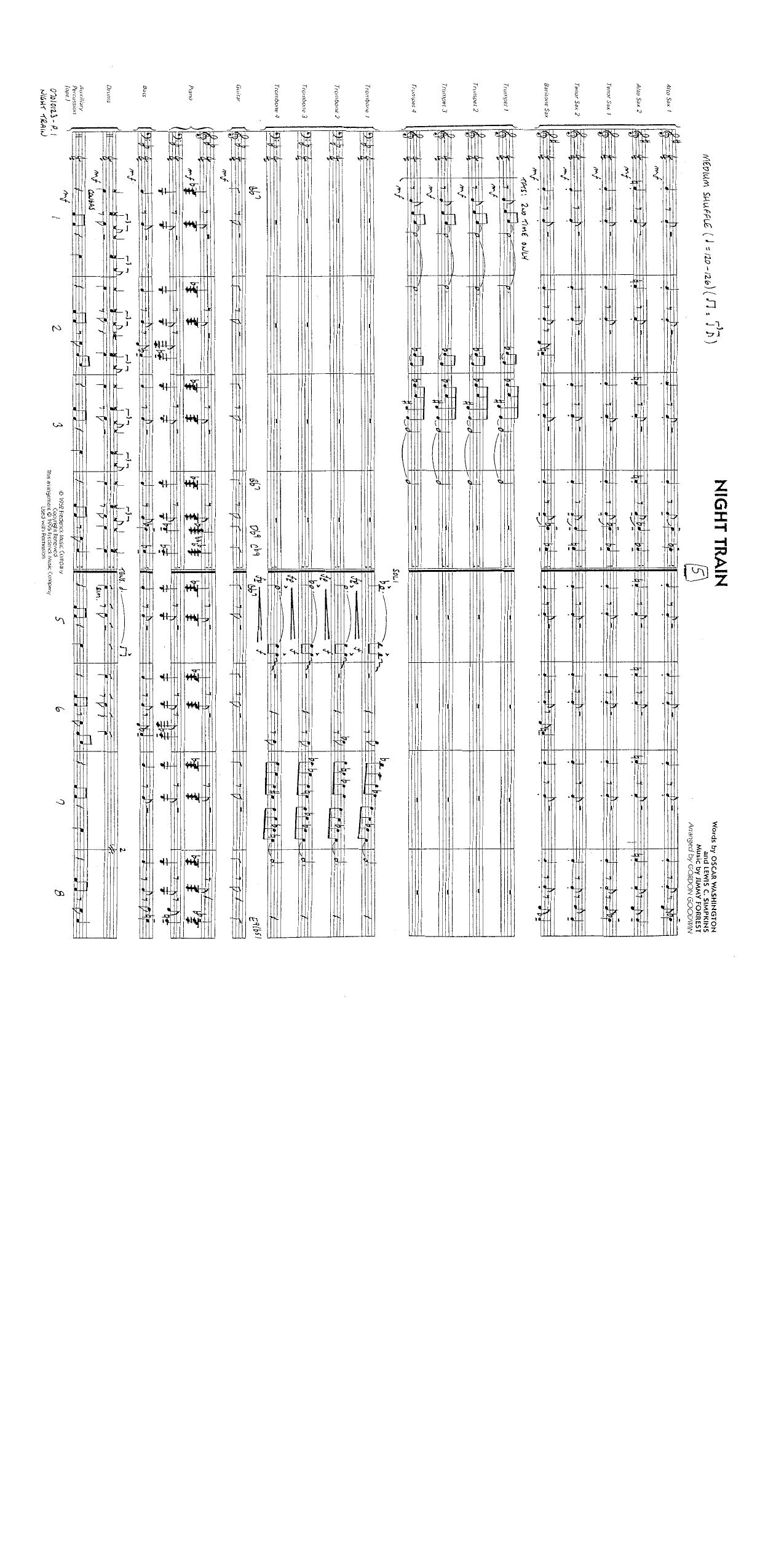
Night Train (G.Goodwin)
Composed by Jimmy Forrest
Arranged by Gordon Goodwin
- Ensemble: Big Band
- Pages: 50
- Instruments (18): Alto Sax 1, Alto Sax 2, Tenor Sax 1, Tenor Sax 2, Baritone Sax, Trumpet 1, Trumpet 2, Trumpet 3, Trumpet 4, Trombone 1, Trombone 2, Trombone 3, Trombone 4, Guitar, Piano, Bass, Drums, Aux. Percussion
- Difficulty: advanced
- Content: Individual Parts
- Format: PDF Download (Instant)
- Price: $24.99
Originally rooted in Lewis Cage's 1951 blues instrumental "Transit Blues," "Night Train" was popularized later that same year by tenor saxophonist Jimmy Forrest, whose driving, honking R&B-inflected rendition turned it into an instant rhythm-and-blues chart-topper and a staple of the jazz and jump-blues canon. Built upon a modified 12-bar blues progression borrowing heavily from Duke Ellington's 1940 recording "Happy-Go-Localy-Local" (specifically matching its famous train-imitating vamp), the composition represents a vital bridge between Kansas City swing, early rhythm and blues, and hard-driving big band jazz. Its infectious train-track groove and instantly recognizable riff have kept it a universal crowd-pleaser for decades. Gordon Goodwin’s signature big band treatment injects high-octane contemporary energy into this mid-century classic while honoring its blues-drenched roots. Set in a driving, high-energy medium-swing tempo (approximately quarter note = 168 BPM), the arrangement opens with the unmistakable rhythmic chug before expanding into a sprawling sonic landscape. Goodwin utilizes his trademark turbocharged harmonic vocabulary—featuring extended upper-structure dominants, tight chromatic voice-leading, and blistering brass counterlines—to transform a simple 12-bar blues into a masterclass of modern big band arranging. The energy builds relentlessly, fueled by razor-sharp sax solis, roaring shout choruses, and dynamic shifts that simulate the accelerating momentum of a locomotive roaring down the tracks. The arrangement heavily showcases the woodwind and brass sections, featuring dueling tenor saxophone and trumpet solos that demand confident, blues-inflected improvisational vocabulary. Technically demanding throughout, the chart requires exceptional ensemble tightness, particularly in the rapid-fire unison lines and crisp articulation required across all sections. The rhythm section is the engine room here; the drummer must maintain an insistent, driving ride cymbal swing pattern complete with train-imitating snare and hi-hat accents, while the bass player walks a heavy, relentless acoustic line. Memorable moments include a cascading full-ensemble soli that utilizes sophisticated modern block voicings juxtaposed against traditional blues shout figures. Advanced high school, collegiate, and professional jazz ensembles will find this chart an ideal centerpiece for a festival program or concert set. Because of the sophisticated articulation demands, fast tempo, and endurance required for the upper brass, it is best suited for groups with strong section leaders and experienced soloists. Performing this chart offers an exhilarating challenge that rewards precision and rewards audiences with an unforgettable, high-octane ride. Conductors should approach Gordon Goodwin’s "Night Train" with a strict focus on rhythmic precision and articulation. The primary technical challenge lies in maintaining a clean, driving swing feel at a brisk tempo without letting the quarter-note drag or rush. Horn players must execute short, clipped staccatos on the train-rhythm figures to emulate the crisp sound of steel wheels on tracks, utilizing exaggerated dynamic contrasts between whispered backgrounds and roaring shout choruses. Brass players should expect demanding high-register work and should utilize traditional jazz articulations—such as intentional doits, falls, and sharp accents—sparingly and with uniform intent across the section. Rehearsal should begin at a reduced tempo with the rhythm section locked tightly together, ensuring the bass and drums establish a heavy, authoritative groove before layering in the horn sections. Pay close attention to dynamic markings under soloists to ensure the ensemble acts as a dynamic cushion rather than an overpowering wall of sound. Q: What instruments and parts are included in this arrangement? A: This 18-instrument big band arrangement includes standard full instrumentation featuring two alto saxophones, two tenor saxophones, baritone saxophone, four trumpets, four trombones, piano, guitar, bass, and drums, accompanied by a comprehensive 50-page conductor score. Q: What is the difficulty level of this chart? A: This arrangement is graded as advanced (Level 4–5), making it best suited for accomplished collegiate, advanced high school, and professional big bands capable of handling brisk tempos and intricate ensemble passages. Q: What is the historical style and background of "Night Train"? A: Originally composed by Jimmy Forrest in 1951 from a blues tradition heavily influenced by Duke Ellington, this piece represents the intersection of Kansas City swing and early rhythm-and-blues. Q: What makes Gordon Goodwin's arrangement unique compared to other versions? A: Goodwin infuses the classic 12-bar blues structure with modern harmonic extensions, high-voltage brass counterlines, intricate contemporary sax solis, and a driving, cinematic energy that revitalizes the traditional melody. Q: What is the performance duration and recommended tempo for this arrangement? A: The arrangement performs at an energetic medium-swing tempo of approximately quarter note = 168 BPM, with a total duration of roughly 4 to 5 minutes depending on the length of the improvised solos.
Questions and answers
- What is included in the Night Train (G.Goodwin) PDF?
- The verified current file contains a conductor score and individual parts across 50 pages.
- How many instruments or parts are listed for Night Train (G.Goodwin)?
- The verified instrumentation list contains 18 entries for this Big Band arrangement.
- Who is credited for Night Train (G.Goodwin)?
- Composer: Jimmy Forrest. Arranger: Gordon Goodwin.
- What difficulty is listed for Night Train (G.Goodwin)?
- The verified difficulty level is advanced.
- Can I preview Night Train (G.Goodwin) before buying?
- Yes. The product page provides a preview generated from the current PDF file.
- How is Night Train (G.Goodwin) delivered?
- After successful payment, the digital PDF is made available for download. The displayed price is $24.99.
Musicians Also Search For
Night Train Gordon Goodwin PDF • Night Train Gordon Goodwin sheet music • Night Train arranged by Gordon Goodwin • Gordon Goodwin big band charts • Gordon Goodwin jazz arrangements PDF • Night Train Jimmy Forrest sheet music • Night Train Jimmy Forrest big band arrangements • Jimmy Forrest big band charts • Night Train big band arrangements • Night Train big band PDF download • Night Train jazz sheet music • big band sheet music download • Night Train conductor score PDF • Night Train individual parts download • Night Train sheet music PDF • buy Night Train sheet music • download Night Train PDF • Night Train jazz charts • best Gordon Goodwin big band arrangements • Jimmy Forrest arranged by Gordon Goodwin • Night Train printable sheet music • big band repertoire PDF