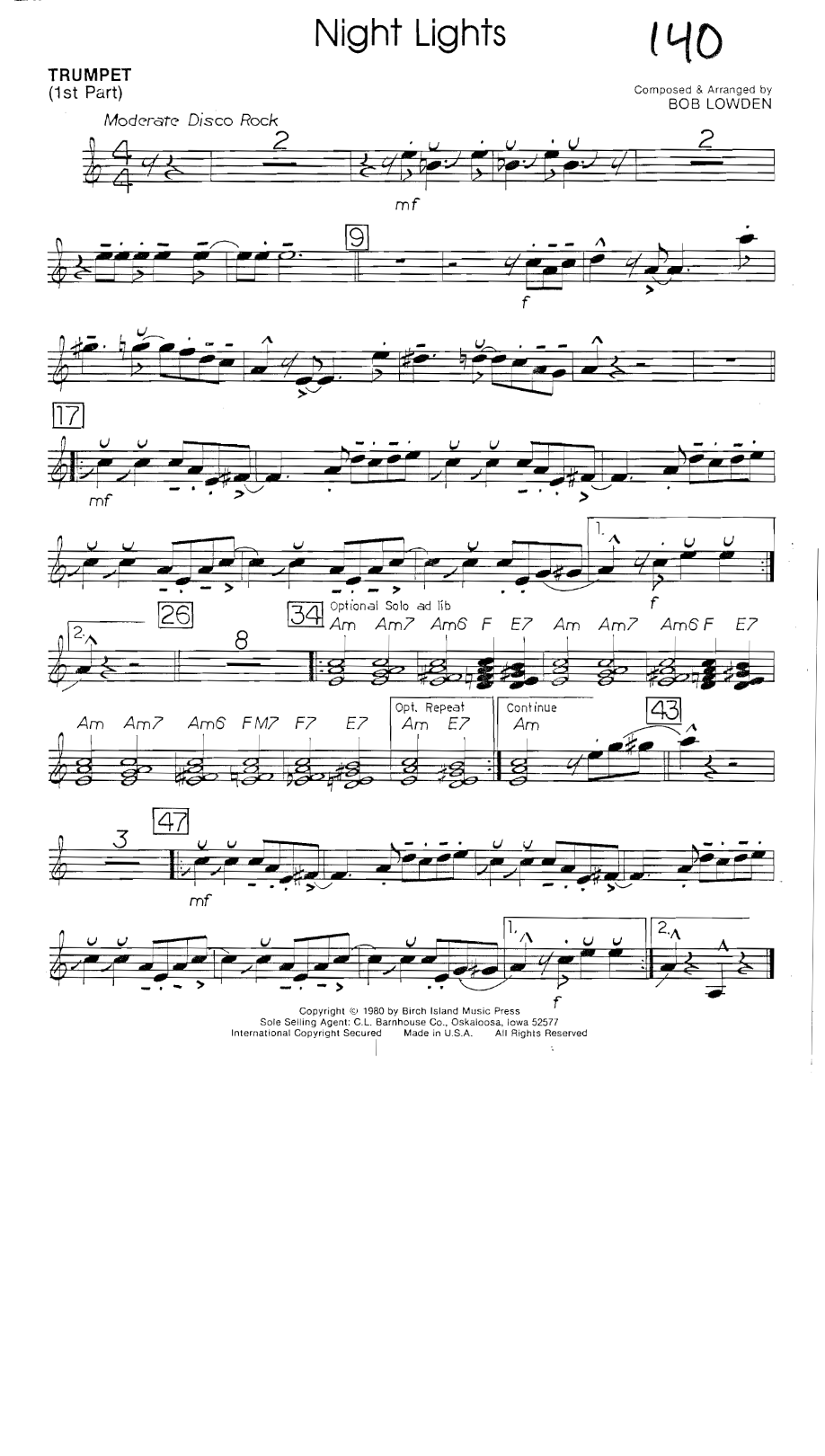
Night Lights (B.Lowden)
Composed by Bob Lowden
Arranged by Bob Lowden
- Ensemble: Small Ensemble
- Style: Jazz Standard
- Pages: 10
- Instruments (6): Trumpet (1st Part), Alto Sax (2nd Part), Trombone (3rd Part), Piano, Bass, Drums
- Difficulty: easy
- Content: Individual Parts
- Format: PDF Download (Instant)
- Price: $12.99
"Night Lights," a captivating jazz standard penned by the prolific Bob Lowden, emerges from an era when melodic invention and sophisticated harmony defined the genre. While the exact original composition date is often debated, Lowden's work generally falls within the mid-to-late 20th century, a period rich with the evolution of post-bebop and cool jazz influences, solidifying its place in the jazz repertoire. Lowden himself, a renowned composer and arranger, was instrumental in popularizing many pieces through his accessible yet musically rich treatments, making "Night Lights" a staple for small ensembles seeking a blend of familiarity and artistic depth. Its enduring appeal lies in its memorable melodic contours and harmonic elegance, which evoke a sense of nocturnal tranquility and urban sophistication, making it a timeless addition to any jazz ensemble's library. This arrangement of "Night Lights" is conceived as a medium swing ballad, typically set in a contemplative 4/4 meter, often in a key like E-flat major or C minor to enhance its reflective mood. The emotional landscape it traverses is one of introspective calm, perhaps with an underlying current of gentle melancholy or quiet optimism. The piece invites a nuanced performance, where dynamics and phrasing are paramount in conveying its subtle emotional shifts. Unlike more aggressive jazz forms, "Night Lights" thrives on a relaxed, unhurried feel, allowing each note to resonate and contribute to the overall atmospheric tapestry. The harmonic language is rich yet approachable, characterized by extended chords and smooth voice leading that are hallmarks of the jazz standard tradition. Bob Lowden's distinctive arranging style shines through in this small ensemble treatment. Known for his ability to craft arrangements that are both pedagogically sound and artistically satisfying, Lowden typically employs clear, logical voicings that allow for transparency within the ensemble. Expect carefully balanced soli sections that showcase the ensemble's blend, often featuring a blend of brass and reeds in unison or close harmony. While a full shout chorus might be less prominent in a ballad, Lowden often builds intensity through gradual dynamic swells and reharmonizations, leading to a satisfying climax before returning to a more subdued texture. The arrangement likely features a prominent melody carried initially by a lead instrument (e.g., trumpet or alto saxophone), followed by opportunities for featured solos, often over a harmonically rich chord progression that encourages expressive improvisation. Lowden's arrangements are celebrated for their playability, making complex jazz harmonies accessible without sacrificing musical integrity. Performing "Night Lights" is a rewarding experience for ensembles at various stages of development, particularly high school, college, and community jazz groups. The primary melody is typically presented by the lead alto saxophone or trumpet, with subsequent sections offering opportunities for other voices to carry melodic fragments or engage in counterpoint. Solo sections are usually open for improvisation, often with clear indications for chord changes, allowing soloists to explore the piece's harmonic landscape. Technical challenges primarily revolve around achieving a cohesive, blended sound, maintaining a consistent medium swing feel at a slower tempo, and executing precise dynamics and phrasing. The piece's inherent musicality and Lowden's thoughtful arrangement make it particularly satisfying to perform, fostering ensemble cohesion and individual expression through its lyrical lines and evocative harmonies. Approaching "Night Lights" requires a focus on sustained lines and a relaxed, yet precise, medium swing feel. Conductors should emphasize breath support and legato phrasing, particularly in the melody and soli sections, to achieve the desired smooth, lyrical quality. The tempo marking will typically be around quarter note = 80-96, but the 'feel' is more crucial than a rigid metronome setting; encourage musicians to listen and breathe together. Technical challenges include maintaining intonation within close voicings and executing dynamic swells and diminuendos with sensitivity. Rehearsal tips include isolating slow, sustained chords to perfect balance and blend, and encouraging soloists to develop melodic ideas rather than purely technical displays, focusing on the emotional arc of the piece. No special techniques like plunger mutes or doits are typically required, allowing the natural timbre of the instruments to shine. Q: What instruments/parts are included in this arrangement? A: This small ensemble arrangement typically includes parts for lead alto saxophone, tenor saxophone, baritone saxophone, 2 trumpets, 1-2 trombones, piano, bass, and drums. Specific instrumentation may vary slightly, but this forms the core. Q: What is the difficulty level of this arrangement? A: This arrangement is generally considered suitable for intermediate-level ensembles, such as advanced high school, college, or community jazz bands. It offers musical depth without overly complex technical demands, making it accessible yet rewarding. Q: What is the musical style and historical context of "Night Lights"? A: "Night Lights" is a jazz standard composed by Bob Lowden, typically performed as a medium swing ballad. It embodies the melodic and harmonic sophistication characteristic of mid-to-late 20th-century jazz, often associated with the cool jazz and post-bebop eras. Q: What makes Bob Lowden's arrangement of "Night Lights" unique? A: Lowden's arrangement is known for its clear, balanced voicings, allowing for transparent ensemble sound. It features well-crafted soli sections and provides excellent opportunities for expressive improvisation over rich harmonic progressions, making it both playable and musically satisfying. Q: What is the typical performance duration or tempo for this piece? A: "Night Lights" is usually performed as a medium swing ballad, with a tempo around quarter note = 80-96. A typical performance duration is approximately 3 to 4 minutes, depending on the number and length of improvised solos.
Questions and answers
- What is included in the Night Lights (B.Lowden) PDF?
- The verified current file contains individual parts across 10 pages.
- How many instruments or parts are listed for Night Lights (B.Lowden)?
- The verified instrumentation list contains 6 entries for this Small Ensemble arrangement.
- Who is credited for Night Lights (B.Lowden)?
- Composer: Bob Lowden. Arranger: Bob Lowden.
- What difficulty is listed for Night Lights (B.Lowden)?
- The verified difficulty level is easy.
- What style is listed for Night Lights (B.Lowden)?
- The catalog lists the style as Jazz Standard.
- Can I preview Night Lights (B.Lowden) before buying?
- Yes. The product page provides a preview generated from the current PDF file.
- How is Night Lights (B.Lowden) delivered?
- After successful payment, the digital PDF is made available for download. The displayed price is $12.99.
Musicians Also Search For
Night Lights Bob Lowden PDF • Night Lights Bob Lowden sheet music • Night Lights arranged by Bob Lowden • Bob Lowden small ensemble charts • Bob Lowden jazz arrangements PDF • Night Lights Bob Lowden small ensemble arrangements • Night Lights small ensemble arrangements • Night Lights small ensemble PDF download • Night Lights jazz sheet music • small ensemble sheet music download • Night Lights individual parts download • Night Lights sheet music PDF • Night Lights Jazz Standard charts • Jazz Standard small ensemble arrangements • buy Night Lights sheet music • download Night Lights PDF • Night Lights jazz charts • best Bob Lowden small ensemble arrangements • Night Lights printable sheet music • small ensemble repertoire PDF