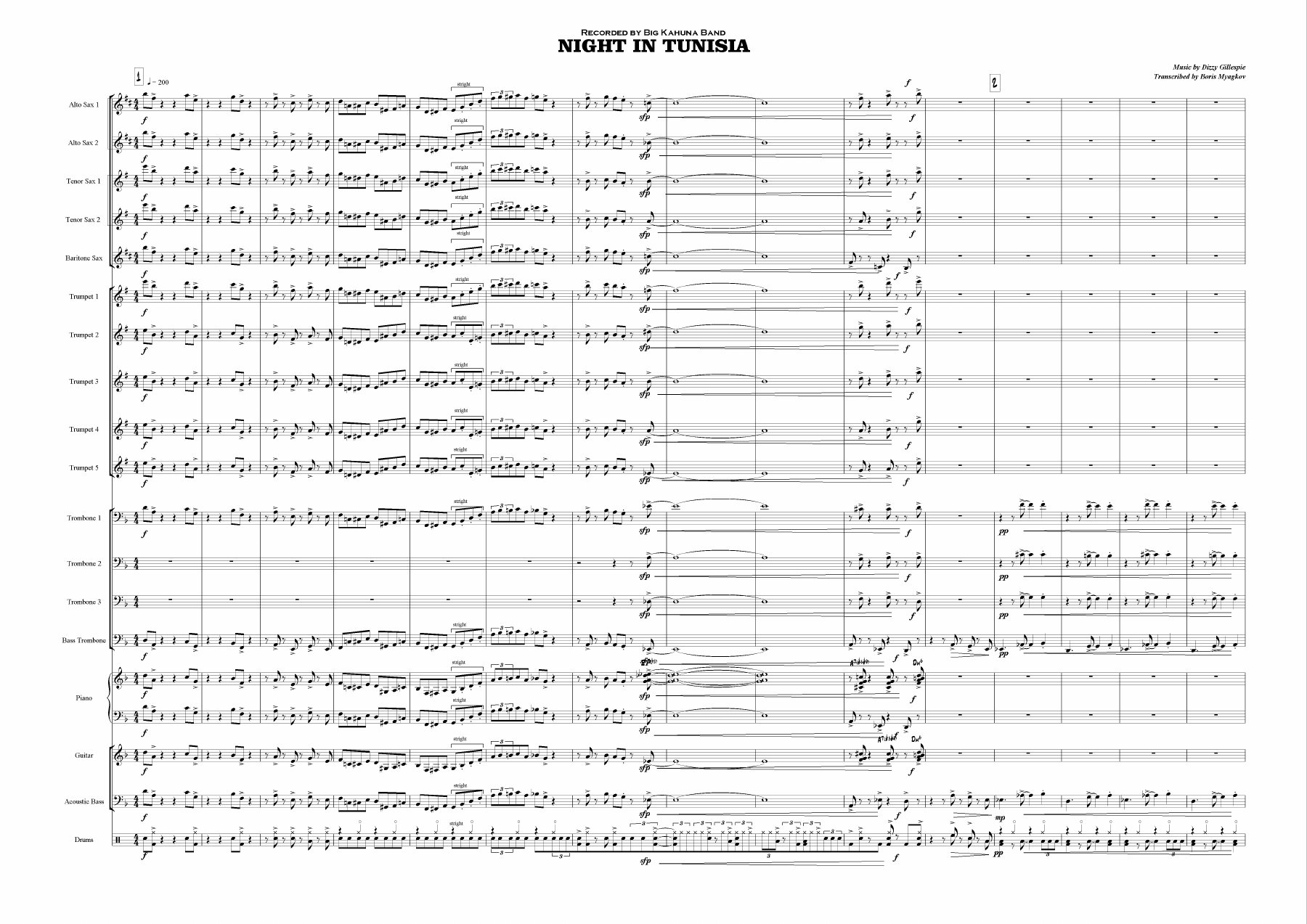
Night In Tunisia (B.Myagkov)
Composed by Dizzy Gillespie, Frank Paparelli
Arranged by Boris Myagkov
- Ensemble: Big Band
- Style: Jazz Standard
- Pages: 76
- Instruments (18): Alto Sax 1, Alto Sax 2, Tenor Sax 1, Tenor Sax 2, Baritone Sax, Trumpet 1, Trumpet 2, Trumpet 3, Trumpet 4, Trumpet 5, Trombone 1, Trombone 2, Trombone 3, Bass Trombone, Piano, Guitar, Acoustic Bass, Drums
- Difficulty: advanced
- Content: Individual Parts
- Format: PDF Download (Instant)
- Price: $24.99
Dizzy Gillespie’s "Night In Tunisia," co-credited with Frank Paparelli, stands as a monumental jazz standard, originally penned in 1942 while Gillespie was playing with the Benny Carter band. This seminal work emerged during the nascent stages of bebop, a revolutionary jazz style characterized by fast tempos, complex chord progressions, and virtuosic improvisation, largely pioneered by Gillespie himself alongside Charlie Parker. "Night In Tunisia" quickly became one of Gillespie's signature pieces, celebrated for its innovative fusion of bebop with Afro-Cuban rhythms, a groundbreaking approach that introduced a distinctive syncopation to the bass line and expanded the harmonic and rhythmic landscape of jazz. Its inclusion in the Grammy Hall of Fame in 2004 for Gillespie's 1946 RCA Victor recording underscores its enduring significance and status as an iconic jazz tune. Boris Myagkov’s arrangement of "Night In Tunisia" for big band captures the electrifying energy and intricate musicality of the original while re-imagining it for a larger ensemble. The piece maintains its characteristic medium-up tempo, driving with an insistent Latin groove in the "A" sections that seamlessly transitions into a swinging bebop feel for the "B" sections and solo passages. The mood is one of vibrant excitement and sophisticated tension, evoking exotic soundscapes and exhilarating rhythmic interplay. Myagkov, known for his meticulous transcriptions and arrangements that often feature robust voicings and dynamic contrasts, approaches this standard with a keen understanding of both its historical roots and its potential for contemporary big band expression. This arrangement features the iconic "A" section melody, often presented with a distinct "Oriental" or "desert vamp" feel, initially carried by the trumpet section, before evolving into rich saxophone soli passages. Solos are prominently featured, with ample space for improvisation over the tune's challenging yet rewarding harmonic structure, including the famous "break" that sets up the first soloist. Myagkov's treatment likely emphasizes intricate horn voicings that maintain clarity amidst the big band’s power, building to a thrilling shout chorus that showcases the full ensemble’s capabilities. The technical challenges lie in maintaining rhythmic precision across the Latin and swing sections, navigating rapid bebop lines, and executing tight ensemble figures. The reward is a performance that is both historically informed and creatively vibrant. With 18 instruments and 76 pages of score, this arrangement is ideally suited for college and advanced community big bands, as well as professional ensembles. Its demands on rhythmic accuracy, harmonic understanding, and improvisational prowess make it an excellent vehicle for developing musicianship at a high level. The arrangement provides a comprehensive musical experience, allowing bands to delve into the complexities of bebop and Afro-Cuban jazz while delivering a powerful and engaging performance that resonates with audiences familiar with this timeless standard. Conductors should emphasize rhythmic precision, particularly in the transitions between the Latin-infused "A" sections and the swinging "B" sections. The opening "desert vamp" requires a tight, percussive feel from the rhythm section, with the bass line providing a strong, syncopated foundation. Articulation is paramount for the horn sections to achieve the characteristic bebop phrasing and the sharp attacks of the Latin grooves. Encourage soloists to embrace the harmonic complexity, utilizing scales like D Harmonic Minor and Lydian Dominant over altered dominant chords. Pay close attention to dynamics, building intensity towards the shout chorus and allowing for contrast in the soli sections. Rehearsal time should be dedicated to isolating the "break" before the first solo, ensuring a unified and impactful execution. Q: What instruments are included in this arrangement? A: This big band arrangement includes parts for 18 instruments: Alto Saxophone 1, Alto Saxophone 2, Tenor Saxophone 1, Tenor Saxophone 2, Baritone Saxophone, four Trumpets, four Trombones, Piano, Guitar, Bass, and Drums, plus a conductor score. Q: What is the difficulty level of this arrangement? A: This arrangement is considered advanced, suitable for college, advanced community, and professional big bands due to its challenging rhythmic complexity, intricate harmonies, and demands on improvisational skill. Q: What is the musical style and historical context of "Night In Tunisia"? A: "Night In Tunisia" is a foundational jazz standard from the bebop era, composed by Dizzy Gillespie in 1942. It is renowned for blending bebop improvisation with innovative Afro-Cuban rhythmic elements. Q: What makes Boris Myagkov's arrangement of "Night In Tunisia" unique? A: Boris Myagkov's arrangement provides a comprehensive big band treatment, featuring robust voicings, dynamic soli sections, and a powerful shout chorus, while maintaining the original's characteristic Latin-to-swing transitions and providing ample space for featured solos. Q: What is the typical tempo and feel of this arrangement? A: This arrangement is designed for a medium-up tempo, driven by an insistent Latin groove in the "A" sections that shifts to a swinging bebop feel for the "B" sections and solo passages, creating a vibrant and energetic performance.
Questions and answers
- What is included in the Night In Tunisia (B.Myagkov) PDF?
- The verified current file contains a conductor score and individual parts across 76 pages.
- How many instruments or parts are listed for Night In Tunisia (B.Myagkov)?
- The verified instrumentation list contains 18 entries for this Big Band arrangement.
- Who is credited for Night In Tunisia (B.Myagkov)?
- Composer: Dizzy Gillespie, Frank Paparelli. Arranger: Boris Myagkov.
- What difficulty is listed for Night In Tunisia (B.Myagkov)?
- The verified difficulty level is advanced.
- What style is listed for Night In Tunisia (B.Myagkov)?
- The catalog lists the style as Jazz Standard.
- Can I preview Night In Tunisia (B.Myagkov) before buying?
- Yes. The product page provides a preview generated from the current PDF file.
- How is Night In Tunisia (B.Myagkov) delivered?
- After successful payment, the digital PDF is made available for download. The displayed price is $24.99.
Musicians Also Search For
Night In Tunisia Boris Myagkov PDF • Night In Tunisia Boris Myagkov sheet music • Night In Tunisia arranged by Boris Myagkov • Boris Myagkov big band charts • Boris Myagkov jazz arrangements PDF • Night In Tunisia Dizzy Gillespie, Frank Paparelli sheet music • Night In Tunisia Dizzy Gillespie, Frank Paparelli big band arrangements • Dizzy Gillespie, Frank Paparelli big band charts • Night In Tunisia big band arrangements • Night In Tunisia big band PDF download • Night In Tunisia jazz sheet music • big band sheet music download • Night In Tunisia conductor score PDF • Night In Tunisia individual parts download • Night In Tunisia sheet music PDF • Night In Tunisia Jazz Standard charts • Jazz Standard big band arrangements • buy Night In Tunisia sheet music • download Night In Tunisia PDF • Night In Tunisia jazz charts • best Boris Myagkov big band arrangements • Dizzy Gillespie, Frank Paparelli arranged by Boris Myagkov • Night In Tunisia printable sheet music • big band repertoire PDF