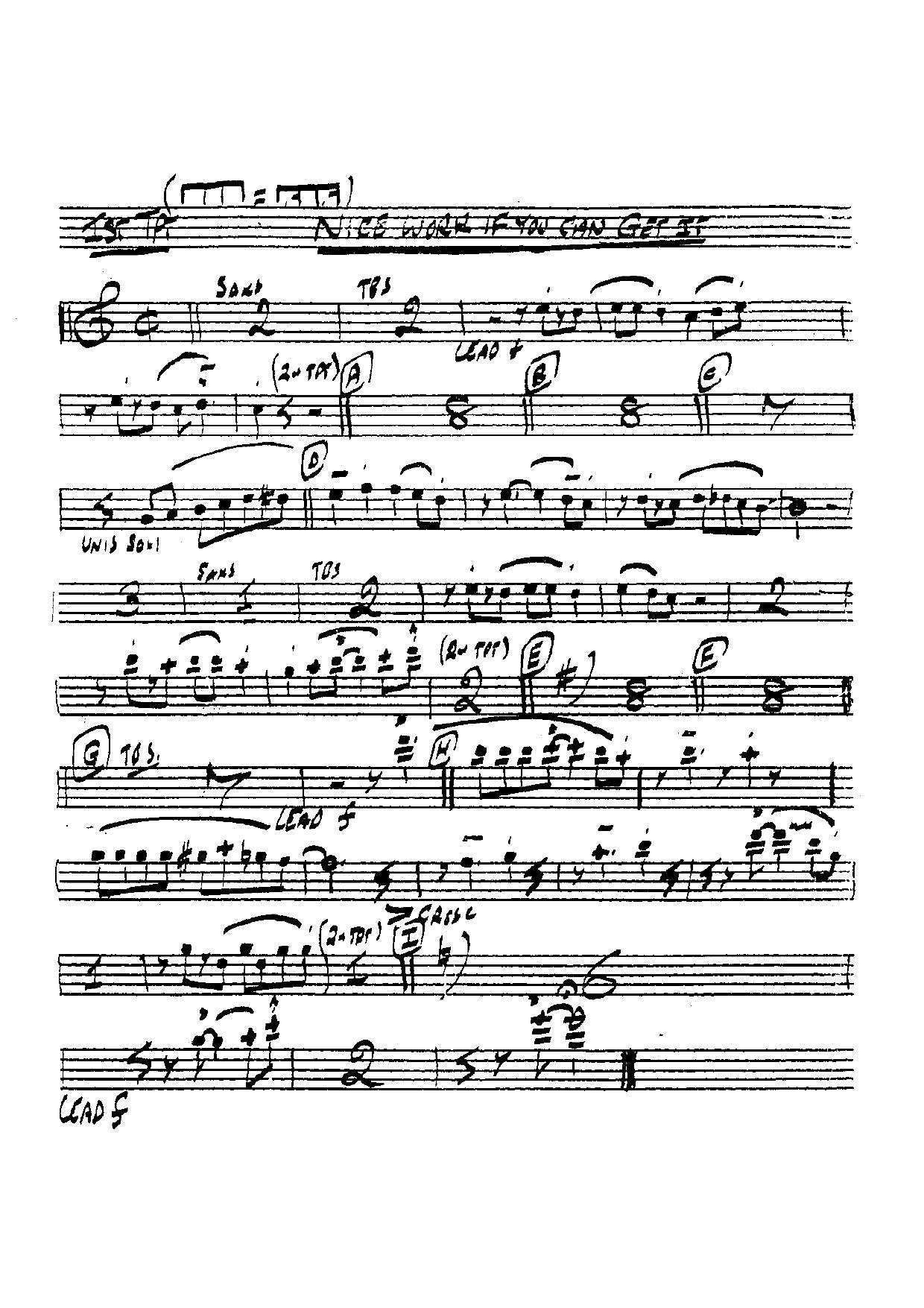
Nice Work If You Can Get It (J.Farley) sheet music preview

Nice Work If You Can Get It (J.Farley)

Composed by George Gershwin

Arranged by John Farley

  • Ensemble: Big Band
  • Pages: 30
  • Instruments (17): 1st Trumpet, 2nd Trumpet, 3rd Trumpet, 4th Trumpet, 1st Trombone, 2nd Trombone, 3rd Trombone, 4th Trombone, 1st Alto Saxophone, 2nd Alto Saxophone, 1st Tenor Saxophone, 2nd Tenor Saxophone, Baritone Saxophone, Bass, Drums, Piano, Guitar
  • Difficulty: medium
  • Content: Individual Parts
  • Format: PDF Download (Instant)
  • Price: $24.99

George Gershwin and Ira Gershwin introduced "Nice Work If You Can Get It" in the 1937 musical film *A Damsel in Distress*, starring Fred Astaire, where it quickly transcended its cinematic origins to become a cornerstone of the Great American Songbook. Immortalized by legendary interpreters like Ella Fitzgerald, Frank Sinatra, and countless small-group bebop sessions, the tune exemplifies the sophisticated yet swinging melodic architecture of the late 1930s Golden Age of Broadway. Its enduring appeal lies in its infectious, driving rhythm changes and a harmonically rich bridge that invites endless reinterpretation by jazz instrumentalists and arrangers alike. John Farley’s dynamic big band adaptation captures the sparkling optimism of the original while injecting a sophisticated, contemporary mainstream jazz vitality. Set in a bright, buoyant medium-up swing feel (approx. quarter note = 180 BPM), the chart opens with a crisp, rhythm-section-driven vamp that establishes an irrepressible groove before the full 17-piece ensemble enters with punchy, brass-led staccato hits. The mood throughout is ebullient, sophisticated, and swinging, evoking the polished elegance of mid-century Count Basie and Nelson Riddle collaborations while retaining a modern harmonic clarity that keeps both performers and audiences thoroughly engaged. Farley’s arrangement distinguishes itself through clever, interlocking counterpoint between the saxes and brass, utilizing rich upper-structure extensions and classic block-chord soli passages that showcase section cohesion. The arrangement features a tightly wound shout chorus that builds organically out of a subdued, walking-bass interlude, utilizing dynamic contrast to maximize its explosive impact. Horn voicings are meticulously crafted to ensure the lead trumpet and lead alto lines soar cleanly above the dense harmonic textures, while the rhythm section parts are thoughtfully written out with stylized comping suggestions that honor the traditional swing idiom without sounding dated. Melody statements are cleverly distributed across the ensemble, opening with a muted trumpet statement before handing the thematic reins to a lush full-ensemble sax soli. Improvisational opportunities are highlighted by an open solo section—ideally suited for tenor saxophone or piano—backed by swinging shout figures that maintain forward momentum. Technically, the chart demands a clean, articulate command of swing eighth-note phrasing, secure high-register work for the lead trumpet (up to written high C), and nimble fingerwork in the woodwinds for rapid scalar passages. Advanced high school, collegiate, and professional community jazz orchestras will find this chart an absolute crowd-pleaser that rewards careful sectional blend, rhythmic precision, and stylistic authenticity. Success with John Farley’s arrangement of "Nice Work If You Can Get It" hinges on maintaining a relentless, driving macro-pulse without rushing the tempo. The rhythm section must anchor the swing feel, with the drummer utilizing crisp ride-cymbal phrasing and sharp hi-hat chokes on beats two and four, while the bassist lays down a steady, acoustic-style walking quarter-note line. Brass players should approach accents with a warm, fat tone rather than an aggressive bite, keeping short notes crisp and long notes supported by continuous air stream. Pay careful attention to the dynamic shifts leading into the shout chorus; undercutting the volume during the transitional interlude will make the final peak exponentially more thrilling. Articulations must be uniform across sections, particularly during the saxophone soli where light tonguing on upbeats drives the rhythmic syncopation. Rehearsal should begin slowly with the rhythm section alone to lock in the groove before layering in the horns section by section. Q: What instruments and parts are included in the 17-instrument orchestration? A: The arrangement is scored for a standard 17-piece big band configuration, featuring 4 trumpets, 4 trombones, 5 saxophones (2 altos, 2 tenors, 1 baritone), and a 4-piece rhythm section comprising piano, guitar, bass, and drums. Q: What is the difficulty level of this arrangement? A: This chart is graded as advanced-intermediate to advanced, making it best suited for accomplished high school, collegiate, and professional big bands that possess strong sectional reading skills and a solid grasp of swing style. Q: What is the historical and stylistic context of this piece? A: Based on George and Ira Gershwin’s 1937 classic, this arrangement honors the traditional swing era and Great American Songbook aesthetic while incorporating contemporary harmonic colorations and dynamic structural pacing. Q: What makes John Farley’s arrangement unique? A: Farley’s chart stands out through its brilliant distribution of the melody across diverse instrumental combinations, sophisticated upper-structure chord voicings, and a carefully sculpted dynamic arc that culminates in a high-energy shout chorus. Q: What is the recommended performance duration and tempo? A: The arrangement plays out in approximately 3 to 4 minutes when performed at the recommended bright medium-swing tempo of approximately quarter note = 180 BPM.

Questions and answers

What is included in the Nice Work If You Can Get It (J.Farley) PDF?
The verified current file contains individual parts across 30 pages.
How many instruments or parts are listed for Nice Work If You Can Get It (J.Farley)?
The verified instrumentation list contains 17 entries for this Big Band arrangement.
Who is credited for Nice Work If You Can Get It (J.Farley)?
Composer: George Gershwin. Arranger: John Farley.
What difficulty is listed for Nice Work If You Can Get It (J.Farley)?
The verified difficulty level is medium.
Can I preview Nice Work If You Can Get It (J.Farley) before buying?
Yes. The product page provides a preview generated from the current PDF file.
How is Nice Work If You Can Get It (J.Farley) delivered?
After successful payment, the digital PDF is made available for download. The displayed price is $24.99.

Musicians Also Search For

Nice Work If You Can Get It John Farley PDFNice Work If You Can Get It John Farley sheet musicNice Work If You Can Get It arranged by John FarleyJohn Farley big band chartsJohn Farley jazz arrangements PDFNice Work If You Can Get It George Gershwin sheet musicNice Work If You Can Get It George Gershwin big band arrangementsGeorge Gershwin big band chartsNice Work If You Can Get It big band arrangementsNice Work If You Can Get It big band PDF downloadNice Work If You Can Get It jazz sheet musicbig band sheet music downloadNice Work If You Can Get It individual parts downloadNice Work If You Can Get It sheet music PDFbuy Nice Work If You Can Get It sheet musicdownload Nice Work If You Can Get It PDFNice Work If You Can Get It jazz chartsbest John Farley big band arrangementsGeorge Gershwin arranged by John FarleyNice Work If You Can Get It printable sheet musicbig band repertoire PDF

All arrangements by John Farley All George Gershwin sheet music