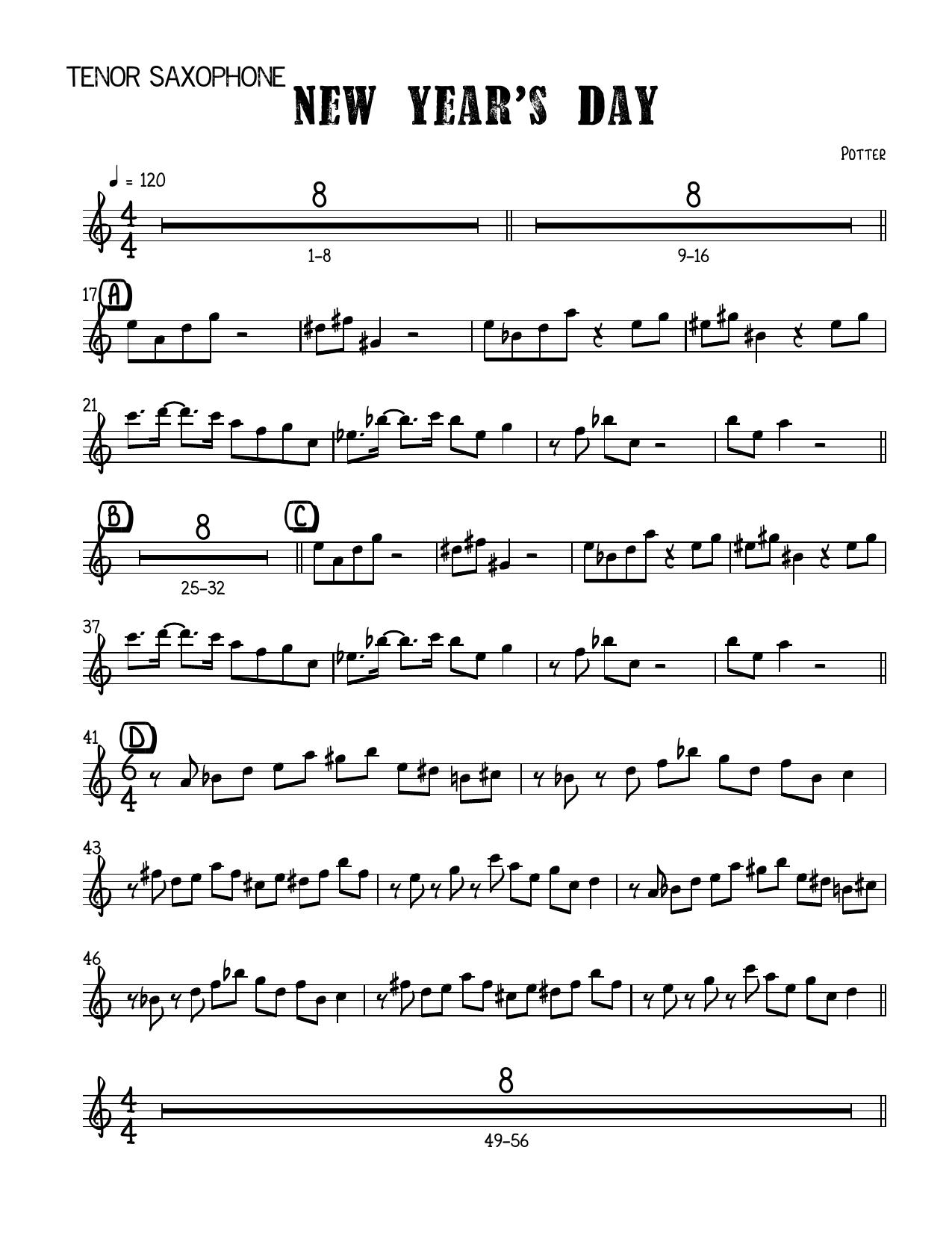
New Year's Day (C.Potter)
Composed by Chris Potter
Arranged by C.Potter
- Ensemble: Big Band
- Style: Jazz Standard
- Pages: 83
- Instruments (18): Tenor Saxophone (Solo), Alto Saxophone 1, Alto Saxophone 2, Tenor Saxophone 1, Tenor Saxophone 2, Baritone Saxophone, Trumpet 1, Trumpet 2, Trumpet 3, Trumpet 4, Trombone 1, Trombone 2, Trombone 3, Bass Trombone, Guitar, Piano, Bass Guitar, Drums
- Difficulty: advanced
- Content: Individual Parts
- Format: PDF Download (Instant)
- Price: $24.99
Chris Potter’s contemporary jazz masterpiece "New Year's Day" bridges the gap between post-bop innovation and modern big band architecture, capturing the sophisticated harmonic language and relentless rhythmic drive that defines twenty-first-century large ensemble writing. Originally associated with Potter's virtuosic small-group concepts and later expanded for adventurous orchestral settings, this composition embodies the restless exploration of contemporary jazz. It stands out not merely as a head-chart, but as an evolving narrative arc that challenges conventional big band forms through intricate metric modulation, dense chromatic counterpoint, and an overarching sense of celebratory yet introspective renewal. Driven by an energetic, contemporary groove that shifts fluidly between straight-eighth modern jazz feels and explosive modal swing, the composition opens with an arresting motivic cell in the low reeds before expanding across the entire brass section. The harmonic landscape is rich with extended altissimo voicings, upper-structure triads, and shifting tonal centers that evoke a mood of crisp winter clarity and dynamic forward momentum. The woodwinds frequently navigate labyrinthine, unison lines that test technical execution, while the brass counterlines provide monumental weight. A standout feature of the arrangement is an expansive, harmonically shifting soli section that showcases the saxophones in a tightly knit texture, seamlessly paving the way for a high-octane shout chorus designed to push the ensemble's endurance and dynamic range to the limit. C.Potter maintains a signature balance between intricate compositional depth and wide-open improvisational spaces, ensuring that the rhythm section serves as an active co-conspirator rather than a mere timekeeping unit. The primary melodic duties are shared dynamically between the lead alto saxophone and tenor saxophone, with ample solo space carved out for featured improvisers to stretch over sophisticated harmonic turnarounds. Technical hurdles center on precision articulation at brisk tempos, maintaining intonation through dense cluster voicings, and executing complex rhythmic unisons across the entire ensemble. For players, the ultimate reward lies in mastering the piece's sweeping crescendos and resolving harmonies, which deliver a profound emotional payoff during the climactic final measures. Advanced collegiate ensembles, premier youth jazz orchestras, and professional big bands will find this chart an extraordinary vehicle for stretching their technical and stylistic boundaries. Because of its demanding metric interplay, advanced harmonic vocabulary, and requirement for mature section blend, it is best suited for groups comfortable with modern post-bop idioms and contemporary orchestral jazz aesthetics. Conductors looking to program a substantial, intellectually stimulating, and visceral centerpiece for a concert will discover that this arrangement commands the attention of any audience from the first downbeat. Navigating "New Year's Day" successfully requires meticulous attention to articulation consistency and rhythmic precision, particularly during the fast-moving unison woodwind passages. The conductor should establish a rock-solid time feel with the rhythm section before layering in the complex horn figures, ensuring that straight-eighth sections maintain a forward-leaning, conversational momentum without rushing. Pay close attention to dynamic markings; the contrast between whispered subtones in the saxophones and brass punches must be exaggerated to maximize the chart's architectural impact. Drummers should approach the groove with a modern jazz sensibility, utilizing cymbal colorations and interactive snare accents rather than a heavy, predictable backbeat. Horn players must carefully voice their chords with an emphasis on the upper extensions, listening across the band to keep the complex cluster harmonies from muddying. Rehearsals should begin by isolating the dense soli sections at a slower tempo before gradually bringing them up to the performance mark, ensuring flawless execution of the intricate rhythmic subdivisions. Q: What instrumentation and parts are included in this publication? A: This 83-page big band publication is scored for an 18-instrument ensemble, featuring a full saxophone section (2 altos, 2 tenors, 1 baritone), standard brass instrumentation (trumpets and trombones), a complete rhythm section, and a comprehensive conductor score. Q: What is the difficulty level of this arrangement? A: This piece is graded as advanced/professional, designed specifically for top-tier college ensembles, youth jazz orchestras, and professional big bands capable of handling complex modern harmonies and rapid metric shifts. Q: What is the style and historical context of the piece? A: Rooted in the contemporary post-bop jazz tradition, the arrangement reflects the sophisticated compositional voice of modern master Chris Potter, blending intricate modal harmony with high-energy modern big band orchestration. Q: What makes this specific arrangement unique? A: It features C.Potter’s signature dense chromatic voicings, tightly interwoven woodwind unisons, an expansive saxophone soli, and a powerful shout chorus that reinterprets traditional big band forms through a contemporary lens. Q: What is the performance duration and tempo framework of the arrangement? A: While performance duration can vary based on individual solo lengths, the chart is built around a brisk, energetic tempo feel that demands sustained endurance and tight rhythmic control from the entire ensemble throughout its substantial multi-movement arc.
Questions and answers
- What is included in the New Year's Day (C.Potter) PDF?
- The verified current file contains a conductor score and individual parts across 83 pages.
- How many instruments or parts are listed for New Year's Day (C.Potter)?
- The verified instrumentation list contains 18 entries for this Big Band arrangement.
- Who is credited for New Year's Day (C.Potter)?
- Composer: Chris Potter. Arranger: C.Potter.
- What difficulty is listed for New Year's Day (C.Potter)?
- The verified difficulty level is advanced.
- What style is listed for New Year's Day (C.Potter)?
- The catalog lists the style as Jazz Standard.
- Can I preview New Year's Day (C.Potter) before buying?
- Yes. The product page provides a preview generated from the current PDF file.
- How is New Year's Day (C.Potter) delivered?
- After successful payment, the digital PDF is made available for download. The displayed price is $24.99.
Musicians Also Search For
New Year's Day C.Potter PDF • New Year's Day C.Potter sheet music • New Year's Day arranged by C.Potter • C.Potter big band charts • C.Potter jazz arrangements PDF • New Year's Day Chris Potter sheet music • New Year's Day Chris Potter big band arrangements • Chris Potter big band charts • New Year's Day big band arrangements • New Year's Day big band PDF download • New Year's Day jazz sheet music • big band sheet music download • New Year's Day conductor score PDF • New Year's Day individual parts download • New Year's Day sheet music PDF • New Year's Day Jazz Standard charts • Jazz Standard big band arrangements • buy New Year's Day sheet music • download New Year's Day PDF • New Year's Day jazz charts • best C.Potter big band arrangements • Chris Potter arranged by C.Potter • New Year's Day printable sheet music • big band repertoire PDF