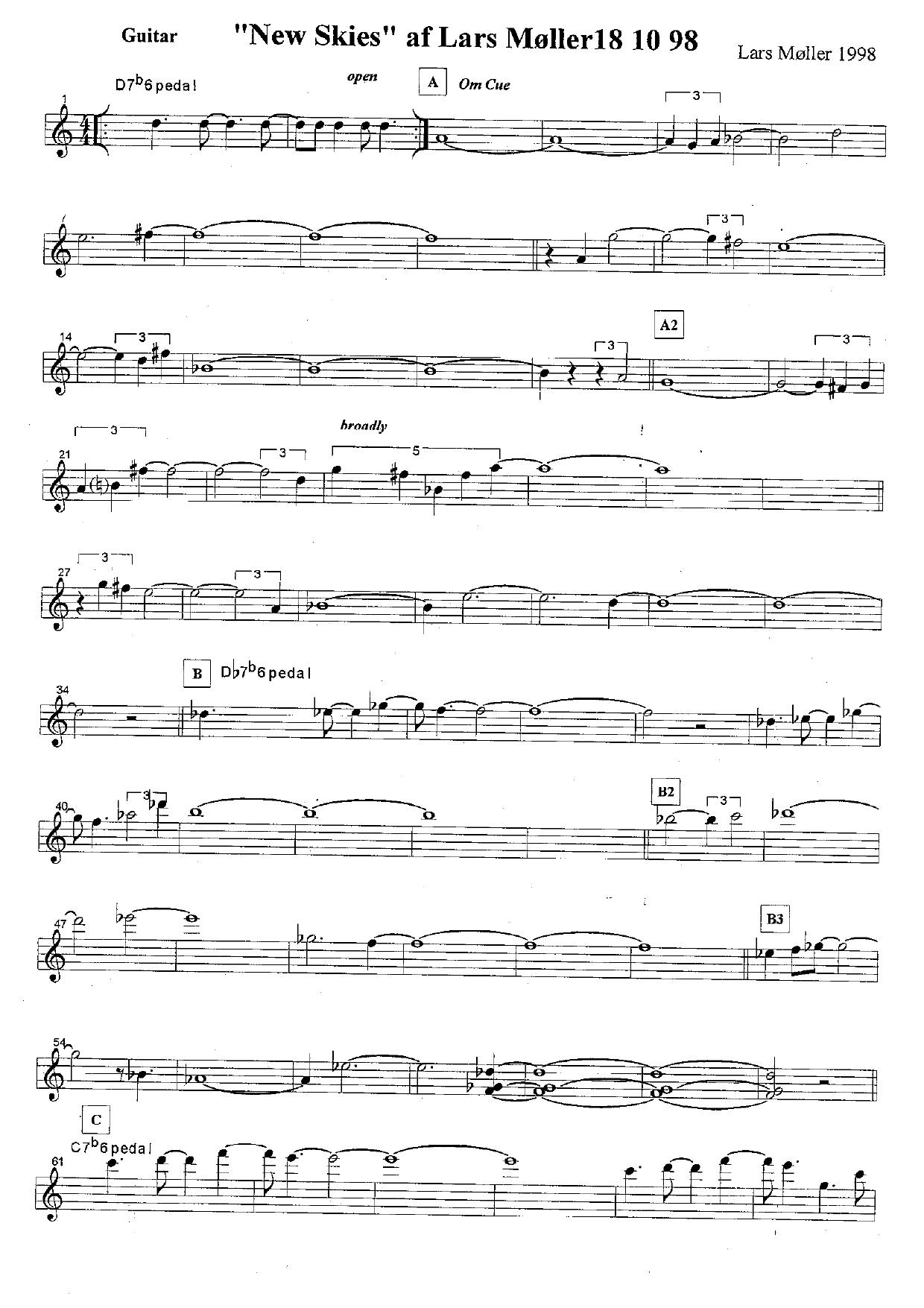
New Skies (L.Moller) sheet music preview

New Skies (L.Moller)

Composed by L. Moller

Arranged by L.Moller

  • Ensemble: Big Band
  • Style: Jazz Standard
  • Pages: 89
  • Instruments (17): Guitar, Piano, Drums, Bass, Alto Sax 1, Alto Sax 2, Tenor Sax 1, Tenor Sax 2, Baritone Sax, Trombone 1, Trombone 2, Trombone 3, Trombone 4, Trumpet 1, Trumpet 2, Trumpet 3, Trumpet 4
  • Difficulty: advanced
  • Content: Individual Parts
  • Format: PDF Download (Instant)
  • Price: $24.99

Capturing the sophisticated harmonic language of modern modal and post-bop idioms, "New Skies," composed and arranged by L. Moller, stands as a striking contemporary contribution to the big band repertoire. Rooted in the rich tradition of late 20th-century large ensemble writing that bridges post-bop complexity with accessible melodic flow, the piece draws inspiration from the compositional frameworks pioneered by masters like Wayne Shorter and Bob Brookmeyer. It reflects an era where big band jazz expanded beyond traditional swing-era constraints to embrace lush, open-voiced harmonies, shifting metric feels, and intricate counterpoint, establishing itself as a staple for modern jazz ensembles seeking to stretch their stylistic boundaries. "New Skies" unfolds at a driving, modal medium-up tempo (approx. quarter note = 192), establishing an atmosphere of restless momentum and expansive optimism. Set in a concert key that favors rich brass sonorities and dark woodwind textures, the composition balances lingering, contemplative suspended chords with aggressive, forward-driving rhythmic unisons. The emotional trajectory shifts seamlessly from introspective, rubato-tinged harmonic exploration in the introduction to an exuberant, high-energy groove that propels the ensemble through cascading dynamic peaks. The mood is at once intellectually stimulating and viscerally exciting, evoking the wide-open horizons suggested by its title through soaring trumpet lines and rolling drum textures. L. Moller’s arrangement treats the standard big band instrumentation as a unified chamber orchestra, utilizing dense, fourth-based voicings in the saxophones and rich, open brass cluster chords to create a modern harmonic palette. Rather than relying on standard sequential shout choruses, Moller crafts an intricate, interlocking counter-melody section that features a tightly integrated four-part saxophone soli, showcasing the arranger's affinity for linear writing. The arrangement builds tension through sophisticated harmonic modulation and metric displacement, giving the rhythm section an active, conversational role rather than merely a time-keeping function. The melodic narrative is initially introduced by the lead alto saxophone and flugelhorn, creating a warm, contemporary timbral blend before opening up to the entire ensemble. Featured improvisational space is allocated for tenor saxophone and piano, both of which navigate sophisticated modal changes over a shifting rhythmic bed. Technical challenges include maintaining crisp articulation during fast syncopated figures, executing wide dynamic shifts within compressed ensemble voicings, and achieving a unified blend across the brass section during exposed rubato passages. Advanced high school bands with strong section leaders, as well as collegiate and professional ensembles, will find this chart exceptionally rewarding for its ability to challenge technical precision while offering deep musical satisfaction. Conductors approaching "New Skies" should prioritize rhythmic precision and balance, particularly during the complex syncopated unisons that occur throughout the brass and saxophones. The core tempo of quarter note = 192 must remain rock-solid, even during rubato transitions and metric modulations. The rhythm section serves as the primary engine for the piece's shifting moods; the pianist should voice chords with open, non-clashing voicings (avoiding root-position clutter), while the drummer should lean heavily on cymbal coloration and subtle polyrhythms rather than a heavy, driving swing ride pattern. Saxophones must focus on a homogeneous tone during the soli section, ensuring that internal balances are maintained without overblowing. Brass players should utilize subtle falls and controlled vibrato sparingly, keeping the overall articulation clean, modern, and articulate. Rehearsal time should be dedicated to isolating the intricate counterpoint sections at a slower tempo before bringing them up to performance speed. Q: What instruments and parts are included in this arrangement? A: This arrangement is scored for a standard 17-piece big band instrumentation, featuring 5 saxophones (with double parts specified where necessary), 4 trumpets (doubling on flugelhorn where indicated), 4 trombones, guitar, piano, acoustic/electric bass, and drum set, totaling 89 pages of comprehensive score and parts. Q: What is the difficulty level of "New Skies"? A: This piece is classified as advanced, making it ideal for top-tier high school jazz bands, collegiate ensembles, and professional big bands that are comfortable with modern harmonic structures and complex syncopated unisons. Q: What is the musical style and historical context of the piece? A: "New Skies" is a contemporary jazz composition written in the post-bop and modal jazz tradition, drawing heavily from the sophisticated compositional approaches of late 20th-century large jazz ensembles. Q: What makes L. Moller’s arrangement unique? A: The arrangement stands out for its fourth-based saxophone voicings, integrated counterpoint, an intricate four-part saxophone soli, and its refusal to rely on traditional, formulaic shout choruses in favor of a progressive, narrative-driven structure. Q: What is the performance duration and tempo of the arrangement? A: The piece is designed to be performed at a driving, modal medium-up tempo of approximately quarter note = 192, with an estimated performance duration of around 6 to 7 minutes.

Questions and answers

What is included in the New Skies (L.Moller) PDF?
The verified current file contains individual parts across 89 pages.
How many instruments or parts are listed for New Skies (L.Moller)?
The verified instrumentation list contains 17 entries for this Big Band arrangement.
Who is credited for New Skies (L.Moller)?
Composer: L. Moller. Arranger: L.Moller.
What difficulty is listed for New Skies (L.Moller)?
The verified difficulty level is advanced.
What style is listed for New Skies (L.Moller)?
The catalog lists the style as Jazz Standard.
Can I preview New Skies (L.Moller) before buying?
Yes. The product page provides a preview generated from the current PDF file.
How is New Skies (L.Moller) delivered?
After successful payment, the digital PDF is made available for download. The displayed price is $24.99.

Musicians Also Search For

New Skies L.Moller PDFNew Skies L.Moller sheet musicNew Skies arranged by L.MollerL.Moller big band chartsL.Moller jazz arrangements PDFNew Skies L. Moller sheet musicNew Skies L. Moller big band arrangementsL. Moller big band chartsNew Skies big band arrangementsNew Skies big band PDF downloadNew Skies jazz sheet musicbig band sheet music downloadNew Skies individual parts downloadNew Skies sheet music PDFNew Skies Jazz Standard chartsJazz Standard big band arrangementsbuy New Skies sheet musicdownload New Skies PDFNew Skies jazz chartsbest L.Moller big band arrangementsL. Moller arranged by L.MollerNew Skies printable sheet musicbig band repertoire PDF

All arrangements by L.Moller