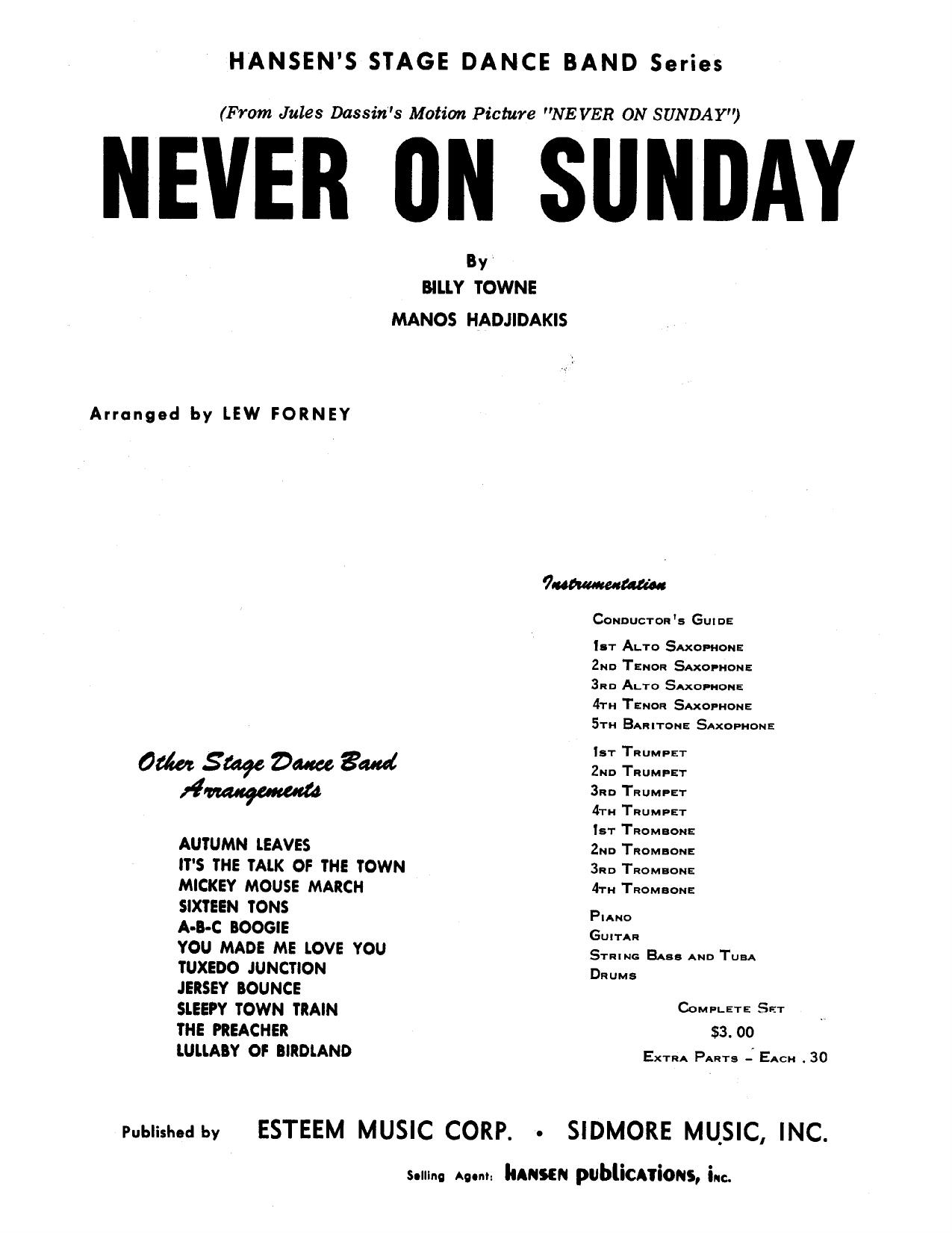
Never On Sunday (Billy Towne-Lew Forney)
Composed by Manos Hadjidakis
Arranged by Billy Towne-Lew Forney
- Ensemble: Big Band
- Style: Jazz Standard
- Pages: 39
- Instruments (18): Conductor's Guide, 1st Eb Alto Saxophone, 3rd Eb Alto Saxophone, 2nd Bb Tenor Saxophone, 4th Bb Tenor Saxophone, 5th Eb Baritone Saxophone, 1st Bb Trumpet, 2nd Bb Trumpet, 3rd Bb Trumpet, 4th Bb Trumpet, 1st Trombone, 2nd Trombone, 3rd Trombone, 4th Trombone, Piano, Bass & Tuba, Drums, Guitar
- Difficulty: medium
- Content: Individual Parts
- Format: PDF Download (Instant)
- Price: $24.99
Manos Hadjidakis’s timeless melody "Never on Sunday"—originally written for the 1960 Academy Award-winning film of the same name and popularized globally by Don Costa’s hit instrumental cover—has long occupied a cherished space where Mediterranean folk traditions intersect with American jazz sensibilities. Originally anchored by a distinctive Greek *tsifteteli* rhythm in 7/4 or rolling 4/4 feels, the tune quickly transitioned from cinematic leitmotif to a flexible vehicle for jazz improvisation. Its buoyant, modal-leaning melody provides an ideal canvas for modern arrangers looking to bridge infectious world-music grooves with traditional big band orchestration. In this sophisticated 17-instrument big band setting, arranger Billy Towne-Lew Forney reimagines the classic theme through a vibrant, high-energy jazz standard lens. The arrangement opens with an alluring modal vamp before settling into a driving, buoyant medium-up swing feel interspersed with subtle Latin-tinged modal breakdowns. The overall mood shifts dynamically from carefree, celebratory jubilation to tight, sophisticated sophistication, evoking the sun-drenched atmosphere of a Piraeus taverna filtered through a smoky mid-century jazz club. Rich extended harmonies, clever countermelodies, and unexpected harmonic turnarounds elevate the familiar tune far beyond a standard nostalgic nod. Towne-Lew Forney crafts a masterclass in dynamic contrast, utilizing lush, Ellingtonian saxophone voicings and punchy, brass-heavy punctuations to drive the narrative forward. The arrangement features a tightly integrated horn soli that reinterprets the iconic melody with intricate bebop-adjacent lines, setting the stage for a soaring shout chorus that builds inexorably in volume and rhythmic complexity. Trumpets and trombones trade crisp, articulated stabs against a rolling rhythm section groove, creating an infectious forward momentum that demands precision and clean articulation from every section. Advanced high school ensembles, collegiate jazz orchestras, and professional community big bands will find this chart to be an exceptionally rewarding centerpiece for a concert program. While the technical demands require confident section playing and nimble fingerwork—particularly in the woodwinds and lead trumpet—the intuitive phrasing and logical harmonic progressions make it accessible with dedicated section rehearsals. Featured solo space allows improvisers to stretch out over standard changes while the ensemble maintains a vibrant, textural backdrop that keeps audiences thoroughly engaged from the first downbeat to the final resounding chord. Success with this arrangement hinges on establishing a crisp, buoyant swing feel that never drags. The tempo should be kept at a comfortable medium-up clip, allowing the syncopated eighth-note figures to breathe without rushing. Conductors should pay close attention to the dynamic contrast between the understated, harmonized saxophone statements and the explosive brass shout choruses. Key technical challenges include executing the tight unison lines in the saxophone section cleanly, particularly during the chromatic modulations. Horn players should utilize controlled, straight-tone phrasing on the modal vamp sections before opening up to a warmer, jazz-informed vibrato during the main theme. The rhythm section is the engine here: the drummer should maintain a crisp, conversational ride cymbal pattern with steady hi-hat chicks on beats two and four, avoiding heavy-handed rock tendencies. Balance is crucial during the counterpoint sections; ensure the inner voices in the trombones do not obscure the primary melody carried by the lead alto and trumpet. Q: What instruments and parts are included in this arrangement? A: The 39-page package includes a full conductor score and individual parts for a standard 17-instrument big band lineup, consisting of five saxophones (1st Alto, 2nd Tenor, 3rd Alto, 4th Tenor, 5th Baritone), four trumpets, four trombones, and a full four-piece rhythm section (piano, bass, drums, and guitar). Q: What is the difficulty level of this chart? A: This arrangement is graded as advanced-intermediate to advanced, making it best suited for accomplished high school jazz ensembles, collegiate bands, and professional community big bands that are comfortable with syncopated rhythms and extended harmonies. Q: What is the musical style and historical background of the piece? A: Originally composed by Manos Hadjidakis for the 1960 film *Never on Sunday*, this arrangement reimagines the beloved Mediterranean melody as a vibrant, swinging jazz standard that blends classic modal textures with traditional big band orchestration. Q: What makes Billy Towne-Lew Forney’s arrangement unique? A: Towne-Lew Forney infuses the familiar cinematic theme with sophisticated harmonic turnarounds, rich Ellingtonian brass voicings, and an intricate, driving shout chorus that elevates the tune far beyond a nostalgic novelty. Q: What is the approximate performance duration and tempo feel? A: The arrangement runs approximately 4 to 5 minutes in duration and is anchored by an infectious, driving medium-up swing feel that keeps the energy high from start to finish.
Questions and answers
- What is included in the Never On Sunday (Billy Towne-Lew Forney) PDF?
- The verified current file contains a conductor score and individual parts across 39 pages.
- How many instruments or parts are listed for Never On Sunday (Billy Towne-Lew Forney)?
- The verified instrumentation list contains 18 entries for this Big Band arrangement.
- Who is credited for Never On Sunday (Billy Towne-Lew Forney)?
- Composer: Manos Hadjidakis. Arranger: Billy Towne-Lew Forney.
- What difficulty is listed for Never On Sunday (Billy Towne-Lew Forney)?
- The verified difficulty level is medium.
- What style is listed for Never On Sunday (Billy Towne-Lew Forney)?
- The catalog lists the style as Jazz Standard.
- Can I preview Never On Sunday (Billy Towne-Lew Forney) before buying?
- Yes. The product page provides a preview generated from the current PDF file.
- How is Never On Sunday (Billy Towne-Lew Forney) delivered?
- After successful payment, the digital PDF is made available for download. The displayed price is $24.99.
Musicians Also Search For
Never On Sunday Billy Towne-Lew Forney PDF • Never On Sunday Billy Towne-Lew Forney sheet music • Never On Sunday arranged by Billy Towne-Lew Forney • Billy Towne-Lew Forney big band charts • Billy Towne-Lew Forney jazz arrangements PDF • Never On Sunday Manos Hadjidakis sheet music • Never On Sunday Manos Hadjidakis big band arrangements • Manos Hadjidakis big band charts • Never On Sunday big band arrangements • Never On Sunday big band PDF download • Never On Sunday jazz sheet music • big band sheet music download • Never On Sunday conductor score PDF • Never On Sunday individual parts download • Never On Sunday sheet music PDF • Never On Sunday Jazz Standard charts • Jazz Standard big band arrangements • buy Never On Sunday sheet music • download Never On Sunday PDF • Never On Sunday jazz charts • best Billy Towne-Lew Forney big band arrangements • Manos Hadjidakis arranged by Billy Towne-Lew Forney • Never On Sunday printable sheet music • big band repertoire PDF