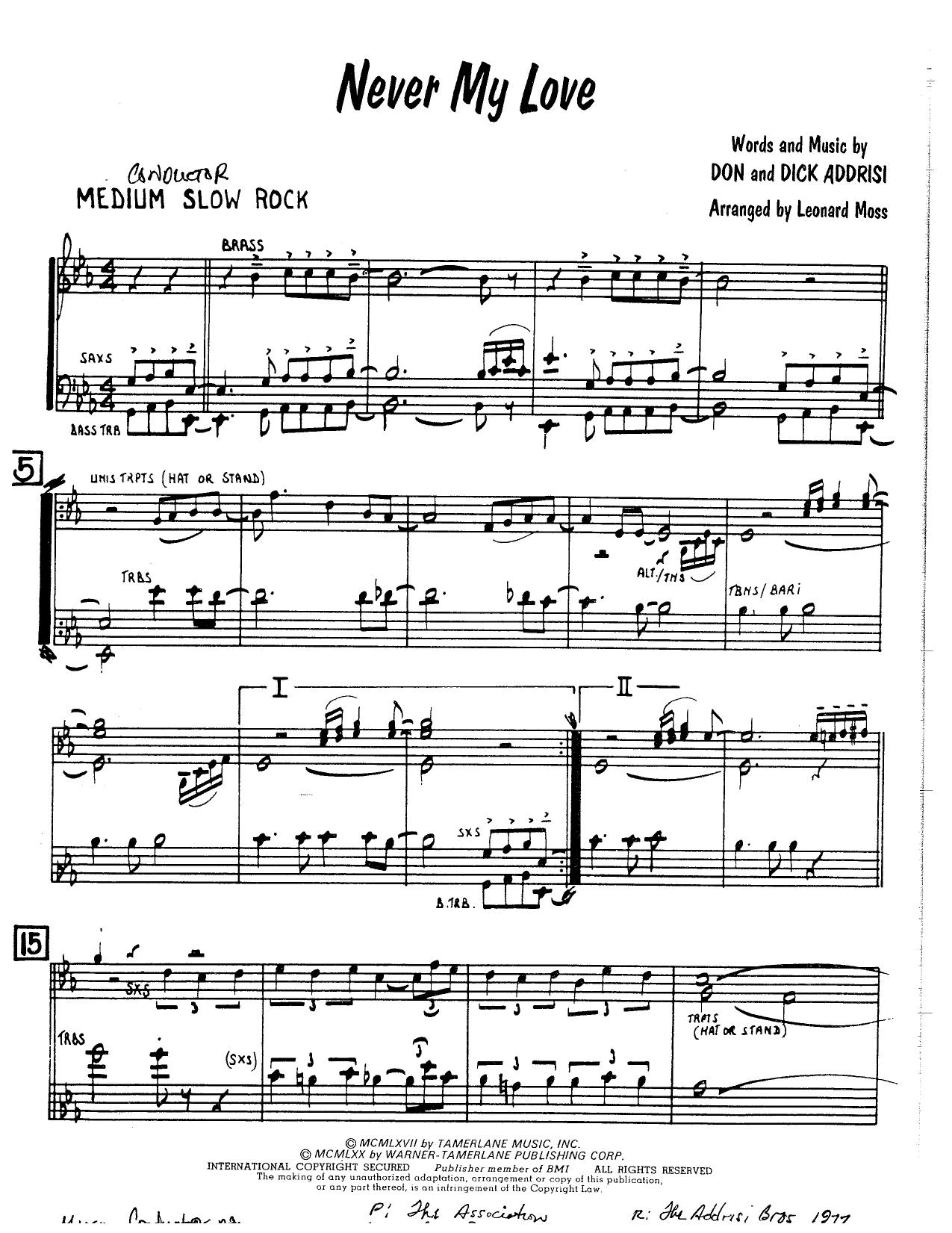
Never My Love (L.Moss)
Composed by Don Addrisi
Arranged by L.Moss
- Ensemble: Big Band
- Style: Jazz Standard
- Pages: 41
- Instruments (19): Conductor, 1st Alto Saxophone, 2nd Alto Saxophone, 1st Tenor Saxophone, 2nd Tenor Saxophone, Baritone Saxophone, Trumpet 1, Trumpet 2, Trumpet 3, Trumpet 4, 1st Trombone, 2nd Trombone, 3rd Trombone, 4th Trombone, Guitar, Piano, Bass Guitar, Bass, Drums
- Difficulty: medium
- Content: Individual Parts
- Format: PDF Download (Instant)
- Price: $24.99
Originally penned by brothers Don and Dick Addrisi and catapulted into pop history by The Association in 1967, "Never My Love" possesses a timeless, lush melodic contour that has long invited sophisticated jazz reinterpretation. While deeply rooted in the American pop-vocalese tradition, the composition’s sophisticated harmonic framework—built on smooth chromatic descents and rich minor-major tonal shifts—makes it a natural vehicle for contemporary big band arranging. In the hands of arranger L.Moss, this classic tune transcends its 1960s soft-rock origins, transforming into a sweeping, emotionally resonant jazz ballad that bridges mainstream appeal with modern harmonic sophistication. L.Moss frames the composition as an expressive, medium-tempo ballad featuring a flowing, rubato-infused 4/4 groove that eventually settles into a steady, warm pocket. The emotional trajectory moves from introspective vulnerability to soaring, widescreen grandeur. The arrangement opens with a delicate, atmospheric introduction featuring shimmering piano comping and muted brass whispers, establishing a contemplative mood before the full ensemble enters. The primary melody is initially delivered by a solo alto saxophone, supported by lush, flugelhorn-heavy brass voicings that evoke the cool-school elegance of the late 1950s. As the chart unfolds, L.Moss employs rich, extended chordal extensions—utilizing sharp 11ths and altered dominants—to inject a sophisticated modern jazz flavor without compromising the iconic melodic familiarity that audiences crave. A standout feature of this chart is a soaring, fully orchestrated sax soli that builds organically out of the bridge, demanding pristine intonation and unified phrasing across the reed section. This leads directly into a dynamic, rolling shout chorus that showcases the full dynamic spectrum of the 18-piece ensemble, climaxing in a brilliant brass peak before dropping back down for a tender, breath-of-air recapitulation. Rhythm section players will appreciate the detailed chart guidelines, which balance structured chord changes with space for expressive freedom, particularly for the rhythm guitar and pianist. Solo opportunities are tastefully integrated, spotlighting a featured tenor saxophone or trumpet over a lush, floating background of sustained brass pads. Advanced high school ensembles with strong section leaders, as well as collegiate and professional community big bands, will find this arrangement an ideal centerpiece for a concert program or festival set. While the technical demands are moderate regarding raw speed, the true challenge and reward lie in ensemble blend, breath control during long-tone phrases, and stylistic maturity. L.Moss has crafted an arrangement that rewards careful listening and sectional cohesion, offering a sophisticated vehicle that satisfies discerning jazz audiences while remaining deeply engaging for the performers on stage. Success with this arrangement hinges on exceptional breath support, ultra-smooth dynamic control, and careful balance within the brass and reed sections. The tempo should remain fluid yet grounded, anchored by a steady, understated ride cymbal pulse that avoids rushing the relaxed ballad feel. Conductors should pay close attention to the rubato style introductory phrases, ensuring the ensemble breathes together as one unit. During the saxophone soli, blend and intonation are paramount; reeds should match the vibrato width of the lead alto. Brass players must exercise restraint during the background figures behind the featured soloist, keeping mutes (if utilized) or open-horn tones warm and never brash. Rehearsal should begin with sectional work focusing on long, sustained chord transitions to lock in the rich extended harmonies. Balance the lower voices—bari sax, bass trombone, and bass—carefully to ensure the foundational root movements support the upper-structure alterations without muddying the texture. Q: What instruments and parts are included in this big band arrangement? A: This complete 18-instrument big band chart includes a full Conductor Score, two Alto Saxophones, two Tenor Saxophones, and a Baritone Saxophone. The brass section features standard parts for four Trumpets (with doubling options) and four Trombones, backed by a full rhythm section of Piano, Guitar, Bass, and Drums across a comprehensive 41-page publication. Q: What is the difficulty level of this L.Moss arrangement? A: This arrangement is graded as medium-advanced, making it exceptionally well-suited for advanced high school ensembles, collegiate jazz bands, and professional community big bands. While rapid technical execution is not the primary hurdle, the chart demands a high degree of maturity regarding intonation, breath control, ensemble blend, and expressive phrasing. Q: What is the musical style and historical background of "Never My Love"? A: Originally written by Don Addrisi and famously recorded by The Association in 1967, this piece has transitioned from a pop-chart staple into a versatile jazz standard. L.Moss's arrangement recasts the familiar tune as an expressive, contemporary jazz ballad characterized by rich, modern harmonic extensions and a lush, cinematic texture. Q: What makes this specific arrangement by L.Moss unique? A: This arrangement stands out through its masterly balance of nostalgic familiarity and modern harmonic sophistication, highlighted by a sweeping saxophone soli and a dynamically rich shout chorus. L.Moss utilizes extended chord voicings and subtle background textures that elevate a pop classic into a sophisticated, emotionally powerful jazz concert piece. Q: What is the performance duration and tempo feel of this piece? A: The arrangement is designed as a medium-tempo jazz ballad in 4/4 time, typically clocking in at around 4 to 5 minutes depending on the conductor's preferred rubato phrasing in the introduction and the length of the featured solo choruses.
Questions and answers
- What is included in the Never My Love (L.Moss) PDF?
- The verified current file contains a conductor score and individual parts across 41 pages.
- How many instruments or parts are listed for Never My Love (L.Moss)?
- The verified instrumentation list contains 19 entries for this Big Band arrangement.
- Who is credited for Never My Love (L.Moss)?
- Composer: Don Addrisi. Arranger: L.Moss.
- What difficulty is listed for Never My Love (L.Moss)?
- The verified difficulty level is medium.
- What style is listed for Never My Love (L.Moss)?
- The catalog lists the style as Jazz Standard.
- Can I preview Never My Love (L.Moss) before buying?
- Yes. The product page provides a preview generated from the current PDF file.
- How is Never My Love (L.Moss) delivered?
- After successful payment, the digital PDF is made available for download. The displayed price is $24.99.
Musicians Also Search For
Never My Love L.Moss PDF • Never My Love L.Moss sheet music • Never My Love arranged by L.Moss • L.Moss big band charts • L.Moss jazz arrangements PDF • Never My Love Don Addrisi sheet music • Never My Love Don Addrisi big band arrangements • Don Addrisi big band charts • Never My Love big band arrangements • Never My Love big band PDF download • Never My Love jazz sheet music • big band sheet music download • Never My Love conductor score PDF • Never My Love individual parts download • Never My Love sheet music PDF • Never My Love Jazz Standard charts • Jazz Standard big band arrangements • buy Never My Love sheet music • download Never My Love PDF • Never My Love jazz charts • best L.Moss big band arrangements • Don Addrisi arranged by L.Moss • Never My Love printable sheet music • big band repertoire PDF