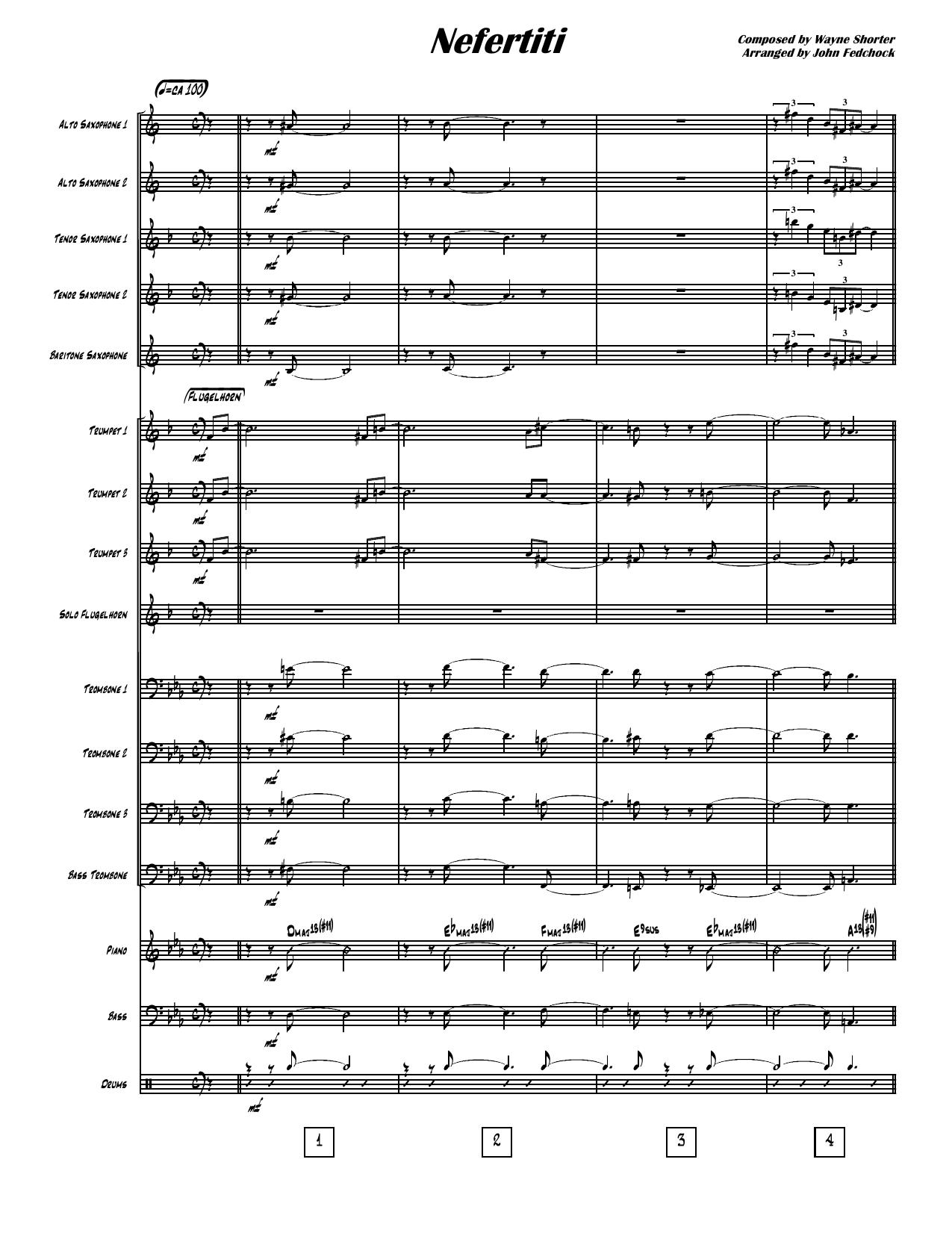
Nefertiti (J.Fedchock)
Composed by Wayne Shorter
Arranged by John Fedchock
- Ensemble: Big Band
- Pages: 50
- Instruments (16): Alto Saxophone 1, Alto Saxophone 2, Tenor Saxophone 1, Tenor Saxophone 2, Baritone Saxophone, Trumpet 1, Trumpet 2, Trumpet 3, Solo Flugelhorn, Trombone 1, Trombone 2, Trombone 3, Bass Trombone, Piano/Guitar, Bass, Drums
- Difficulty: advanced
- Content: Individual Parts
- Format: PDF Download (Instant)
- Price: $24.99
Wayne Shorter’s 1967 masterpiece, originally immortalized by the Miles Davis Quintet on the album of the same name, represents a pivotal moment in the evolution of post-bop jazz. The composition is celebrated for its revolutionary "circular" structure, where the haunting, serpentine melody is repeated continuously while the rhythm section provides the primary improvisational development. By translating this small-group classic into the big band idiom, John Fedchock captures the ethereal, mysterious essence of the original while expanding its harmonic palette through the sophisticated lens of modern large-ensemble writing. This arrangement serves as a bridge between the avant-garde sensibilities of the late 1960s and the powerful, coordinated precision of a contemporary jazz orchestra. The musical character of this arrangement is defined by a medium-tempo, floating swing feel that demands a high level of rhythmic maturity from the ensemble. Rather than a standard head-solo-head format, the piece maintains a sense of constant forward motion and atmospheric tension. The mood is sophisticated and slightly dark, utilizing Shorter’s signature non-functional harmony to create a landscape that feels both ancient and futuristic. Fedchock employs a rich, dense harmonic language, often utilizing clustered voicings and tertiary extensions that evoke a sense of longing and intellectual depth. The energy builds not through simple volume, but through the layering of textures and the increasing complexity of the rhythmic interplay between the horn sections and the drums. John Fedchock’s approach is unmistakable, characterized by the same virtuosic trombone-led sensibilities and linear contrapuntal writing that defined his work with the Woody Herman Orchestra and his own New York Big Band. In this treatment of "Nefertiti," Fedchock utilizes the saxophone section to carry the initial weight of the melody, often voiced in tight, harmonically rich blocks that mirror the fluidity of Shorter’s soprano saxophone. A standout feature of this arrangement is the way Fedchock orchestrates the "solos"; rather than isolated features, he weaves improvisational elements into the fabric of the ensemble, using shout choruses that feel like organic outgrowths of the main theme. His signature use of the trombone section for warm, foundational support and the trumpets for shimmering, high-register color creates a wide dynamic range that keeps the listener engaged throughout the 50-page score. Performing this arrangement requires an ensemble capable of nuanced expression and precise intonation. The technical challenges lie in the sustained phrasing of the melody and the ability of the brass to execute difficult intervals with a light, agile touch. It is an exceptionally rewarding piece for advanced ensembles, as it moves away from big band clichés and toward a more symphonic jazz aesthetic. Due to the harmonic sophistication and the required rhythmic independence of the rhythm section, this arrangement is best suited for professional-level bands, elite university jazz ensembles, or highly advanced community groups looking to challenge their musicians with a cornerstone of modern jazz literature. The primary challenge in "Nefertiti" is maintaining the "floating" feel of the 12-bar melody without losing the underlying pulse. The conductor should emphasize a legato approach in the saxophone soli sections, ensuring that the staggered breathing does not interrupt the circular flow of the phrase. The rhythm section, particularly the drummer, must be encouraged to interact aggressively with the melody—mimicking Tony Williams’ approach on the original recording—rather than simply keeping time. Trumpet players should be prepared for demanding ranges that require consistent breath support to maintain the "cool" aesthetic of the piece. Special attention should be paid to the balance of the low brass; the bass trombone and baritone saxophone must provide a firm but agile foundation for the complex upper-structure harmonies. Rehearsals should focus on the transition points where the ensemble density shifts, ensuring the crescendos feel structural rather than merely loud. Q: What is the specific instrumentation required for this John Fedchock arrangement? A: This arrangement is scored for a 16-piece big band consisting of 5 saxophones (2 altos, 2 tenors, 1 baritone), 4 trumpets, 4 trombones (including a dedicated bass trombone part), and a 3-piece rhythm section of piano, bass, and drums. The 50-page package includes a full conductor’s score and all individual instrumental parts. Q: How difficult is this arrangement to perform for a standard high school band? A: This is a professional-level (Grade 5 or 6) arrangement that features complex harmonic voicings and requires significant rhythmic independence. While a very advanced high school band might tackle it, it is most appropriate for collegiate or professional ensembles due to the sophisticated phrasing and range requirements. Q: Does this arrangement follow the traditional "solos followed by a shout chorus" structure? A: No, Fedchock stays true to the spirit of the original Wayne Shorter composition by emphasizing the repetition of the melody as the primary vehicle for development. The arrangement builds intensity through orchestral layering and ensemble textures rather than a long string of individual soloists. Q: What musical style and era does this piece represent? A: The piece is a modern big band reimagining of a 1967 post-bop jazz standard. It combines the modal and non-functional harmonic explorations of the 1960s with the contemporary linear writing style characteristic of John Fedchock’s New York Big Band. Q: What is the recommended tempo and approximate duration of the piece? A: The arrangement is intended to be played at a medium-slow to medium "floating" swing tempo, typically between 110 and 125 BPM. Depending on the conductor's interpretation of the repeats and the length of the drum interjections, the performance duration is approximately 6 to 8 minutes.
Questions and answers
- What is included in the Nefertiti (J.Fedchock) PDF?
- The verified current file contains a conductor score and individual parts across 50 pages.
- How many instruments or parts are listed for Nefertiti (J.Fedchock)?
- The verified instrumentation list contains 16 entries for this Big Band arrangement.
- Who is credited for Nefertiti (J.Fedchock)?
- Composer: Wayne Shorter. Arranger: John Fedchock.
- What difficulty is listed for Nefertiti (J.Fedchock)?
- The verified difficulty level is advanced.
- Can I preview Nefertiti (J.Fedchock) before buying?
- Yes. The product page provides a preview generated from the current PDF file.
- How is Nefertiti (J.Fedchock) delivered?
- After successful payment, the digital PDF is made available for download. The displayed price is $24.99.
Musicians Also Search For
Nefertiti John Fedchock PDF • Nefertiti John Fedchock sheet music • Nefertiti arranged by John Fedchock • John Fedchock big band charts • John Fedchock jazz arrangements PDF • Nefertiti Wayne Shorter sheet music • Nefertiti Wayne Shorter big band arrangements • Wayne Shorter big band charts • Nefertiti big band arrangements • Nefertiti big band PDF download • Nefertiti jazz sheet music • big band sheet music download • Nefertiti conductor score PDF • Nefertiti individual parts download • Nefertiti sheet music PDF • buy Nefertiti sheet music • download Nefertiti PDF • Nefertiti jazz charts • best John Fedchock big band arrangements • Wayne Shorter arranged by John Fedchock • Nefertiti printable sheet music • big band repertoire PDF