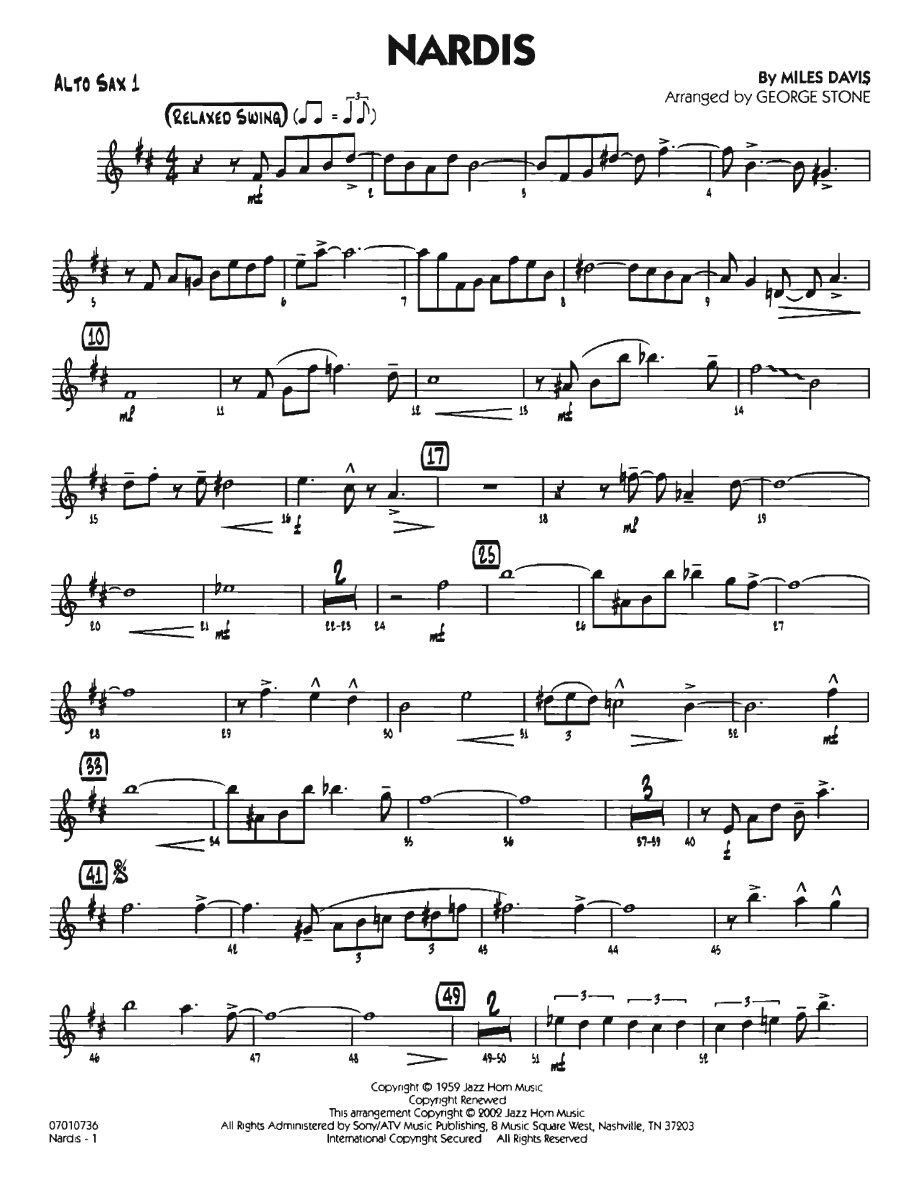
Nardis (G.Stone) sheet music preview

Nardis (G.Stone)

Composed by Bill Evans

Arranged by George Stone

  • Ensemble: Big Band
  • Pages: 49
  • Instruments (17): Alto Sax 1, Alto Sax 2, Tenor Sax 1, Tenor Sax 2, Baritone Sax, Trumpet 1 (Flugel), Trumpet 2 (Flugel), Trumpet 3 (Flugel), Trumpet 4 (Flugel), Trombone 1, Trombone 2, Trombone 3, Trombone 4, Guitar, Piano, Bass, Drums
  • Difficulty: medium
  • Content: Individual Parts
  • Format: PDF Download (Instant)
  • Price: $24.99

Composed by legendary pianist Bill Evans in 1961, "Nardis" stands as one of the most enigmatic and enduring modal compositions in the modern jazz canon. Originally written for Cannonball Adderley’s *Know What I Mean?* album before becoming a permanent fixture of Evans’s own trio repertoires, the piece reflects a profound fascination with modal jazz and Eastern-influenced exoticism. Built around haunting, descending Dorian and Phrygian structures, "Nardis" challenges conventional harmonic motion, urging improvisers to explore dark, atmospheric sonic landscapes far removed from standard blues or standard changes. Master arranger George Stone reimagines this modal masterwork for full jazz ensemble, injecting the 17-piece big band with a palpable sense of cinematic tension and kinetic energy. Operating at a brisk, driving tempo with a relentless rhythmic undercurrent, the chart trades the intimate introspection of Evans’s trio for sweeping, multi-textured power. The mood shifts masterfully between brooding, secretive unison lines and explosive, brass-heavy climaxes that evoke the vast, windswept character of the original melody. Stone utilizes sophisticated extended harmonies and dense, contemporary voicings that preserve the modal ambiguity of the original while expanding its dynamic and textural palette. Throughout the arrangement, the woodwind section frequently anchors the thematic material, weaving agile counterlines beneath searing brass interventions. Stone constructs rich saxophone solis that unpack the labyrinthine melody with fluid grace, while leaving ample structural space for featured soloists to build intense, narrative-driven improvisations over the shifting modal framework. Technical demands center on rhythmic precision within complex syncopated figures, crisp articulation across rapid scalar passages, and the ability to sustain a high level of expressive intensity over a driving groove. The rhythm section acts as the primary engine, requiring a sophisticated, interactive approach to modal accompaniment rather than a standard, time-keeping swing feel. Advanced collegiate, community, and professional jazz orchestras will find this chart an exceptional vehicle for showcasing technical finesse and collective maturity. Because of its demanding harmonic language, intricate ensemble interplay, and reliance on sophisticated stylistic interpretation, it is best suited for experienced groups capable of balancing subtle, atmospheric understatement with thunderous, high-energy ensemble power. Conductors approaching George Stone’s arrangement of "Nardis" must prioritize rhythmic clarity and dynamic restraint during the exposed modal intro to establish its distinct atmosphere. The tempo should remain steady and forward-moving, avoiding any tendency to rush the fast swing or modal groove sections. Saxophone and brass sections need to pay meticulous attention to balance, ensuring that inner-voice harmonies and contemporary voicings are clearly voiced beneath the primary melody. Rhythm section players should approach the chart with a modern sensibility; the drummer must drive the ensemble without overpowering the delicate modal voicings, utilizing cymbals for color rather than heavy-handed timekeeping. Pianists and bassists should lean into the suspended, open-ended quality of the harmonies, avoiding overly dense root-position chords that might muddy Stone’s sophisticated writing. Rehearsals should focus initially on sectional isolation of the complex unison lines and rhythmic unisons before attempting full-ensemble integration at performance tempo. Q: What instruments and parts are included in this arrangement? A: This chart is scored for a standard 17-piece big band instrumentation, featuring 5 saxophones (2 altos, 2 tenors, 1 baritone), 4 trumpets, 4 trombones, and a standard rhythm section of piano, bass, drums, and guitar, supported by a comprehensive 49-page conductor score. Q: What is the difficulty level of this arrangement? A: This arrangement is graded as advanced, making it ideal for collegiate, advanced high school, and professional jazz ensembles that possess strong reading skills and familiarity with contemporary modal harmony. Q: What is the historical context and musical style of "Nardis"? A: Originally composed by Bill Evans in 1961, "Nardis" is a cornerstone modal jazz composition that draws on Middle Eastern scalar influences and features a dark, hypnotic character distinct from standard functional harmonic jazz. Q: What makes George Stone's arrangement unique? A: Stone transforms an intimate trio standard into a massive, cinematic big band journey by utilizing contemporary extended voicings, rich textural contrasts, and powerful, driving ensemble climaxes while preserving the piece's core modal tension. Q: What is the performance duration and tempo feel of the piece? A: The arrangement is built around a brisk, driving modal-swing tempo that demands sustained rhythmic energy and focus, typically resulting in a performance duration of approximately 5 to 7 minutes depending on solo spaces.

Questions and answers

What is included in the Nardis (G.Stone) PDF?
The verified current file contains a conductor score and individual parts across 49 pages.
How many instruments or parts are listed for Nardis (G.Stone)?
The verified instrumentation list contains 17 entries for this Big Band arrangement.
Who is credited for Nardis (G.Stone)?
Composer: Bill Evans. Arranger: George Stone.
What difficulty is listed for Nardis (G.Stone)?
The verified difficulty level is medium.
Can I preview Nardis (G.Stone) before buying?
Yes. The product page provides a preview generated from the current PDF file.
How is Nardis (G.Stone) delivered?
After successful payment, the digital PDF is made available for download. The displayed price is $24.99.

Musicians Also Search For

Nardis George Stone PDFNardis George Stone sheet musicNardis arranged by George StoneGeorge Stone big band chartsGeorge Stone jazz arrangements PDFNardis Bill Evans sheet musicNardis Bill Evans big band arrangementsBill Evans big band chartsNardis big band arrangementsNardis big band PDF downloadNardis jazz sheet musicbig band sheet music downloadNardis conductor score PDFNardis individual parts downloadNardis sheet music PDFbuy Nardis sheet musicdownload Nardis PDFNardis jazz chartsbest George Stone big band arrangementsBill Evans arranged by George StoneNardis printable sheet musicbig band repertoire PDF

All arrangements by George Stone All Bill Evans sheet music