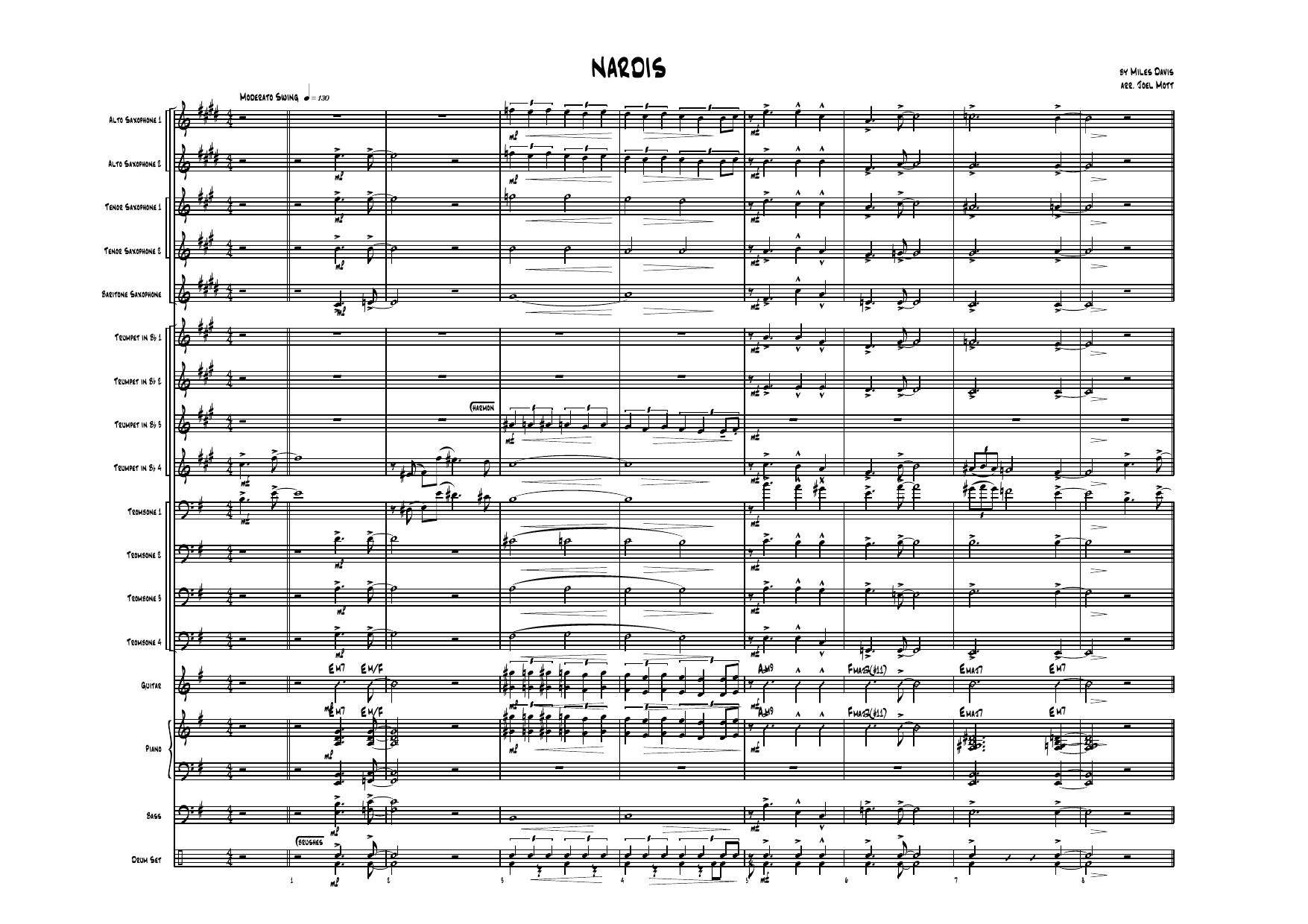
Nardis (J.Mott) sheet music preview

Nardis (J.Mott)

Composed by Miles Davis

Arranged by J.Mott

  • Ensemble: Big Band
  • Style: Jazz Standard
  • Pages: 71
  • Instruments (17): Alto Saxophone 1, Alto Saxophone 2, Tenor Saxophone 1, Tenor Saxophone 2, Baritone Saxophone, Trumpet in Bb 1, Trumpet in Bb 2, Trumpet in Bb 3, Trumpet in Bb 4, Trombone 1, Trombone 2, Trombone 3, Trombone 4, Guitar, Piano, Bass, Drum Set
  • Difficulty: advanced
  • Content: Individual Parts
  • Format: PDF Download (Instant)
  • Price: $24.99

Miles Davis composed "Nardis" in 1958, a fascinating modal composition that first appeared on Cannonball Adderley’s landmark album *Somethin' Else*. Though Miles rarely performed it live himself, the tune became irrevocably linked to the legendary pianist Bill Evans, who adopted it as a staple of his trio repertoires for decades. Steeped in a distinct modal framework infused with Middle Eastern and Spanish minor colorations, "Nardis" stands apart from standard 32-bar AABA forms, offering improvisers a haunting, atmospheric landscape built on a unique harmonic architecture. Its enduring appeal lies in its dark, hypnotic intensity and the vast improvisational freedom it affords adventurous ensembles. J.Mott’s ambitious big band adaptation transforms this intimate modal vehicle into a sweeping, cinematic powerhouse. Operating at a smoldering, driving medium tempo with a taut, perpetual-motion groove, the arrangement maintains the brooding mystique of the original while expanding its canvas into massive orchestral textures. The mood shifts expertly between tense, whispered unison lines and explosive, brass-heavy climaxes. Mott utilizes rich, extended chord voicings—frequently leveraging fourth-intervals and chromatic inner-voice movement—to heighten the harmonic suspense, capturing the essence of Evans' impressionistic harmonic palette translated to a 17-piece jazz orchestra. The arrangement opens with a atmospheric, rhythm-section-driven vamp before the saxophones introduce the sinuous head in tight, intertwined voicings. As the charts builds, Mott deploys dense brass counterlines that weave beneath the melody, creating a polyphonic texture that feels both modern and deeply rooted in jazz tradition. A soaring, high-energy shout chorus acts as the emotional apex of the chart, utilizing full-ensemble dynamic swells and sharp rhythmic punches to test the band's articulation and stamina. Featured solo space is thoughtfully integrated, allowing ample room for a tenor saxophone or piano soloist to stretch out over the modal vamps. Advanced high school, collegiate, and professional big bands will find this arrangement an exceptionally rewarding centerpiece for a festival program or concert set. The chart demands a mature rhythm section capable of maintaining a relentless, subtle drive without rushing, as well as a horn section with strong intonation for complex, rubato-leaning chord clusters. Directors programming J.Mott’s "Nardis" will discover a sophisticated vehicle that challenges the ensemble's listening skills, balance, and stylistic cohesion while delivering a profound impact on the audience. Conductors tackling J.Mott’s arrangement of "Nardis" must prioritize rhythmic precision and dynamic contrast. The primary technical challenge lies in executing the dense, interlocking horn lines cleanly at a driving medium tempo without letting the articulation become heavy. Emphasize a light, forward-moving eighth-note feel that avoids a cliché swing cadence, keeping the modal atmosphere taut and hypnotic. The rhythm section serves as the anchor: the drummer should utilize atmospheric cymbals and conversational snare drops during the quieter head statements, building to a relentless, driving cymbal pulse beneath the solo sections and shout chorus. Bassists must lock in with the piano's left-hand rootless voicings to ground the shifting modal centers. Pay special attention to the dynamic markings leading into the shout chorus; pulling back to a stark piano before unleashing a fortissimo wall of sound will maximize the dramatic tension intrinsic to Mott's scoring. Q: What instruments and parts are included in this arrangement? A: This big band chart is scored for a standard 17-instrument ensemble: 5 saxophones (Alto 1, Alto 2, Tenor 1, Tenor 2, Baritone), 4 trumpets, 4 trombones, guitar, piano, bass, and drums, alongside a comprehensive conductor score. Q: What is the difficulty level of this chart? A: This arrangement is graded as advanced, making it best suited for college ensembles, advanced high school bands, and professional community jazz orchestras with strong section leaders and experienced soloists. Q: What is the musical style and historical background of "Nardis"? A: Originally composed by Miles Davis in 1958 and famously championed by Bill Evans, "Nardis" is a modal jazz standard characterized by its dark, Middle Eastern-inflected harmony and departure from standard blues or 32-bar forms. Q: What makes J.Mott's arrangement unique? A: Mott successfully translates the intimate, impressionistic trio aesthetic of Bill Evans into a massive 17-piece orchestrations, utilizing extended fourth-voicings, intricate counterlines, and a powerful dynamic arc culminating in a striking shout chorus. Q: What is the performance duration and tempo feel of the piece? A: The arrangement runs approximately 6 to 7 minutes depending on solo lengths, set at a driving, smoldering medium tempo that emphasizes modal tension and rhythmic momentum over a fast swing feel.

Questions and answers

What is included in the Nardis (J.Mott) PDF?
The verified current file contains a conductor score and individual parts across 71 pages.
How many instruments or parts are listed for Nardis (J.Mott)?
The verified instrumentation list contains 17 entries for this Big Band arrangement.
Who is credited for Nardis (J.Mott)?
Composer: Miles Davis. Arranger: J.Mott.
What difficulty is listed for Nardis (J.Mott)?
The verified difficulty level is advanced.
What style is listed for Nardis (J.Mott)?
The catalog lists the style as Jazz Standard.
Can I preview Nardis (J.Mott) before buying?
Yes. The product page provides a preview generated from the current PDF file.
How is Nardis (J.Mott) delivered?
After successful payment, the digital PDF is made available for download. The displayed price is $24.99.

Musicians Also Search For

Nardis J.Mott PDFNardis J.Mott sheet musicNardis arranged by J.MottJ.Mott big band chartsJ.Mott jazz arrangements PDFNardis Miles Davis sheet musicNardis Miles Davis big band arrangementsMiles Davis big band chartsNardis big band arrangementsNardis big band PDF downloadNardis jazz sheet musicbig band sheet music downloadNardis conductor score PDFNardis individual parts downloadNardis sheet music PDFNardis Jazz Standard chartsJazz Standard big band arrangementsbuy Nardis sheet musicdownload Nardis PDFNardis jazz chartsbest J.Mott big band arrangementsMiles Davis arranged by J.MottNardis printable sheet musicbig band repertoire PDF

All arrangements by J.Mott All Miles Davis sheet music