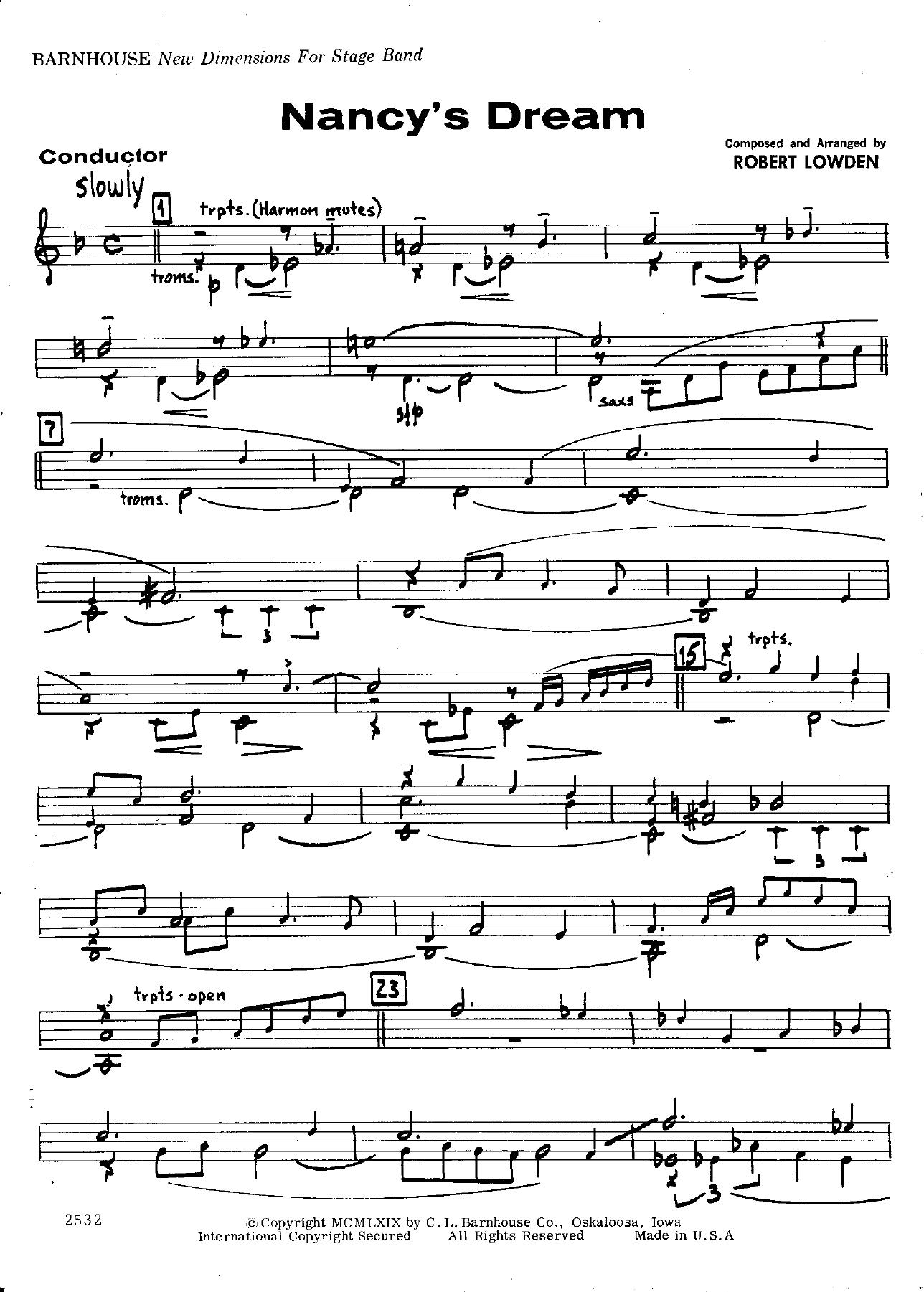
Nancy's Dream (B.Lowden) sheet music preview

Nancy's Dream (B.Lowden)

Composed by Bob Lowden

Arranged by Bob Lowden

  • Ensemble: Big Band
  • Pages: 25
  • Instruments (17): 1st Eb Alto Saxophone, 2nd Eb Alto Saxophone, 1st Bb Tenor Saxophone, 2nd Bb Tenor Saxophone, Eb Baritone Saxophone, 1st Bb Trumpet, 2nd Bb Trumpet, 3rd Bb Trumpet, 4th Bb Trumpet, 1st Trombone, 2nd Trombone, 3rd Trombone, 4th Trombone, Guitar, Piano, Bass, Drums
  • Difficulty: medium
  • Content: Individual Parts
  • Format: PDF Download (Instant)
  • Price: $24.99

Bob Lowden’s "Nancy’s Dream" stands as a quintessential exemplar of mid-century big band writing, capturing the sophisticated harmonic language and swinging vitality that defined the era's educational and professional jazz landscape. Composed and arranged by the prolific Lowden—a master craftsman renowned for his idiomatic, highly playable charts that never sacrifice artistic integrity—this composition reflects the rich tradition of swing-era balladry infused with contemporary jazz-harmonic colorations. While not an obscure avant-garde experiment, "Nancy’s Dream" operates in that coveted sweet spot of traditional big band repertoire, offering an accessible yet deeply rewarding journey through lush chord changes, lyrical melodic contours, and an engaging dynamic arc that naturally commands an audience's attention. The musical character of "Nancy’s Dream" is defined by a warm, evocative medium-tempo swing feel that seamlessly transitions between tender, introspective lyrical passages and vibrant, full-ensemble climaxes. Built upon a flowing 4/4 meter, the piece opens with a captivating, atmospheric introduction that establishes a reflective mood in a comfortable, brass-friendly key center. Lowden masterfully balances rich, block-chord sax solis with punchy, conversational interjections from the brass section. The emotional landscape shifts gracefully from nostalgic and dreamy to uplifting and exuberant, driving toward a cohesive shout chorus that highlights the dynamic capabilities of a fully-voiced jazz orchestra without demanding excessive high-note heroics from the lead trumpet. Lowden’s signature arranging approach prioritizes transparent counterpoint, rich secondary dominants, and intelligent doubling that ensures every section of the 17-piece ensemble remains thoroughly engaged. The melody is introduced primarily by the saxophone section, supported by subtle, shimmering background figures in the muted brass, before opening up into a collaborative ensemble texture. Solo opportunities are thoughtfully integrated into the form, allowing featured improvisers space to stretch out over standard-esque changes while the rhythm section lays down an infectious, buoyant groove. The technical demands are cleverly distributed: while the chart features sophisticated syncopation and articulate swing phrasing, the ranges remain within comfortable parameters, making it an exceptional vehicle for developing musicality, blend, and stylistic cohesion. Advanced high school ensembles, collegiate jazz orchestras, and professional community big bands will find "Nancy’s Dream" an ideal centerpiece for festival programs, formal concerts, or recorded projects. Its structural clarity allows conductors to focus deeply on articulation, dynamic shading, and stylistic nuance—such as proper placement of the backbeat and the execution of clean, weightless swing eighth notes. Musicians will relish the sophisticated harmonic voice-leading, while audiences will connect instantly with the memorable melodic themes and the satisfying, traditional momentum of Lowden’s timeless writing. Conductors should approach "Nancy’s Dream" with a primary focus on stylistic uniformity and dynamic control, ensuring the lighter passages maintain an airy, floating quality. The tempo should be kept at a relaxed, swinging medium pace; pushing the tempo too hard will dilute the dreamy, expressive quality embedded in the composer's conception. Attention must be paid to the articulation of swing eighth notes, keeping them light, connected, and driven by a strong, understated pulse from the rhythm section (particularly the hi-hat on beats two and four). Saxophones should prioritize a rich, homogeneous blend during the soli sections, utilizing gentle vibrato to enhance the vocal quality of the lines. Brass players should focus on warm, rounded tones rather than aggressive edge, reserving brass bites and falls strictly for designated accents to preserve the sophisticated mood. The rhythm section pianist should voice chords cleanly with minimal clutter, letting the bass player walk a steady, supportive line that anchors the harmonic shifts. Balance is the ultimate key to success here: the accompanying brass must dynamically recede whenever the saxophones carry the primary melodic weight. Q: What specific instruments and parts are included in this 17-instrument big band arrangement? A: The instrumentation comprises a standard 17-piece big band layout: 1st Eb Alto Saxophone, 2nd Eb Alto Saxophone, 1st Bb Tenor Saxophone, 2nd Bb Tenor Saxophone, Eb Baritone Saxophone, plus standard trumpet, trombone, and complete rhythm section parts, backed by a comprehensive conductor score spanning 25 pages. Q: What is the difficulty level of Bob Lowden's "Nancy's Dream"? A: This arrangement is graded as medium difficulty, making it exceptionally well-suited for advanced high school jazz ensembles, college bands, and community big bands looking for a rewarding challenge in swing phrasing and harmonic blend. Q: What is the musical style and historical context of this piece? A: Written in the mid-20th-century big band tradition by master arranger Bob Lowden, the piece operates primarily in a warm, expressive medium-swing style that echoes the sophistication of classic jazz orchestrations. Q: What makes this specific arrangement by Bob Lowden unique? A: Lowden’s writing is celebrated for its idiomatic voice-leading, transparent section textures, and clever distribution of technical demands, allowing even developing ensembles to achieve a professional, rich big band sound without excessive high-range strain. Q: What is the typical performance duration and tempo feel of the arrangement? A: The piece is set in a comfortable, flowing 4/4 meter at a relaxed medium-swing tempo, resulting in a standard performance duration of approximately 3 to 4 minutes depending on the length of improvised solo choruses.

Questions and answers

What is included in the Nancy's Dream (B.Lowden) PDF?
The verified current file contains a conductor score and individual parts across 25 pages.
How many instruments or parts are listed for Nancy's Dream (B.Lowden)?
The verified instrumentation list contains 17 entries for this Big Band arrangement.
Who is credited for Nancy's Dream (B.Lowden)?
Composer: Bob Lowden. Arranger: Bob Lowden.
What difficulty is listed for Nancy's Dream (B.Lowden)?
The verified difficulty level is medium.
Can I preview Nancy's Dream (B.Lowden) before buying?
Yes. The product page provides a preview generated from the current PDF file.
How is Nancy's Dream (B.Lowden) delivered?
After successful payment, the digital PDF is made available for download. The displayed price is $24.99.

Musicians Also Search For

Nancy's Dream Bob Lowden PDFNancy's Dream Bob Lowden sheet musicNancy's Dream arranged by Bob LowdenBob Lowden big band chartsBob Lowden jazz arrangements PDFNancy's Dream Bob Lowden big band arrangementsNancy's Dream big band arrangementsNancy's Dream big band PDF downloadNancy's Dream jazz sheet musicbig band sheet music downloadNancy's Dream conductor score PDFNancy's Dream individual parts downloadNancy's Dream sheet music PDFbuy Nancy's Dream sheet musicdownload Nancy's Dream PDFNancy's Dream jazz chartsbest Bob Lowden big band arrangementsNancy's Dream printable sheet musicbig band repertoire PDF

All arrangements by Bob Lowden All Bob Lowden sheet music