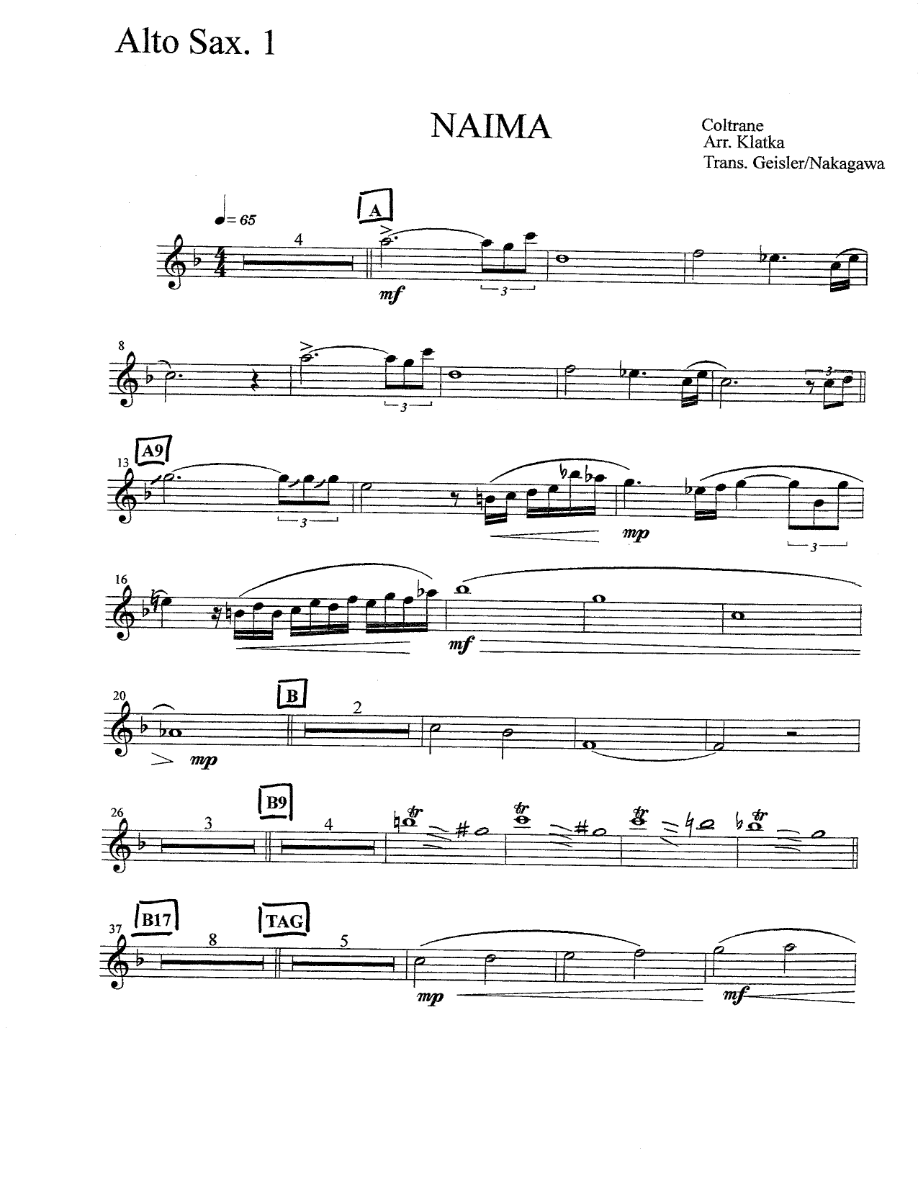
Naima (T.Klatka) sheet music preview

Naima (T.Klatka)

Composed by John Coltrane

Arranged by T.Klatka

  • Ensemble: Big Band
  • Style: Jazz Standard
  • Pages: 31
  • Instruments (17): Alto Sax. 1, Alto Sax. 2, Tenor Sax. 1, Tenor Sax. 2, Baritone Sax., Trumpet in Bb 1, Trumpet in Bb 2, Trumpet in Bb 3, Flugelhorn, Trombone 1, Trombone 2, Trombone 3, Trombone 4, Piano, Guitar, Bass, Drums
  • Difficulty: medium
  • Content: Individual Parts
  • Format: PDF Download (Instant)
  • Price: $24.99

John Coltrane’s transcendent ballad "Naima," first recorded on his landmark 1959 Atlantic album *Giant Steps*, stands as one of the most sublime and enduring compositions in modern jazz history. Dedicated to his first wife, Juanita Naima Grubb, the piece reflects Coltrane’s deep spiritual maturity during a period of intense harmonic exploration. Moving beyond standard bebop idioms, Coltrane utilized a hypnotic, pedal-point bass foundation and a suspended, modal harmonic framework that creates an atmosphere of suspended time and profound serenity. Transforming a legendary small-group meditation into a richly textured, 17-piece big band canvas requires a delicate balance of restraint and expansive coloration, a challenge masterfully met in this adaptation. In this masterful treatment by T.Klatka, "Naima" unfolds as a sweeping, emotionally resonant tone poem. Retaining the contemplative, rubato-esque intros and spacious pacing of the original, the arrangement gracefully shifts into a slow, pulsing jazz waltz/ballad feel (or a deeply expansive 4/4 cushion, depending on the conductor's interpretive push) anchored by lush, modern extended chord voicings. The emotional arc moves from hushed, introspective vulnerability in the woodwinds to soaring, dense brass climaxes that evoke the spiritual gravity of late-period Coltrane without ever losing the tranquil core of the melody. T.Klatka employs rich, contemporary reharmonizations in the sax section, utilizing tight, interlocking cluster voicings that shimmer against warm, sustained horn pads. The melody is initially introduced with exquisite delicacy by the lead alto saxophone, gradually unfolding to envelop the entire saxophone section in a rich, five-voice soli that highlights the intricate beauty of Coltrane's original head. Featured solo space allows a designated tenor saxophone or trumpet soloist to stretch out over the modal vamp, capturing the exploratory spirit of the composer. Technically, the challenges lie not in breakneck velocity, but in breath control, intonation across extreme dynamic ranges, and maintaining a cohesive ensemble blend during exposed, soft passages. The rhythm section acts as the vital heartbeat, requiring a sensitive drummer adept with brushwork and a bassist capable of grounding the drifting pedal points with a warm, acoustic-like resonance. Advanced high school, collegiate, and professional jazz ensembles will find this arrangement an invaluable showcase for developing mature musicality, stylistic nuance, and sectional listening. Because big band literature is frequently dominated by high-energy shout choruses and driving swing tempos, this chart provides a vital, contrasting emotional centerpiece for any concert program. Performing T.Klatka’s interpretation of "Naima" demands patience, deep tonal control, and a shared commitment to lyricism, rewarding both the performers and the audience with an unforgettable musical experience. Conductors should approach T.Klatka’s arrangement of "Naima" with an emphasis on transparency, dynamic restraint, and fluid rubato pacing. The tempo must remain relaxed and breathing, avoiding any rigid metronomic feel; let the underlying pulse ebb and flow naturally with the soloist's phrasing. Intonation is the primary technical hurdle, particularly in the saxophone and muted brass sections during sustained, dissonant chord clusters—encourage players to tune vertically within sections rather than just horizontally. Balance is critical: the rhythm section must keep comping ultra-light, utilizing shimmering cymbals and warm, deep bass notes that never crowd the texture. Woodwind doubles and subtle mutes in the brass should be handled with absolute care to blend seamlessly into the harmonic wash. Rehearsals should focus first on achieving a unified concept of sound and vibrato before integrating dynamic peaks. Q: What instruments and parts are included in this arrangement? A: This standard 17-instrument big band chart includes full parts for 2 alto saxophones, 2 tenor saxophones, 1 baritone saxophone, 4 trumpets, 4 trombones, guitar, piano, bass, and drums, spanning a comprehensive 31-page score and parts set. Q: What is the difficulty level of this arrangement? A: This chart is graded as advanced (appropriate for collegiate, advanced high school, and professional big bands), primarily due to the demands for mature intonation, breath control, and subtle dynamic control during exposed, slow passages. Q: What is the musical style and historical context of the piece? A: It is a sophisticated big band adaptation of John Coltrane’s legendary 1959 jazz ballad, maintaining the modal, reflective aesthetic and harmonic depth of the original recording while translating it for a full jazz orchestra. Q: What makes T.Klatka's arrangement unique? A: T.Klatka utilizes modern extended harmonies, intricate five-voice saxophone solis, and lush chord clusters that expand upon Coltrane's original pedal-point framework without losing the piece's trademark intimate, spiritual atmosphere. Q: What is the performance duration and tempo feel of the piece? A: The arrangement is designed as a slow, spacious jazz ballad/waltz feel, typically running between 5 to 7 minutes depending on the length of the improvised solos and the conductor's preferred rubato pacing.

Questions and answers

What is included in the Naima (T.Klatka) PDF?
The verified current file contains individual parts across 31 pages.
How many instruments or parts are listed for Naima (T.Klatka)?
The verified instrumentation list contains 17 entries for this Big Band arrangement.
Who is credited for Naima (T.Klatka)?
Composer: John Coltrane. Arranger: T.Klatka.
What difficulty is listed for Naima (T.Klatka)?
The verified difficulty level is medium.
What style is listed for Naima (T.Klatka)?
The catalog lists the style as Jazz Standard.
Can I preview Naima (T.Klatka) before buying?
Yes. The product page provides a preview generated from the current PDF file.
How is Naima (T.Klatka) delivered?
After successful payment, the digital PDF is made available for download. The displayed price is $24.99.

Musicians Also Search For

Naima T.Klatka PDFNaima T.Klatka sheet musicNaima arranged by T.KlatkaT.Klatka big band chartsT.Klatka jazz arrangements PDFNaima John Coltrane sheet musicNaima John Coltrane big band arrangementsJohn Coltrane big band chartsNaima big band arrangementsNaima big band PDF downloadNaima jazz sheet musicbig band sheet music downloadNaima individual parts downloadNaima sheet music PDFNaima Jazz Standard chartsJazz Standard big band arrangementsbuy Naima sheet musicdownload Naima PDFNaima jazz chartsbest T.Klatka big band arrangementsJohn Coltrane arranged by T.KlatkaNaima printable sheet musicbig band repertoire PDF

All arrangements by T.Klatka All John Coltrane sheet music