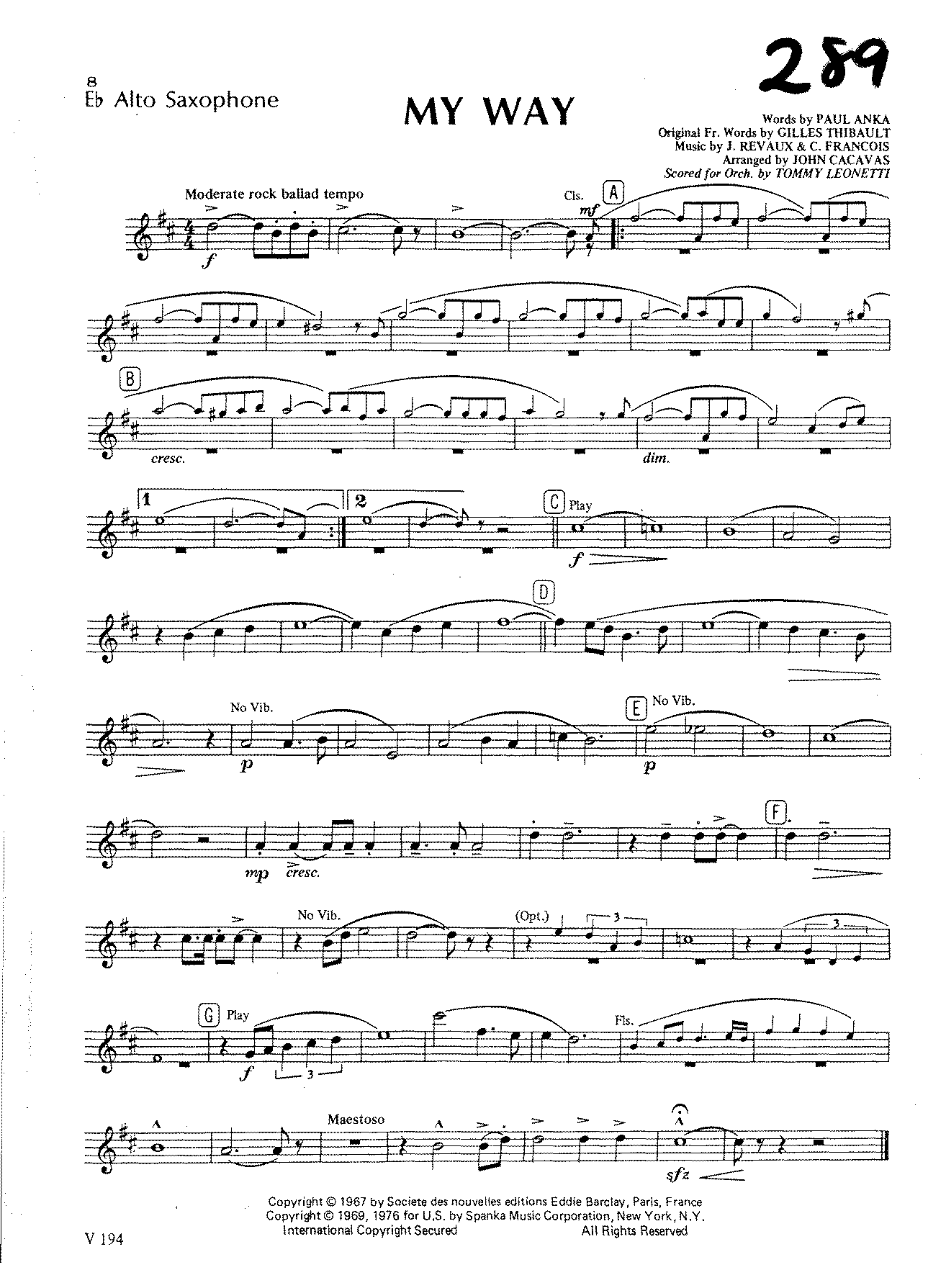
My Way (J.Cacavas) sheet music preview

My Way (J.Cacavas)

Composed by Claude François

Arranged by John Cacavas

  • Ensemble: Big Band
  • Pages: 21
  • Instruments (19): Eb Alto Saxophone, 1st Bb Clarinet, 2nd Bb Clarinet, Bb Tenor Saxophone, Eb Baritone Saxophone, 1st Flute, 1st Trombone, 2nd Trombone, 3rd Trombone, 4th Trombone, Piano, Guitar (Rhythm), String Bass, Percussion, 1st Bb Trumpet, 2nd Bb Trumpet, 3rd Trumpet, 4th Trumpet, 1st Horn in F
  • Difficulty: medium
  • Content: Individual Parts
  • Format: PDF Download (Instant)
  • Price: $24.99

Originally born as "Comme d'habitude," composed by Claude François and Jacques Revaux in 1967, the melody was famously transformed into an anthemic masterpiece when Paul Anka wrote English lyrics tailored for Frank Sinatra. While Sinatra's definitive 1969 vocal recording cemented the tune as a legendary cultural touchstone, its soaring, dramatic arc and sophisticated harmonic progression naturally invited jazz interpretation. It occupies a unique space where French pop craftsmanship meets the grand tradition of the American popular songbook, lending itself effortlessly to expansive big band scoring. Rich, cinematic, and deeply expressive, this setting unfolds with a ballad-like reverence before opening into a lush, mid-tempo swing groove. The emotional trajectory shifts masterfully from reflective, intimate introspection to soaring, triumphant crescendos. Harmonic colors are warm and cinematic, featuring extended tertian harmonies, rich saxophone voicings, and subtle modulations that heighten the dramatic tension. The mood balances nostalgic melancholy with ultimate empowerment, evoking the grand tradition of late-60s Las Vegas stage arrangements while maintaining a sophisticated jazz sensibility. Veteran arranger John Cacavas applies his signature compositional clarity and rich orchestration techniques to the score, balancing the thick textures of a 19-instrument big band with transparent, dynamic phrasing. Rather than relying on frantic technical display, Cacavas focuses on textural contrast, utilizing warm woodwind doublings—including parts for clarinets alongside the standard saxophone section—to create a distinct orchestral warmth reminiscent of mid-century studio jazz writing. Brass lines are thoughtfully voiced to support without overpowering, allowing the underlying harmonic motion to drive the narrative forward through clever countermelodies and sweeping dynamic swells. The melody is primarily introduced by the saxophone section and clarinets, gradually drawing in the full brass ensemble as the arrangement builds toward a powerful, emotionally resonant climax. While designed ensemble cohesion takes precedence over extended improvised soloing, the chart provides ample opportunity for lead players to showcase lyrical phrasing, rubato control, and mature tone production. Technical demands center on blend, intonation, and stylistic uniformity across the 21-page score rather than breakneck velocity, making expressive interpretation the primary key to a successful execution. Advanced high school ensembles, collegiate jazz orchestras, and professional community big bands will find this arrangement an exceptional vehicle for developing mature ensemble balance and stylistic maturity. Because the chart relies heavily on rubato pacing, dynamic shading, and subtle swing integration rather than complex polyrhythms, it serves as an ideal masterclass in ballad interpretation and large-ensemble phrasing for developing players. The primary technical challenge in executing this John Cacavas arrangement lies in maintaining a cohesive, unified ensemble sound during the frequent transitions between rubato ballad phrasing and steady-tempo swing feels. Conductor and band alike must approach the opening stretches with extreme flexibility, ensuring that tempo fluctuations feel organic rather than erratic. The rhythm section is tasked with laying down an understated, feather-light pulse that anchors the lush harmonic textures of the 19-piece ensemble without dragging. Special attention should be paid to the woodwind integration; the inclusion of clarinet parts requires careful blend management against the brighter timbre of the alto and tenor saxophones. Brass players must exercise strict dynamic control, utilizing warm, rounded tones rather than aggressive edge during the transitional crescendos. Ensure that the lead trumpet player approaches high-register entries with a sustained, vocal quality that matches the sweeping nature of the original vocal line. Rehearsals should initially isolate the dynamic swells and harmonic shifts at slow tempos to ensure immaculate intonation across complex chord extensions before locking in the groove. Q: What instruments and parts are included in this 19-instrument big band arrangement? A: The instrumentation features a comprehensive 19-piece setup including Alto Saxophone, Clarinet 1, Clarinet 2, Tenor Saxophone, Baritone Saxophone, alongside standard big band brass and rhythm section parts, spanning a total of 21 pages. Q: What is the difficulty level of this arrangement? A: This arrangement is well-suited for advanced high school, collegiate, and community big bands, prioritizing sophisticated ensemble blend, lyrical phrasing, and dynamic control over high-velocity technical demands. Q: What is the musical style and historical context of the piece? A: Based on Claude François’s 1967 French composition popularized globally by Frank Sinatra, this chart blends cinematic ballad traditions with a sophisticated, mid-tempo jazz big band treatment. Q: What makes John Cacavas's arrangement unique? A: Cacavas distinguishes this chart by incorporating distinct clarinet voicings within the saxophone section and utilizing rich, extended harmonies that create a warm, cinematic texture distinct from standard horn-heavy swing charts. Q: What is the expected performance duration and tempo feel? A: The arrangement generally runs between 3.5 to 4.5 minutes depending on the conductor's rubato choices, moving fluidly between an expressive, free-tempo ballad feel and a steady, swinging medium groove.

Questions and answers

What is included in the My Way (J.Cacavas) PDF?
The verified current file contains individual parts across 21 pages.
How many instruments or parts are listed for My Way (J.Cacavas)?
The verified instrumentation list contains 19 entries for this Big Band arrangement.
Who is credited for My Way (J.Cacavas)?
Composer: Claude François. Arranger: John Cacavas.
What difficulty is listed for My Way (J.Cacavas)?
The verified difficulty level is medium.
Can I preview My Way (J.Cacavas) before buying?
Yes. The product page provides a preview generated from the current PDF file.
How is My Way (J.Cacavas) delivered?
After successful payment, the digital PDF is made available for download. The displayed price is $24.99.

Musicians Also Search For

My Way John Cacavas PDFMy Way John Cacavas sheet musicMy Way arranged by John CacavasJohn Cacavas big band chartsJohn Cacavas jazz arrangements PDFMy Way Claude François sheet musicMy Way Claude François big band arrangementsClaude François big band chartsMy Way big band arrangementsMy Way big band PDF downloadMy Way jazz sheet musicbig band sheet music downloadMy Way individual parts downloadMy Way sheet music PDFbuy My Way sheet musicdownload My Way PDFMy Way jazz chartsbest John Cacavas big band arrangementsClaude François arranged by John CacavasMy Way printable sheet musicbig band repertoire PDF

All arrangements by John Cacavas All Claude François sheet music