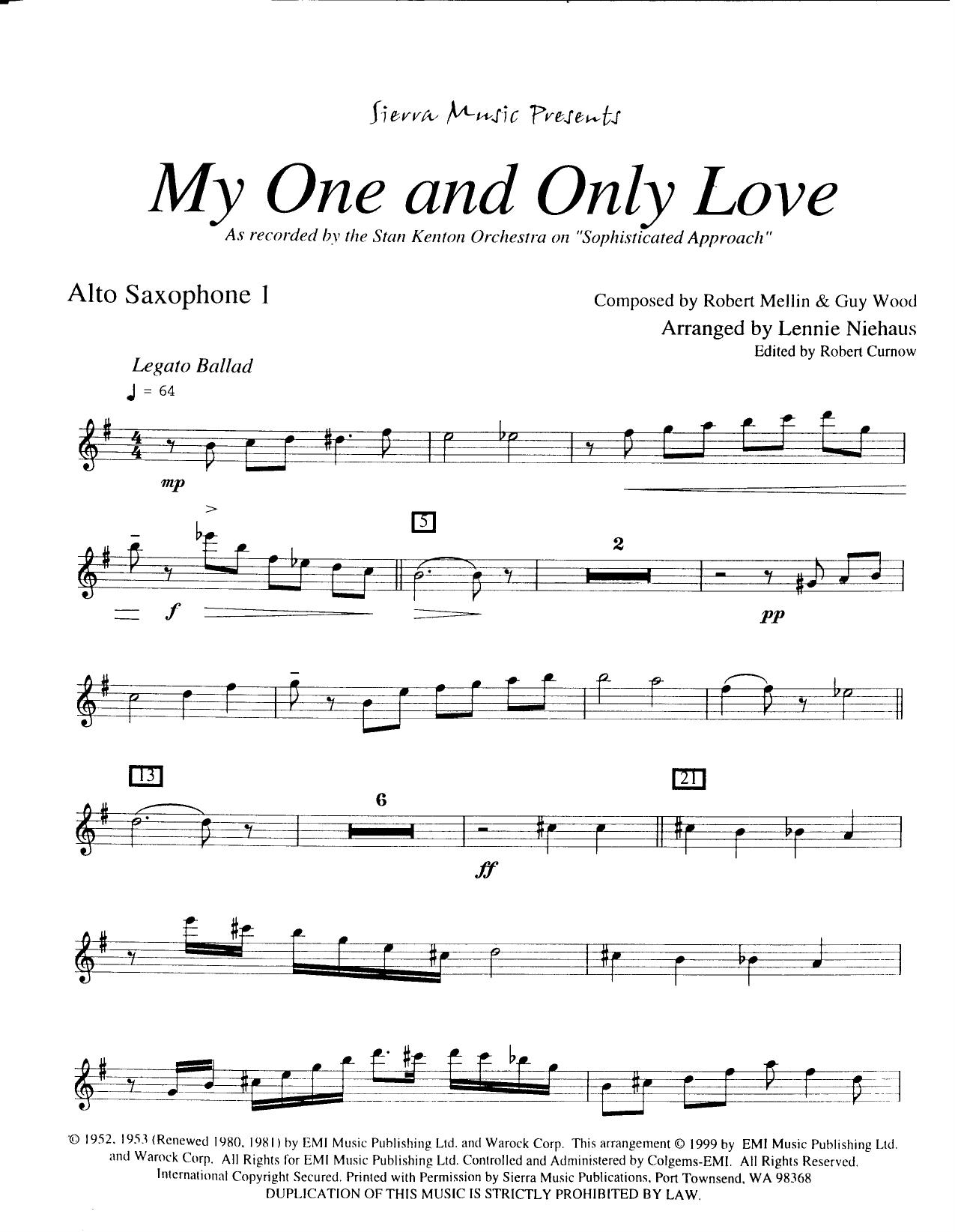
My One And Only Love (L.Niehaus)
Composed by Guy Wood
Arranged by Lennie Niehaus
- Ensemble: Big Band
- Pages: 56
- Instruments (19): Alto Saxophone 1, Alto Saxophone 2, Baritone Saxophone, Bass, Trombone 1 (Solo), Trombone 2, Trombone 3, Trombone 4, Tuba / Bass Trombone 5 (Opt.), Drums, Guitar (Opt.), Piano, Tenor Saxophone 1 (Solo), Tenor Saxophone 2, Trumpet 1, Trumpet 2, Trumpet 3, Trumpet 4, Trumpet 5
- Difficulty: advanced
- Content: Individual Parts
- Format: PDF Download (Instant)
- Price: $24.99
Penned in 1952 by composer Guy Wood with lyricist Robert Mellin, "My One And Only Love" achieved immortal status in the Great American Songbook largely due to Frank Sinatra and, most definitively, the 1963 recording by Johnny Hartman and John Coltrane. This timeless ballad represents the pinnacle of mid-century romantic jazz expression, blending lush harmonic structures with profound lyrical melancholy. It remains a litmus test for jazz artists seeking to balance intense emotional vulnerability with sophisticated harmonic exploration, transitioning from a popular ballad into an essential modern jazz standard interpreted by virtually every major instrumentalist and vocalist. Lennie Niehaus approaches this masterwork with the West Coast cool jazz sophistication and immaculate counterpoint that defined his legendary career as a saxophonist and arranger for Stan Kenton. Cast in a lush, introspective ballad tempo, the arrangement opens with delicate, translucent saxophone voicings that immediately establish a reflective, twilight mood. Niehaus avoids dense, overpowering brass blocks in favor of transparent, harmonically rich textures where inner voices move with linear independence. The emotional arc moves gracefully from tender, hushed vulnerability in the opening phrases to a soaring, emotionally resonant climax that showcases the full dynamic spectrum of a traditional 16-piece big band without ever sacrificing warmth for volume. Throughout the chart, the lead alto saxophone and flugelhorn or muted trumpet sections carry the primary thematic weight, delivering sweeping, velvety lines that demand absolute breath control and tone blending. A featured improvised solo—ideally suited for a sensitive tenor saxophonist or trumpeter—sits at the structural heart of the chart, supported by subtle, shimmering chordal accompaniment from the rhythm section. Technical challenges lie primarily in endurance, intonation, and stylistic cohesion; maintaining a pristine, unforced sound at ultra-slow tempos requires immense maturity. The rhythm section must approach the 4/4 meter with an elastic, feather-light pulse, utilizing brushed snare work and spacious piano voicings to maintain momentum without rushing the delicate harmonic shifts. Advanced high school, collegiate, and professional jazz ensembles will find this 56-page arrangement an exceptional vehicle for cultivating ensemble listening, blend, and lyrical expression. Because it relies heavily on nuance, dynamic shading, and subtle rubato-esque pacing rather than sheer velocity, it serves as a masterclass in ballad playing. Directors looking to program a sophisticated, emotionally gripping feature that moves audiences away from high-octane burners and toward deep, expressive musicianship will discover that Niehaus’s masterful scoring offers an unforgettable concert centerpiece. Executing this arrangement successfully demands extraordinary dynamic control and immaculate intonation, particularly in the saxophone soli and exposed reed passages. Conductors should establish a relaxed, flowing ballad tempo, ensuring the underlying pulse never bogs down while allowing soloists ample rubato freedom. The primary technical hurdle is maintaining a warm, centered tone at very soft dynamics (pianissimo to mezzo-piano); players must avoid pinching high notes or forcing lower-register entries. Mutes should be utilized in the brass sections where indicated to achieve that velvety, distant cool-jazz timbre characteristic of the West Coast idiom. Rehearsal should begin with sectional work focusing on balance and unified vibrato usage, ensuring that inner-voice harmonies are heard clearly beneath the lead melody. The rhythm section must anchor the texture with understated elegance—pianists should voice chords sparsely, avoiding heavy left-hand clusters, while bassists sustain a warm, half-note or walking foundation that breathes with the soloists. Q: What instruments and parts are included in this 56-page big band arrangement? A: The score and parts accommodate a standard 16-piece big band instrumentation, featuring Alto Saxophone 1 and 2, Tenor Saxophone 1 and 2, Baritone Saxophone, 4 Trumpets, 4 Trombones, Piano, Guitar, Bass, and Drums. Q: What is the difficulty level of this Lennie Niehaus chart? A: This arrangement is graded as advanced, primarily suited for collegiate, advanced high school, and professional big bands due to its high demands on endurance, intonation, blend, and mature expressive control at slow tempos. Q: What is the musical style and historical context of "My One And Only Love"? A: Composed in 1952 by Guy Wood, this piece is a quintessential romantic jazz ballad immortalized by legendary collaborations like John Coltrane and Johnny Hartman, arranged here through the refined West Coast cool jazz lens of Lennie Niehaus. Q: What makes this specific arrangement by Lennie Niehaus unique? A: Niehaus distinctively prioritizes transparent, linear inner-voice movement and delicate harmonic textures over dense brass scoring, creating an intimate, emotionally resonant ballad style that highlights subtle ensemble dynamics and sophisticated voicings. Q: What is the recommended performance tempo and duration for this piece? A: The arrangement is set as a slow, expressive ballad in 4/4 time, typically running between 4 to 5 minutes depending on the length allotted for the featured improvised solo and expressive rubato pacing.
Questions and answers
- What is included in the My One And Only Love (L.Niehaus) PDF?
- The verified current file contains a conductor score and individual parts across 56 pages.
- How many instruments or parts are listed for My One And Only Love (L.Niehaus)?
- The verified instrumentation list contains 19 entries for this Big Band arrangement.
- Who is credited for My One And Only Love (L.Niehaus)?
- Composer: Guy Wood. Arranger: Lennie Niehaus.
- What difficulty is listed for My One And Only Love (L.Niehaus)?
- The verified difficulty level is advanced.
- Can I preview My One And Only Love (L.Niehaus) before buying?
- Yes. The product page provides a preview generated from the current PDF file.
- How is My One And Only Love (L.Niehaus) delivered?
- After successful payment, the digital PDF is made available for download. The displayed price is $24.99.
Musicians Also Search For
My One And Only Love Lennie Niehaus PDF • My One And Only Love Lennie Niehaus sheet music • My One And Only Love arranged by Lennie Niehaus • Lennie Niehaus big band charts • Lennie Niehaus jazz arrangements PDF • My One And Only Love Guy Wood sheet music • My One And Only Love Guy Wood big band arrangements • Guy Wood big band charts • My One And Only Love big band arrangements • My One And Only Love big band PDF download • My One And Only Love jazz sheet music • big band sheet music download • My One And Only Love conductor score PDF • My One And Only Love individual parts download • My One And Only Love sheet music PDF • buy My One And Only Love sheet music • download My One And Only Love PDF • My One And Only Love jazz charts • best Lennie Niehaus big band arrangements • Guy Wood arranged by Lennie Niehaus • My One And Only Love printable sheet music • big band repertoire PDF